by No Comments

Presentation of Final Rochester Bicycle Master Plan 6pm-8pm Monday, Dec 13

The final resentation of the Rochester Bicycle Master Plan will take place on Monday, 12/13, from 6:00-8:00 PM at the Kate Gleason Auditorium of the Rochester Central Library – Bausch & Lomb Building (116 South Ave). Your attendence and input will be most welcome.

The final version of the report will be available on the Web approximately one week prior to the meeting on the Rochester Bicycle Master Plan Website:

http://www.cityofrochester.gov/bikeplan/

I hope to see you there.

Scott

by No Comments

Ithaca Bike Symposium and Bike Boulevards

With the Rochester Bicycle Master Plan almost completed, one of the options for providing access is bike boulevards as noted below.

Summary Jon Schull and Scott MacRae’s Trip to Ithaca Bike Symposium 11- 19 &20, 2010

We were fortunate to attend the Ithaca Bike Symposium. Unable to make the afternoon sessions, we joined the Bike & Beer Gathering Friday Night. We met some Ithaca bike advocates and were introduced as the “Rochester Brothers” because Jon and I both put Rochester after our first names.

The next morning Mia Burke, Alta Planning, former bike coordinator for Portland, Oregon 1993-1999 who now runs a 60 employee national bike consulting company gave a talk on Bicycle Boulevards” or “Neighborhood Greenways”. Here are the highlights.

60% of the population is classified as “Interested and Concerned” and these folks are that the population that responds Bike Boulevards appeal to. (There are the 1% young and fearless and 7% are enthused and confident, 30% are uninterested in bicycling.)

Bike Boulevards or Neighborhood Greenways, have been very successful in Portland but the first one is a challenge since the community does not know what to expect. The cost is $250,000/mile so they may not be cheep compared to the $10-20,000/mile for painting lanes. They are ideal to set up on streets that run parallel to preferred routes. The preferred traffic volume is 3,000-4,000 but 1,500 or lower is ideal. Some bike boulevards are now shooting for <500 cars/day. There are different levels of commitment for Bike Boulevards or Neighborhood Greenways. The first level is signage and pavement markings. Another is prioritizing traffic so that the cyclists don’t have to stop frequently. They also traffic use traffic calming (slowing) techniques like elongated speed bumps, traffic circles and curb extensions to slow traffic ideally to 15-25 mph. A higher level of commitment is auto traffic diversion to a different street. Adjoining street dwellers often complain about this driving more traffic to their streets but this is typically less than expected because traffic disperses more to other non adjacent streets. Public involvement is important and the process should not be rushed into. The neighborhood needs to be surveyed and canvassed as well as ride and public workshops all contribute to educating the neighborhoods on the positive effects. This includes the increase in land values of neighborhoods around bike boulevards. They use median and refuge islands which are separate from the pedestrian islands to allow the cyclists to cross busy streets. A street may be blocked off from 2 way car traffic and become a one way street but allow bikes to go 2 ways. A popular trend is to combine “bike boulevards” with “green streets” which includes bioswales and storm water management as well as green plantings to improve the livability for everyone. The park service people like this because it can create an atmosphere of a mini park in a park inaccessible area. Bike Boulevards are one part of the puzzle of making a community bike friendly.
A great video on Portland, Oregon’s Bike Boulevard Program is available at:

http://www.treehugger.com/files/2010/11/portland-mode-share-tops-7.php?campaign=th_rss&utm_source=feedburner&utm_medium=feed&utm_campaign=Feed:+treehuggersite+(Treehugger)

Scott

by No Comments

Dutch Cyclists Shun Helmets – Wall Street Journal Article

Dutch cyclist are fighting the recommendaton by health professionals to wearing helmets. This is a familiar controversy where some cycling advocates are wary of encouraging helmets because it sends a message that cycling can be dangerous. The other side argues that not wearing a helmet is risky behavior. I think we’ve heard this argument before but which ever side you are on you can read about it below in the motherland of cycling in Europe. I personaly perfer to maintain as many brain cells as I can. Link below: Scott

http://online.wsj.com/article/SB10001424052702304248704575574250616160146.html?mod=ITP_TEST

by 1 Comment

Dutch Cyclists Shun Helmets – Wall Street Journal Article

Dutch cyclist are fighting the recommendaton by health professionals to wearing helmets. This is a familiar controversy where some cycling advocates are wary of encouraging helmets because it sends a message that cycling can be dangerous. The other side argues that not wearing a helmet is risky behavior. I think we’ve heard this argument before but which ever side you are on you can read about it below in the motherland of cycling in Europe. I personaly perfer to maintain as many brain cells as I can. Link below: Scott

http://online.wsj.com/article/SB10001424052702304248704575574250616160146.html?mod=ITP_TEST

by No Comments

Comrades- they’re on to us!

Colorado Republican gubernatorial candidate Dan Maes knows you might think bicycles and bicycle riding are harmless, but beware: “That’s exactly the attitude they want you to have.”

The Denver Post reports that Maes, a Tea Party friendly candidate facing former Rep. Scott McInnis in the August 10 Republican primary, has come out against a public bicycle program run by the city of Denver. Denver’s mayor, John Hickenlooper, is the presumptive Democratic nominee, and a cycling supporter.

“This is all very well-disguised, but it will be exposed,” Maes said at a small campaign rally last week, according to the Post. “These aren’t just warm, fuzzy ideas from the mayor. These are very specific strategies that are dictated to us by this United Nations program that mayors have signed on to.”

http://tpmdc.talkingpointsmemo.com/2010/08/co-gov-goper-maes-hickenloopers-bike-love-is-a-un-plot.php?ref=fpblg

-Bill Collins

by No Comments

River Meadow Crossing

Allen Kerkeslager helped me find an even better link to connect the RITtweenway with the Genesee Valley Greenway, and Jay Jackson pointed out that a bike ferry could be a way cool and relatively easy way to get the job done.   
 Here is the site we are talking about in google maps.  On the east side of the crossing, the land is reportedly owned by developers planning to create a pond and preserve in the big open areas, and on the west side some unused NYState owned property seems to be waiting for our new lease on life.
The crossing would connect  the “River Meadow Preserve” to an asphalted former water testing facility reportedly owned by New York State.  The landing would offer  near-perfect access to to the Genessee Valley Greenway either via Scottsville Rd and Brook Rd, or southwest by way of the road that exteds from right across the landing.
.  Here is the eastward looking view back to River Meadow Dr.

As for how the crossing would be implemented, one could imagine a bicycle/pedestrian bridge or even a small cable ferry (which could be designed and built by RIT faculty and students!)  
·      River Meadow Crossing 
  • would create new recreational options for local residents,  
  • would create a short and safe bike-commute to and from RIT and RIT’s new Global Village
  • would create a scenic and efficient 10 mile bike ride to downtown Rochester via RIT, Park Point and the Rochester Greenway.
  • would make us essential links in the emerging Rochester-Williamsport Greenway
  • would establish Henrietta, RIT, and Rochester as leaders in the  transition to more ecological, economical, and healthy  life styles. 
  • would enrich the community. 


The “Rochester Bicycle Ecology” is  a flagship project of RIT’s Center for Student Innovation (which I now direct.) 
     We have been promoting the under-appreciated “Rochester Greenway” that connects Henrietta with Downtown Rochester by way of RIT and the Lehigh Valley North Trail.
     We organized last October’s Rochester Cycling Summit , helped found the Rochester Cycling Alliance  and  helped put theRochester-Williamsport Greenway on the agenda for NY and PA planners. 
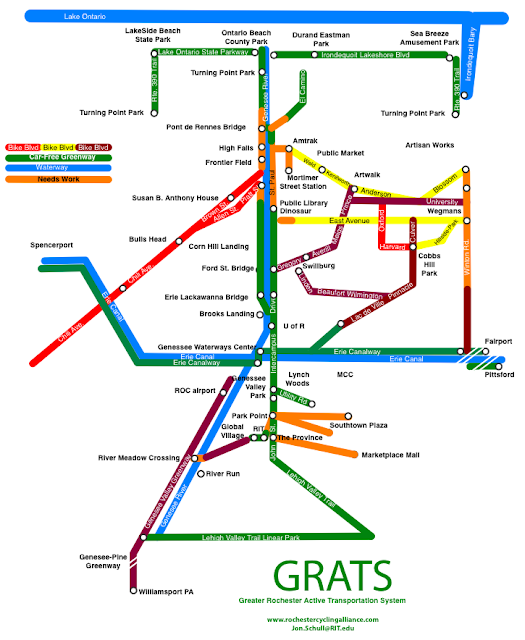
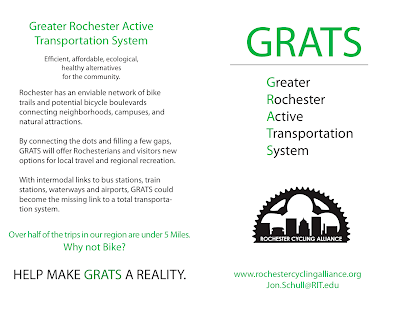
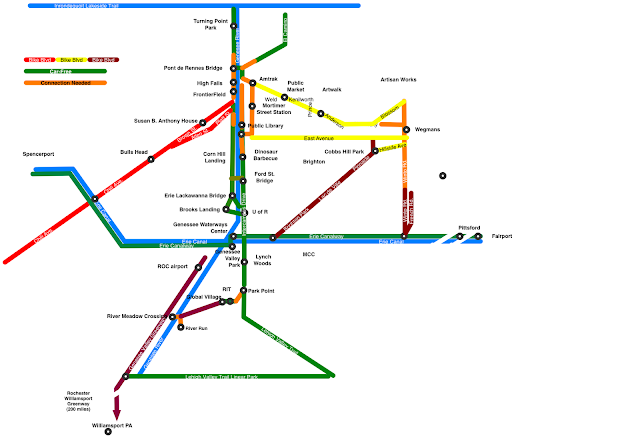
     In less than a year, we’ve had significant impact, and this  summer we are working with the Rochester Cycling Alliance to stimulate and coordinate a  “Greater Rochester Active Transportation System“.