Thank you to our advocates who continue to speak up, stay engaged, and hold our elected leaders accountable for safer streets and improved transit. Your commitment is pivotal for meaningful action and tangible improvements, and we share your sense of urgency. As autumn begins in earnest, we are highlighting where our efforts stand, where momentum is building, and where continued attention and action are needed.
Rochester Intermodal Station Phase 2 expansion
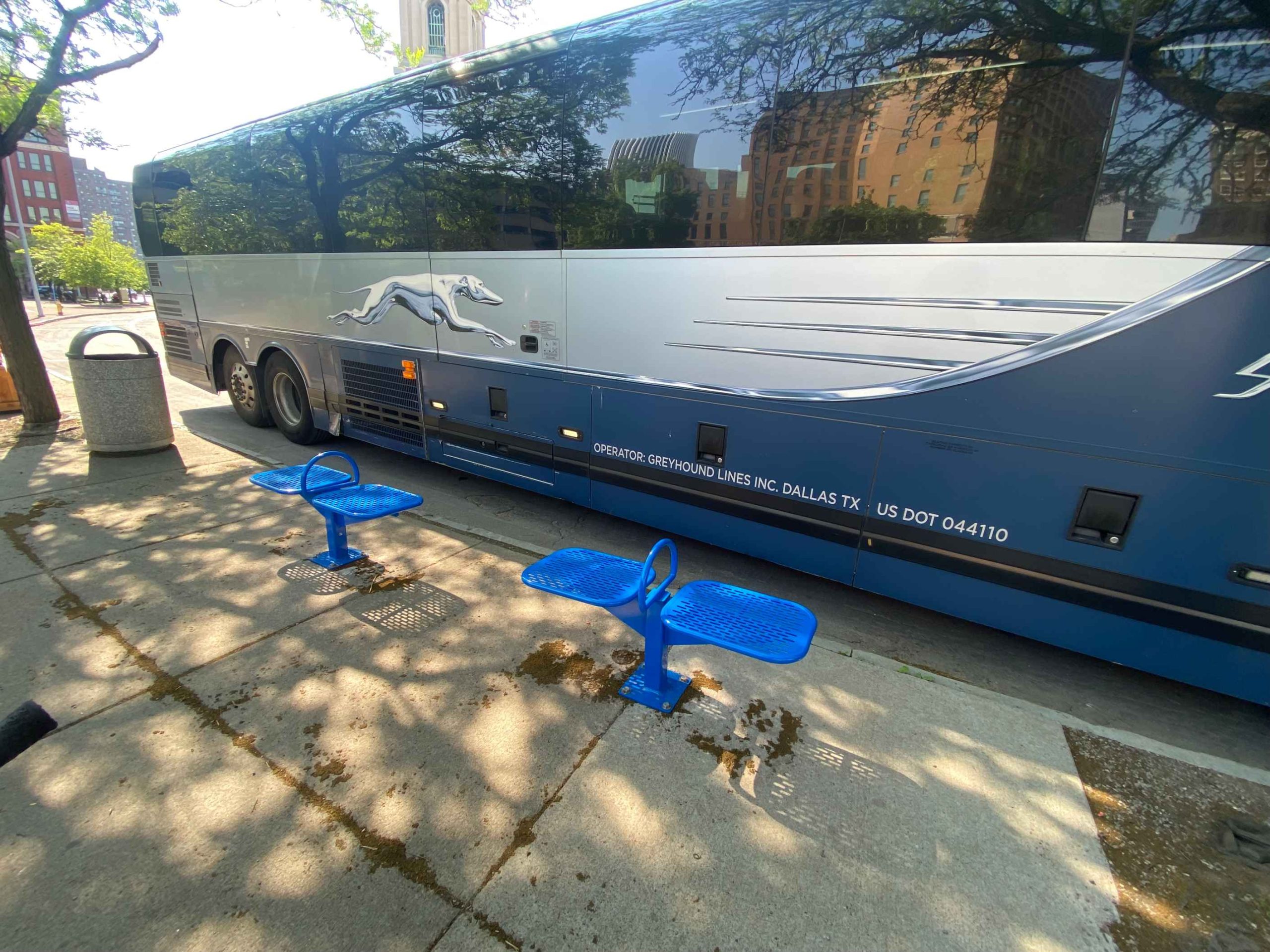
Three years ago we made a big push to fulfill the original vision of the new train station, also known as the Louise M Slaughter Rochester Intermodal station, to include inter-city buses and be a truly intermodal gateway to our region with a dignified place for bus passengers to wait. We succeeded, with strong leadership from Sen. Cooney, in getting $18M allocated from the state to build out the bus terminal addition.
So, why are bus passengers still waiting on Pleasant St with winter coming fast? Well, we haven’t lost sight of the urgent need to give intercity bus passengers the station they deserve. This project is very complex with more than a dozen stakeholders and parties involved. We decided at Reconnect that we weren’t satisfied with waiting for updates, so we’ve taken the lead in convening the stakeholders to help conversations advance and timelines to accelerate. We don’t want more winters where residents traveling across our state by intercity bus are standing in the cold on a downtown streetcorner.
Where’s the conversation at with automated enforcement of reckless drivers?
Earlier this year, Reconnect Rochester, as part of the Mayor’s ROC Vision Zero taskforce, helped organize 5 community engagement events all throughout the city to talk about our traffic safety crisis and appropriate enforcement-based strategies to hold drivers accountable. Since then, the City fielded a questionnaire to gather additional input. With this ground-up information gathering, the City put together a final report that was released by the Mayor on Wednesday. It’s posted on the ROC Vision Zero website if you want to read it. The TLDR:
- Most people agree there’s a traffic safety crisis in Rochester and something should be done about it
- Most people prefer engineering streets and only see enforcement as part of a broader effort, like we’re doing with Vision Zero
- Opinions about automated enforcement were overall fairly negative, with many people citing the past Red Light Camera program as a bad experience.
- But, people supported the use of automated enforcement in specific contexts like to stop speeding school zones.
- Finally, the scandals around Flock misusing its cameras for surveillance have resulted in more distrust of camera programs. Whatever the City proposes will need strong guardrails to avoid the potential for misuse and privacy violations.
The City is considering these conclusions and discussing the next steps. We can’t say yet exactly what the city might do next, but we do feel this approach to centering community input first and foremost before putting out a program proposal is a good practice to ensure a fair and equitable enforcement strategy.
Why don’t we just focus on road project design instead of enforcement?

The reality is that we need a lot of different and complementary strategies to improve traffic safety to get to a safer system for everyone who uses our streets. Rochester is moving ahead on some very important street redesign projects and we will need a lot of community activation to get the best possible designs. For example, next year we’ll likely see designs for Monroe Ave in the city, East Main St, Chili Ave, Lexington Ave, and Winton Rd. We can redesign Rochester’s roads quickly – other cities are doing it across the country.
In addition to their regular road project cycle, which does a handful of major projects every year, they’re using quick build techniques and materials to calm traffic and improve safety. Reconnect’s been doing this kind of quick build/tactical urbanism project for years with Complete Streets Makeovers and Downtown SmART Streets. If you want to see one in action, head down to S. Union by Spotted Octopus this month before the barriers are removed for the winter.
Working behind the scenes with the Broadway and S. Union community
Together with the Pearl Meigs Monroe Neighborhood Association, we advocated to encourage the City of Rochester to make the Broadway & South Union Reconstruction Project more pedestrian and cyclist friendly. Our behind the scenes advocacy led to the inclusion of separated all-ages-all-abilities bike infrastructure across the entire corridor, shortened turning radiuses to encourage slower and safer turns, and include leading pedestrian intervals at signals. While we didn’t get every design element we advocated for, we were able to push the needle on safe streets infrastructure and we have begun strategising about next year’s upcoming road projects.
Brighton’s Monroe Ave Corridor Updates
We’re currently working together with Brighton residents and the Town on responding to the comments NYS Department of Transportation provided on the Monroe Avenue advocacy we pushed earlier this year. We at Reconnect are disappointed that more of the public input provided by hundreds of Brightonians was largely dismissed by the State DOT on this project. We’re getting our points and strategy together and you can expect more advocacy on this critically important project later in the fall.
Zoning Alignment Project
There are a ton of hearings this month as we’ve shared and they are all posted on the City Council’s website. The ZAP draft released in April 2026 is on the ZAP website and that’s the map the City Council will ultimately be debating and voting on.
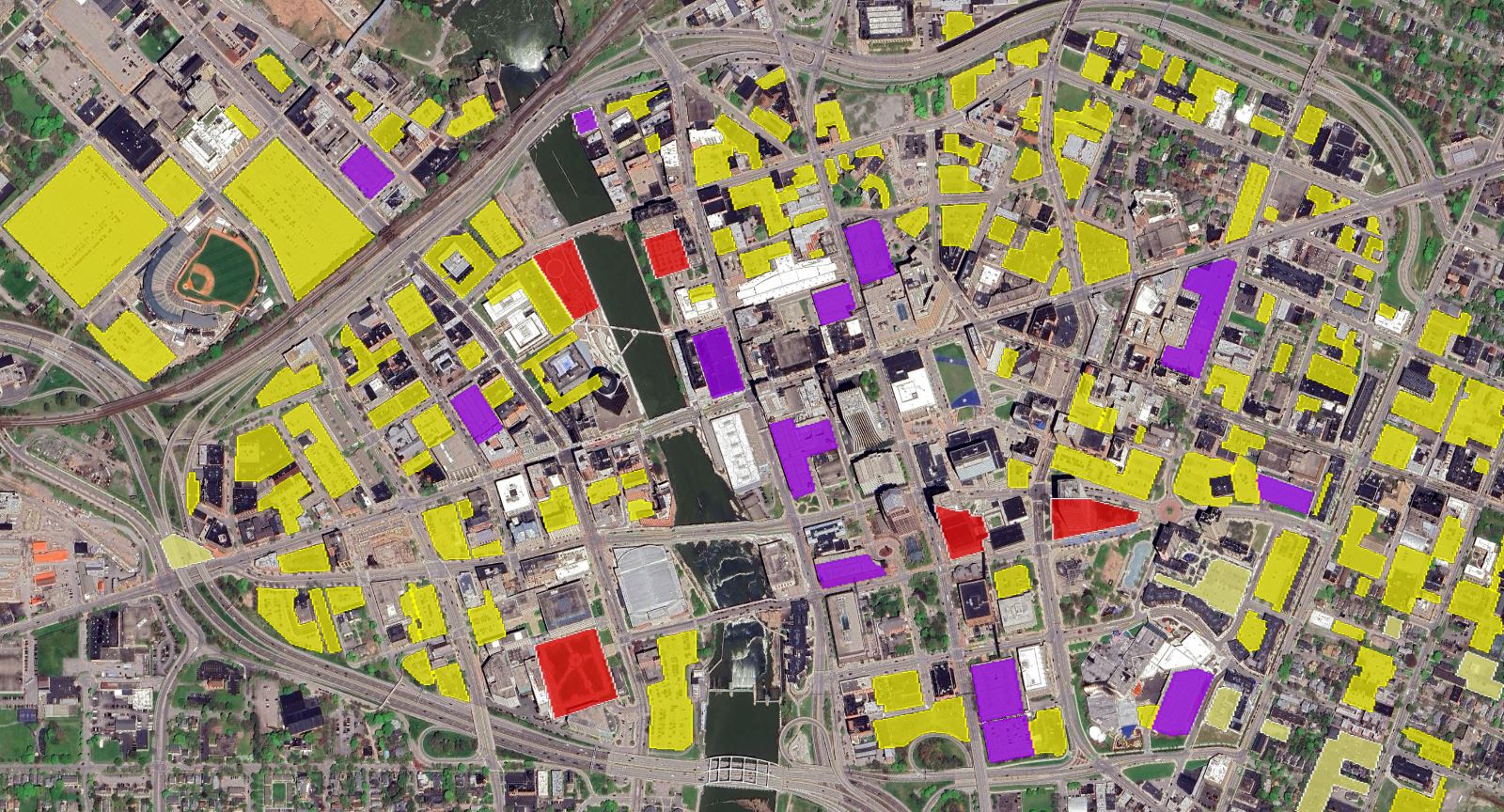
All of the parking in downtown Rochester, with yellow being surface lots, red underground and purple parking garages.
The City recognizes that it has too much unused parking downtown and it’s started to fill in those lots with housing like center city courtyard and Alta Vista right outside our office doors. We were pleased to see the City’s draft zoning proposal eliminated parking requirements in downtown and other commercial/mixed-use districts. It’s a good start, but doesn’t go far enough to truly unlock the potential of more affordable development throughout the city. We don’t want only dense housing downtown and the rest of the city with a sea of underutilized parking lots.
We’re asking the City to eliminate all parking minimums in all residential districts as well. Over 100 cities including Buffalo and Canandaigua have done this. After that reform, in Buffalo, 83% of developments still included parking, but these parking lots were right-sized and allowed for increased flexibility while reducing the cost of building new housing. Parking minimums are based in pseudoscience and force developers and homeowners to overbuild parking in regardless of context.
Why would we put unnecessary parking requirements in the residential neighborhoods where we want housing to be built? Unnecessary parking spaces add tens of thousands of dollars of cost to projects. It adds more asphalt surfaces to residential neighborhoods, causing heat island effects and contributing to drainage issues. Parking spaces also don’t generate tax revenues; housing units do. More and bigger parking lots attached to new developments also cause long-term property management obligations like snow clearing, routine sealing and repair, which we know from experience here in Rochester a lot of landlords struggle to keep up with.
In sum, eliminating parking requirements in Rochester’s final zoning code update, including allowing buildings to share parking lots instead of building new ones, gives residential developers more flexibility. As we think about building for future residents of Rochester, it’s also important to cite that younger people prefer living car-free or car lite. Younger residents seeking more affordability will reduce driving or have 1 car households. The more we can continue to affordably build housing in transit rich City neighborhoods, the more we’ll see less of a need for extra parking.
Working with Bus Riders Impacted by Service Cuts
Reconnect is working with a broad coalition including VOCAL NY, Climate Solutions Accelerator and others across the state to raise the alarm over service cuts impacting our county’s most vulnerable residents. Back in September, RTS cut the On Demand service in the suburbs and northwest of the City of Rochester after 8 pm and on Weekends. So, if you relied on that service to get to jobs or other services, and you can’t afford a car or a rideshare app, you’re effectively cut off.
We’re trying to build a base of bus riders who are ready to go to Albany and tell their story about how critically important our buses are during the next legislative session. If you ride the bus and want to get involved, send us an email (info@reconnectrochester.org) with your details. In addition, you can email the Governor’s office today to demand she fix the fiscal crisis facing upstate public transportation in the next budget.
As always, let us know if you have suggestions!
Please share our Mobility Action Alerts with your friends and family who care about mobility and encourage them to sign up! We are so grateful that we now have 650 people working with us to move the needle on mobility in Monroe County. If you ever miss an action alert, we are posting them to our website. We’re committed to providing more frequent updates through our blog posts and social media – if there are ways we can do better or answer specific questions, please let us know.