
Car Lite Rochester is a blog series that highlights the stories of Rochesterians living a car-lite lifestyle. The term “car lite” encompasses a variety of multimodal transportation lifestyles, featuring little dependence (but not NO dependence) on a car. It typically looks like sharing one car within a household or only using a car when absolutely necessary.
So, we hope you’ll continue to follow along. Maybe you will be inspired to join our bloggers in living a car-lite lifestyle!
Wanna rep it? Check out the t-shirt in our online shop.

By: Steve Roll
For most of my adult life, I got around using the default transportation mode in America: a car. I didn’t own a bike as an adult and never thought about using the bus. I was perfectly content to drive my Honda Fit to wherever I needed to go.
Then, in the spring of 2019, I had a seizure while walking out into a parking lot after a workout. I grew up with epilepsy, but it was well-controlled and I hadn’t had a seizure in about a decade. As I regained consciousness and the EMTs began loading me up into the ambulance, my mind quickly focused on one thing: not the ambulance bill I was going to get or the fact that I just had a seizure again, but that I wouldn’t be allowed to drive for at least 6 months.
You see, when someone has a seizure in New York State, they lose their driving privileges for 6-12 months until their neurologist and the DMV Medical Review Board clear them. I had to go through this once before when I was in high school and I remember how frustrating it was to lose my independence suddenly and be reliant on others for rides.
That’s what I was scared of: losing my independence to get around because I relied solely on my car for transportation. That’s why this is called “car dependency.”

I lived alone, so my mind was suddenly flooded with questions like:
- How will I get to work?
- How will I get groceries or run errands?
- How will I see friends and family?
The options seemed to be:
- Get a bike and a use the bus
- Depend on friends, family and Uber/Lyft to chauffeur me around
- Be stuck at home for 6-12 month
I chose to get a bike and a bus pass.
Adapting to Life Without a Car
The Importance of Walkable Neighborhoods
One thing that helped a lot is that I live in a walkable neighborhood in Rochester, the North Winton Village. I didn’t fully appreciate the importance of a walkable neighborhood until I wasn’t allowed to drive.
I live about a mile from Wegmans, walking distance to where I worked at the time (Carlson Cowork), and near plenty of shops, restaurants, and parks. This made a huge difference. Life would’ve been much more challenging if I had lived in the car-dependent suburbs.
Getting around by bike
Soon after the seizure, I went to my local bike shop and bought my first bike as an adult, a Trek FX3, which I still ride today. I also made sure to get a bike rack and a set of panniers so that I could carry cargo like groceries (more on that later).
At first, riding my bike on the road around cars was nerve-racking. However, I was lucky enough to find out about Reconnect Rochester’s On-Bike Smart Cycling Class taught by Jesse Peers where I learned how to ride safely on city streets. After taking the class, I was surprised at how much more confident and comfortable I felt biking through Rochester. I highly recommend it!

Getting around with the bus
Besides my bike, I began using the bus more regularly to get to doctor appointments and other trips that were too far away or inconvenient to bike. Although the bus was not as convenient as a car, it was nice not to have to do the actual driving in traffic and I could sit and read.

It’s also really easy to combine a bike and the bus with the nifty bike rack on the front of the bus. Or you can bring your scooter. This adds a lot more flexibility to using the bus and it extends the range of a bike, especially on corridors where it’s unsafe to ride. For example, I recently had to go BayTowne Plaza from the city. Instead of biking on Empire Boulevard and putting my life at risk next to four lanes of 60 mph traffic, I rode my bike from my house to Empire Boulevard and took the bus the rest of the way.
Managing Challenges
Busy Roads
Early on, I used Google Maps to map out a route to bike on. This would often give me a route that was shortest, but that also included busy roads that were very stressful to ride on, especially with all the giant SUVs and pickups these days.
At the Smart Cycling class, I learned about Reconnect Rochester’s Low-Stress Bike map and the Bike Boulevard Network. These tools helped me plan out a safe, comfortable bike route to get where I needed to go.
For example, riding downtown for me includes a lovely ride down Harvard St.

Groceries
I thought getting groceries would be a big challenge without a car, but I quickly realized that a bike is fully capable of carrying a load of groceries. With a set of panniers, I can carry two fully loaded grocery bags with room on top of the rack for more. It’s also easy to hook up a small trailer to carry more and e cargo bikes are becoming more popular options as well.
When I didn’t ride my bike for groceries, it was easy enough to take the bus. I found the bus more convenient than I expected to get to Wegmans, as long as I didn’t stay too long and miss the bus on the way back!
That’s all to say: Good News Everyone! You don’t need an F-250 to get groceries!


Weather
The weather also wasn’t as much of a challenge as I had expected. I try to avoid riding during a downpour, personally, but if the roads are wet or it’s only raining lightly, bike fenders and some rain gear go a long way.
Even in the winter, the roads are usually snow-free most of the time. Also, cold weather isn’t as bad as you’d think on a bike, as long as you have the right gear, like pogies to keep your hands warm. Even if it’s chilly out, riding a bike naturally warms you up with the exercise.
In the summer, the challenge sometimes is hot, humid weather. Riding at a leisurely pace helps, but it can be a challenge if I need to arrive somewhere and I don’t want to be all sweaty. This is where e-bikes have an advantage over regular bikes.
Bus Routes
A main challenge with taking the bus was that I often needed to make a connection through the Transit Center. This was compounded with the fact that bus headways were often 30 minutes apart or more. Together, this meant that the travel time could be an hour or more by bus instead of a simple 15 minute drive by car. A short errand could take half a day on a bus.
However, if the bus route is convenient, it’s a great way to get to where you need to go. Just use the Transit app to easily see what bus you need to take and buy a bus pass on your phone!
Transitioning to Car-Lite Living and Lessons Learned
Overall, I was able to maintain my independence during those six months thanks to my bike and the bus. After about 6-months, I was cleared to drive again.
These days, I’d say I’m “car-lite.” I get around by bike if I can, but I drive when I need to go somewhere farther away or when the weather is bad and I just don’t feel like biking (that’s OK, too!). In case I have a seizure in the future (a very real possibility), I want to live a lifestyle that’s not dependent on driving everywhere.
[8/29/24 edit: Welp, unfortunately, I did have another seizure last week. Looks like I jinxed myself writing this. In the future, I’ll have to write an update about Car-Free Living Round 2!]
I learned a number of good lessons during this period
1 – The Benefits of Traveling by Bike
First, I realized so many unexpected benefits from riding a bike for transportation, which is why I still ride my bike to get around today. Some key benefits:
- Being more active and enjoying the health benefits
- Feeling more connected to the community as I bike through it
- Improved mental well-being – I always feel better if I get somewhere by bike than by sitting in a car
- Improved personal finances, since the cost of car ownership now exceeds $10,000 per year
- For a family, skipping the car drop-off line at school
- It’s just more fun to get around on a bike
Also, you always get the best parking:

2 – The Importance of Transportation Resilience
A major lesson I learned is how important transportation resilience is. If you’re solely reliant on driving for everything, having a car breakdown, a medical issue leaving you unable to drive, or aging out of driving can be a major life challenge. For this reason alone, I think it’s important, both on a personal level and societal level, to make sure different transportation options are available. Just in case.
3 – The Inadequacy of Rochester’s Transportation System for Non-drivers
24% of Rochester households don’t have access to a car, but Rochester’s transportation system is built around the assumption that everyone has a personal automobile and can drive. This largely ignores the transportation needs of non-drivers; people who also need to get around to live life.
When driving was taken away from me as an option, I realized how difficult our city makes it for non- drivers in our community to get around. The main issues I personally noticed were:
- Inadequate public transit: too infrequent, lack of connectivity, and lack of amenities like benches and shelters
- Lack of a safe, connected network of comfortable bike lanes
- Not enough safe crosswalks and crosswalks spaced too far apart
- Roads built for moving cars fast at the expense of safety for pedestrians, bicyclists, kids, and other drivers
Signs of Improvement
Despite the challenges for non-drivers, I am excited about the steady progress and improvement I’ve seen in Rochester since 2019.
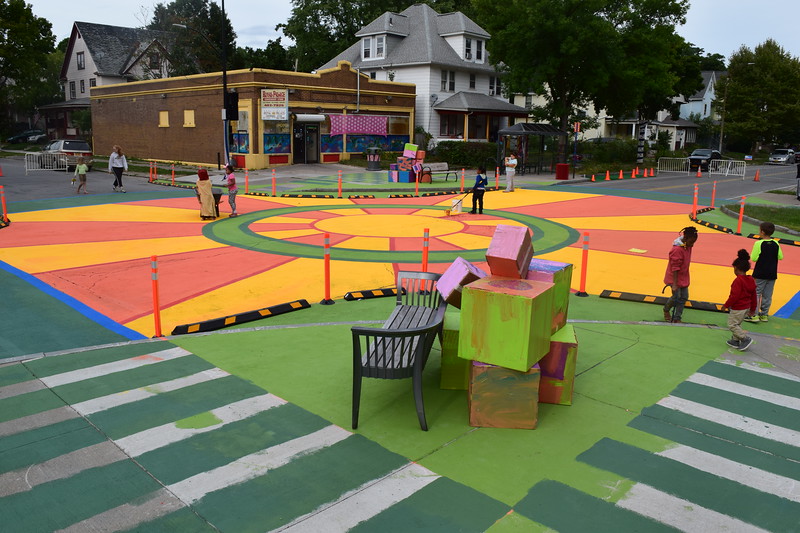
A (literally) concrete example of this progress is the reconstruction of E. Main between Culver and Goodman, which includes comfortable cycle paths, traffic calming measures, pedestrian islands, and crosswalks. Now, I bike it almost weekly to shop at the Public Market. Yes, bike lanes are good for business!
A few developments I’m most excited about:
- Rochester and Monroe County Active Transportation Plans
- And Senator Schumer working to get funding to implement it!
- The Inner-Loop North project and Aquaduct project
- Veo bike/scooter share and Roc Floshare
- Rochester’s commitment to Vision Zero
- Upcoming street projects, with many prioritizing safety and “complete streets”
Get Involved
Reconnect Rochester has been integral to improving transportation options in Rochester and Monroe County. This work is important so that transportation is less of an obstacle for daily living.
Join Reconnect Rochester in making our city and county more livable by expanding transportation options:

- Sign up for Mobility Action Alerts to stay in the loop with opportunities of how to advocate for safer streets, bicycle infrastructure, and transportation options
- Join the next On-Bike Smart Cycling Class
- Join the weekly community bike ride or a local history bike tour
- Donate to support Reconnect Rochester’s work
Be part of the change happening in Rochester by getting “multi-modal” yourself and riding a bike,
taking the bus, walking, or rolling for your next trip!
At Reconnect, we’re inspired by the stories of people in our community, like Robert Picciotti, Calvin Eaton and Yamini Karandikar, who are passionate about living a car-lite or car-free lifestyle.
Let us know if you want to share your mobility story! What’s in it for you? The intrinsic reward of knowing you’ve inspired others, and a free t-shirt from our online shop! Contact Chaz to submit your story.


