What is Twin Cities Streets for People? | Twin Cities Streets for People
Imagine KC from Arnold Imaging on Vimeo.
Stimulus Watch: Keeping an Eye on Economic Recovery Spending
Below are the “shovel-ready” projects for which this city submitted in the 2008 U.S. Conference of Mayors report. You can click on a project to read (and add to) its description. You can also discuss the project and vote on whether you believe it is critical or not.
The total cost of all the projects submitted by Rochester is $50,946,000
Copenhagenize.com – The Copenhagen Bike Culture Blog: Copenhagen Winter Cycling
Copenhagenize.com – Winter Cycling from Colville Andersen on Vimeo.
Scenes from a cycling life in Copenhagen during the winter. Featuring some of the 400,000 citizens who choose the bicycle throughout the wint
Bikes needed
R Community Bikes, a grassroots organization that collects and repairs used bikes to distribute free of charge to adults and children in need, will be collecting bicycles on Sat, Sept 19, at Penfield Fitness and Racket Club, 667 Panorama Trail West, from 10 a.m. to 2 p.m.
Information: www.rcommunitybikes.net
The R2k09.10: “The Rochester Area Recumbent Enthusiasts and the Rochester Bicycling Club will host the 10th Annual RARE Recumbent Rally, ‘The R2K09.10’.
The ride is confirmed for June 27th, 2009
RIDES START AT 8amfrom the main parking lot of Hamlin Beach State Park”
Bikes Belong works to put more people on bicycles more often. From helping create safe places to ride to promoting bicycling, we carefully select projects and partnerships that have the capacity to make a difference.
We concentrate our efforts in four areas:
Support letters from the local bicycle industry are KEY
to your proposal. Letters from Bikes Belong members—retailers and
suppliers—will strengthen your application. Please ask your supporters
to address their letters to the Bikes Belong Grant Committee, as form
letters will not be considered. Click here to view a list of Bikes Belong members.
Bike Sharing — We teamed with Humana to provide 1,000 loaner bikes during the 2008 Democratic and Republican national conventions. Learn more.
Bicycling Booklet — We’ve distributed 30,000 copies of our booklet, Bicycling – Moving America Forward, which highlights the benefits of bicycling.
Statistics — We facilitate communication among the leading sources of bicycle industry statistics …. In addition, we’re assembling data on the benefits of bicycling to help make a case with community and government leaders.
Photos — We conduct professional photo shoots to capture high-quality riding images, and then share these images to help others promote bicycling.
Videos — We’ve started creating videos now and then, if we think of a good story to tell. Plus our ace videographer, Mat, sometimes gets a wild hair up his sleeve. Check out our video about:
Vélib (the Paris bike rental system)
Bike commuting
The innovative Freiker program, which is encouraging kids to ride to school
Coming soon: the story of how Boulder became a gold-level Bicycle Friendly Community
The Alliance for Biking & Walking will award a total of $250,000 in
2009. Advocacy Advance Grants will range from $5,000–$30,000.
Approximately $125,000 will be available for Round 1 and another
$125,000 in Round 2. Each round will include a balance of Start-up and
Innovation Grants. The Alliance’s ability to award grants is dependent
upon receipt of the support pledged for this program.
These grants are to help catapult emerging and developing organizations
with matching challenge grants. Awards of $5,000–$30,000 will match
dollar for dollar new funds raised within six months. These funds are
to help leverage private and public investment and launch campaigns
that are proven to grow bicycling and walking. Priority for Start-up
Grants will be given to organizations serving cities and states with
the greatest potential for biking and walking advocacy organizations.
Funding may be used to develop staff, membership, and resources to
reach target outcomes that both support an increase in biking and
walking and sustain the organization. Advance funding will be
considered, but the majority of funding will be paid when funds have
been raised and/or pledges have been committed in writing.
These grants are intended to help organizations take bold steps to
increase bicycling, walking, and safety. These grants can be used to
fund activities that will:
The goal is to create successful models that can spread throughout North
America. Priority for Innovation Grants will be given to established
organizations who demonstrate a clear work plan to develop and freely
share their innovative program. Grants from $5,000–$30,000 will be
awarded for winning proposals. Matching funds and over-matches are
encouraged and will be evaluated favorably.
Advocacy Advance Grants Round 2:
In exceptional circumstances, grant applications outside the official grant rounds will be considered. Contact Chanda for more details.
Applications must be complete and all attachments e-mailed to grants@PeoplePoweredMovement.org by the deadline date. Incomplete and late applications will not be considered. If you have questions or need help with your application, do not wait until the last minute to contact the Alliance staff.
This blog’s many readers will note that a number of deadlines approach.
The recent posts highlight highly-relevant competitions
—
Urban Green Expo Garage Inventors competition deadline July 27th, 2009
WPA 2.0: Whoever rules the sewers rules the city deadline August 7, 2009
The Kodak American Greenways Program | The Conservation Fund deadline July 15, 2009
Alliance for Biking and Walking Advocacy and Startup grants, deadline August 26, 2009
BikesBelong Facilities and Advocacy grants, deadline August 24, 2009
Even more pressing and perhaps more promsing, Ram Shrivastava of Larsen Engineering points out that the County and the City will be submitting applications for NYSERDA / DOE Formula based block grants to the County and the City on June 25, 2009. He suggests that we
Obviously there are other sources that can be contacted later, but this opportunity needs immediate action. Please do point out that this fits into Rochester Green program and would help create jobs and economic development in Rochester.”
The Kodak American Greenways Program | The Conservation Fund a partnership project of the Eastman Kodak Company, The Conservation Fund, and the National Geographic Society, provides small grants to stimulate the planning and design of greenways in communities throughout America.
Greenways—corridors of protected public and private lands—link recreational, cultural, and natural features and provide multiple public benefits. They provide paths for people and wildlife; protect forests, wetlands and grasslands; and improve the quality of life for everyone. Often associated with rivers, stream valleys, mountain ridges, abandoned railroad corridors, and utility rights-of-way, greenways also can be built along canals, scenic roads or other linear features.
The Program operated by The Conservation Fund invites land trusts, local governments, and other organizations to submit proposals for small greenway project grants. Funded projects typically advance one or more of the following Program goals:
The 2009 application deadline has been extended to July 15. [All applications must be submitted electronically.
Award Amounts: Most grants range from $500 to $1,000. The maximum grant is $2,500.
Click here for access the guidelines for the 2009 Greenways Awards.
![]() |
|
|
GREEN GARAGE INVENTORS COMPETITION
NOW ACCEPTING SUBMISSIONS Submission Deadline: July 27th, 2009 Click Here For The Green Garage Inventors Competition Call for Submissions The Green Garage Inventors Competition seeks to foster the creative ingenuity needed to usher in the green buildings of tomorrow and to retrofit our existing buildings. The competition will highlight innovative building products that address sustainability in compelling but practical ways. Winning inventions will be showcased in a dedicated section on the Urban Green Expo trade show floor on Sept. 22–23 in New York City, gaining exposure to the most vibrant real estate, media and financial market in the country. Winners will also be featured on the Urban Green Council and Urban Green Expo websites. |
Winners will be selected based on the following criteria:
• Innovation/ originality
• Clarity of design and presentation
• Potential environmental value/ impact
Eligibility Requirements:
• Invention must relate to buildings
• Invention must have a working prototype
• Invention must be reproducible
• Invention may not be commercially available or subject to a patent held by another
person or organization
Invention Categories:
• Site (Suggested Sub-Categories: Heat-Island Effect Mitigation, Stormwater Management)
• Water Efficiency (Suggested Sub-Categories: Water-Use Reduction, Wastewater Technologies)
• Energy (Suggested Sub-Categories: Energy Efficiency, Renewable Energy, Emission Reduction)
• Materials and Resources (Suggested Sub-Categories: Recycled Materials, Renewable Materials, Waste Reduction)
• Indoor Environmental Quality (Suggested Sub-Categories: Ventilation/Thermal Comfort, VOC/Toxicity Issues, Daylighting and Views)
• Other

![]() ![]() Jury: Stan Allen,Cecil Balmond, Elizabeth Diller, Walter Hood, Thom Mayne, Marilyn Jordan Taylor WPA 2.0: an open design competition for working public architecture organized and sponsored by cityLAB cityLAB, an urban think tank at UCLA’s Department of Architecture and Urban Design, announces a call for entries to “WPA 2.0: Working Public Architecture.” WPA 2.0 is an open competition that seeks innovative, implementable proposals to place infrastructure at the heart of rebuilding our cities during this next era of metropolitan recovery. WPA 2.0 recalls the Depression-era Works Projects Administration (1935-43), which built public buildings, parks, bridges, and roads across the nation as an investment in the future—one that has, in turn, become a lasting legacy. We encourage projects that explore the value of infrastructure not only as an engineering endeavor, but as a robust design opportunity to strengthen communities and revitalize cities. Unlike the previous era, the next generation of such projects will require surgical integration into the existing urban fabric, and will work by intentionally linking systems of points, lines and landscapes; hybridizing economies with ecologies; and overlapping architecture with planning. This notion of infrastructural systems is intentionally broad, including but not limited to parks, schools, open space, vehicle storage, sewers, roads, transportation, storm water, waste, food systems, recreation, local economies, ‘green’ infrastructure, fire prevention, markets, landfills, energy-generating facilities, cemeteries, and smart utilities. Download the competition brief here: http://wpa2.aud.ucla.edu/inx/files/wpa20brief.pdf |
July 24, 2009:
REGISTRATIONS CLOSES; last day to submit questions
July 31, 2009:
Final update posted to Questions and Answers
August 7, 2009:
PROPOSALS DUE (5 PM PDT)
|
500 East Ave # 200 Rochester, NY 14607 – (585) 256-2130
Directions and more » www.geneseelandtrust.org |
I had breakfast last week with Tom Frey and Gay Mills, head of the Genessee Land Trust. I learned all sorts of things I didn’t know, but most importantly, the Genessee Valley Land Trust is all about preserving green places, and connecting them to people and neighborhoods.
According to their newsletter, their new strategic plan outlines five conservation initiatives
I also learned that they share offices with the Rochester Area Community Foundation….
Image via Wikipedia
The High Line–world’s most innovative urban park (so far)– opened last week in New York City. Betsy and I visited it today. It’s beautiful, functional, and inspiring.
The High Line was an overgrown and abandoned elevated railroad line slated for demolition in a decaying neighborhood. A couple of dreamers with no particular qualifications met at a public hearing and advanced the idea that it should become a new public park. Ten years later, it is so. (History, Design Slideshow, my photos)
We were impressed by a number of things.
The merging of old and new, industrial and natural. (right)
The success of the social design and the instant community (below; note the kid- and wheelchair-friendly bleachers)
And the unity-in-diversity of the vistas.


And above all the demonstration that regular people can turn radical visions into life-enhancing realities. 
I found Thomas Frey of the Genessee Valley Land Trust (and former Monroe County Executive) watering a tree at a new park on the corner of Clifford and Conkey Streets. Adjacent to that park (he explained) runs the former track of a CSW Railroad Spur that went from the Power Plant in High Falls all the way up to the top of the Genessee River near Charlotte. Tom helped the City of Rochester obtain a $2 million grant that will turn that trackbed into a bike path in the next year!
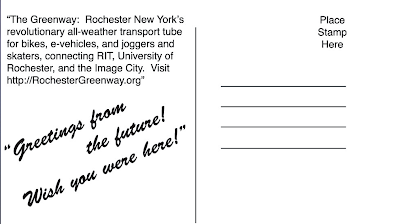
Besides offering to help us advance the Rochester Greenway, Tom told me more than I could fully absorb about the history of the various rail lines that criss-crossed Rochester in the past and provides us with such interesting opportunities for the future. What I *was* able to absorb is now recorded on the google Earth map at http://RochesterGreenway.org (and above right).
The conversation will continue.
This blog chronicles the progress of the RochesterGreenway project.
Presumably you’ve already been to
http://RochesterGreenway.org?
If not go there! Then come back.
Today I initiated this blog, where you may find day by day updates on the project.
On the right you’ll find a clipping service, featuring items of interest (if you’re interested in this kind of thing) from around the web.
Co-editors, apply within!