Written by Arian Horbovetz and originally published on The Urban Phoenix blog
For 6 years, I’ve been dreaming of the day when Genesee street in downtown Utica, NY might be reduced from four lanes to two with a turning lane and bike lanes. To be perfectly frank, this was a reality I feared would never materialize. Despite the fact that countless cities and towns across the country have successfully executed a “road diet,” thus making a street safer for pedestrians, cyclists AND drivers with zero-to-minimal impact on travel time, so many Uticans had abrasively rejected my vision every time I brought it up.
Thanks to the vision of Utica Common Council member Katie Aiello, that formally unrealized hope for Utica’s historic Genesee Street was re-striped a little over a month ago with two travel lanes, a left-hand turning lane and bike lanes, just like I’ve imagined so many times.


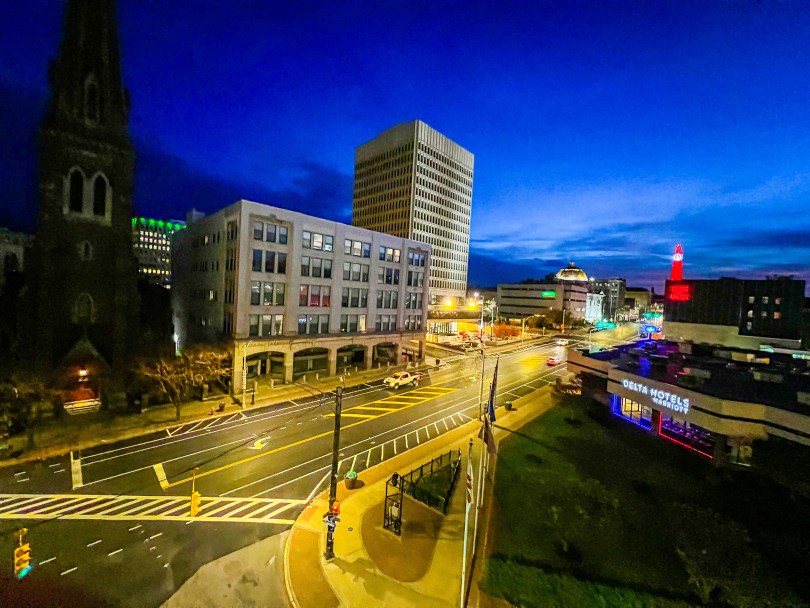
This was done as part of a 90-day trial period to assess the impact of the project. But as is typical when a city is introduced to the concept of Complete Streets and road diets for the first time, many people responded with a flurry of dissent.
Hot tip… if you ever want to sit back and watch a relentless flow of verbal bile and fire-scorched sense of logic, suggest a road diet in a downtown to a city and metro population for the first time. Just grab a substantial bag of buttery, salted popcorn and watch the horror unfold.
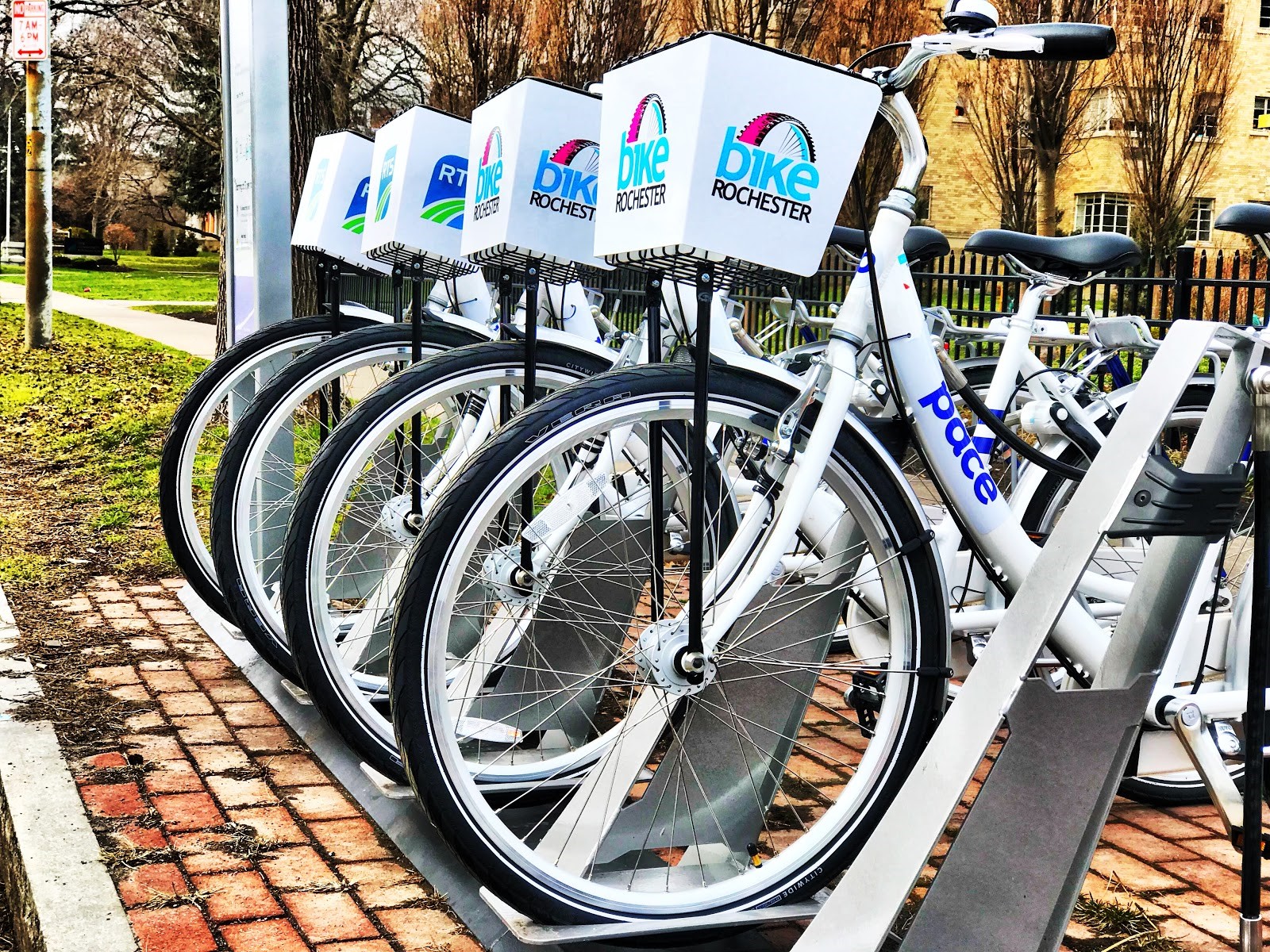
I’ve spent a significant amount of time assuring the people of Utica that projects like this make our streets safer for everyone, as well as helping to elicit private investment and provide greater accessibility of community resources for the population. A big part of this assurance is telling people that if this kind of project worked on the Main Street of my home city of Rochester with a population of over 200,000 people, it will work for a city with a population of just over 60,000 people. Genesee Street in Utica and Rochester’s Main Street downtown each have similar daily traffic counts (approximately 9,000 vehicles per day, well below the 15,000-20,000 that begin the four-lane road conversation).
But, as usual with these sorts of projects, my fact-backed urgings and invitations to references and resources in support of road diets were often met with a “no thanks,” as many community leaders choose their own opinions over actual data that has been repeated hundreds, if not thousands of times. My favorite comments from leading members of a prestigious local organization implied that bike lanes and greater walkability would make the area more accessible for “crack dealers.”
The irony of the above social media take is that the opposite is far more often true… that walkability, traffic calming, and bike access complement and enhance small business and local arts culture.
What it all boils down to is this… many residents still have an insulated “out my front door” view that their city or community is unique. And while to some extent this is true, for the most part, Rust Belt (or as I like to call them, Robust Belt) cities are all dealing with, and recovering from, the same barriers. And again, as much as we struggle to admit the solutions of de-prioritizing the automobile, creating small business-friendly environments, solving issues of equity and access and laying the fertile soil for human-centered economic growth are the broad but key lenses of change for all communities, it’s the proven truth. Despite the aforementioned opposition by many of Utica’s community leaders, the road diet that has taken place on Genesee Street is a small but significant puzzle piece with regard to the solution.
Maybe you’re still not comfortable thinking that your city isn’t as unique as you think it is. OK, I’ll concede that for a moment… but what I will not waiver on is that, as soon as we Americans get in our cars, we act more predictably than ever.
We all make subjective statements like “Massachusetts drivers are the worst,” or “Indiana drivers always pass on the right.” The truth is, people don’t drive differently because they’re from a different locale. Real world data shows that there are scores of given principles that determine the behavior of drivers. If the roads are wide, people will drive faster. If there are no vertical points of reference (trees for example) people will drive faster. If there is parallel parking, people will drive slower. If the lane is 9 feet wide instead of 11 feet wide, people will drive slower. And why is automobile speed so important when blended with walkability? Because of the shocking data from the National Traffic Safety Board…

A pedestrian hit by a car traveling 40 miles per hour is nearly twice as likely to be killed than if the car was traveling 30 miles per hour. Building infrastructure that reduces speeds, even by a few miles per hour, has the potential to save lives. But in order to do this, we must accept that traffic in our community doesn’t behave differently than traffic in other locales. We must accept that the drivers in Utica behave the same way as they do anywhere else… it’s the infrastructure that determines how safely or unsafely people pilot their vehicles.
This is typically where people will stand up and point out that cyclists and pedestrians break the law as well. My answer is always the same… sure, just like drivers, those who walk, bike and scooter break the law… the difference is that they are not piloting a 3,000-6,000 pound vehicle capable of 100mph that doesn’t just threaten their own life, it threatens the life of other people and property as well. Car crashes are the close #2 killer of children and teens, after gun violence. The NHTSA states that car crashes in the United States cost nearly a trillion dollars annually. And much of this burden is directly shouldered by the taxpayer. Why, then, would anyone rally against a mobility strategy that had the potential to save lives, lessen the chance of personal injury AND save taxpayer money?
The answer is entitlement that is always thoroughly-veiled in the word “freedom.” Drivers often view projects like this as yet another assault on their personal freedom. The irony, of course, is that transportation infrastructure that prioritizes the most expensive modality (automobiles) means that one doesn’t have a choice in how to access jobs and resources in their community. Because driving is subsidized so heavily in the US, there is no equitable alternative that is feasible or practical. Because of far higher gas taxes, gasoline in Europe costs twice as much… but the average American spends four times as much on transportation as the average European. This has led to the antithesis of transportation freedom for the American, replacing it with a blatant “pay-to-play” scenario. You must own a car to have the opportunity to succeed.
No, simply re-striping Utica’s Genesee Street won’t, on its own, invigorate a pedestrian and bike-friendly culture in the city’s downtown. No, it won’t single-handedly increase sales at local stores, restaurants, museums and theaters. It should be seen, instead, as a social and economic fulcrum, or a sort of fertilized soil that can help grow the seeds of prosperity for Utica’s future. It’s a small step, but one that so many cities have taken toward a more socially and economically prosperous community.