
Written by George Cassidy Payne and originally published on Medium.
Cody Donahue didn’t grow up with freedom of movement. His childhood stretched along a thin ribbon of rural highway in Oregon’s Willamette Valley — a Walmart, a decimated downtown, and three miles of empty road between home and anything else. “I didn’t have much transportation freedom in my youth,” he says. Bikes came late. Driving later. Independence arrived only in fragments.
He carried that mindset into adulthood: When work calls, a car is the simpler solution. He believed that for years” with “for years, the car was the only option to get around in rural Oregon.”
Then he moved abroad, first to France for study abroad and then to West Africa to work for a nonprofit.
In Dakar, he discovered a city humming without car dominance. People moved through dense streets by foot, bike, taxis, and informal buses called “Ndiaga Ndiayes”, an ecosystem built on proximity rather than horsepower. “Only the very rich had their own car. You could get anywhere by other means. It was a different way of moving,” he recalls.
That realization reshaped his sense of what mobility could be.
Today, as Co-Executive Director of Reconnect Rochester, Donahue channels that revelation into the city he now calls home. He chains errands, bikes to work, hops the 17 bus when the weather turns. Simplicity is the point. Connection is the ethos.
Rethinking the Urban Core
Ask Donahue what Rochester could look like without political or financial constraints, and he doesn’t leap into fantasy. He points to a real project already unfolding: the Inner Loop North redesign.
“We’re actually getting the opportunity to do this,” he says. “The project will replace a sunken, underutilized highway that disconnects neighborhoods with a neighborhood scale street grid. We’re not advocating to eliminate roads — but to create spaces where people can feel comfortable walking and biking with their families. ”
The plan envisions creating 22 acres of new development parcels in the heart of the city, with calm, tree-lined neighborhood streets, restored parks, integrated walking and cycling infrastructure, and connections to the future High Falls State Park. Each section of the 1.5 mile stretch can be somewhat different, but Donahue is excited about the possibility for mixed-use, dense development, and ground-floor businesses around our transit hubs. “We can build up around our Intermodal Station while also expanding its footprint to be the hub for intercity buses,” said Donahue of a project that has state funding and will run in parallel to the Inner Loop North redevelopment.
“This whole area is going to be a lot more vibrant and connected,” Donahue says. “The uncomfortable truth about the Inner Loop is that it was designed to bring people from the suburbs to work and then back home. It wasn’t built for city residents. This project corrects that.”
The state has already secured $100 million for construction. While timelines may shift, bidding is set for September 2027, construction begins in April 2028, and completion is projected for October 2030. Parcel development will follow over the subsequent years, reshaping not just infrastructure but the way people live and move in Rochester.
The Hidden Curriculum of Movement
“Reconnect Rochester now offers everything from ‘Getting Back on Your Bike’ workshops to school safety lessons, winter cycling training, commuter programs, and hands-on Smart Cycling classes,” Donahue says. As he scales that range — from fifth graders to downtown workers — patterns emerge.
“We’re really invested in bike education because kids should have it,” he says. “When they don’t, they develop unsafe habits and carry them into adulthood. That contributes to crashes.” Nearly half the time, the cyclist triggers the crash — not necessarily because they’re reckless, but because no one ever taught them the proper way to ride.
That lack of training intersects with a fragmented bike map.
“We have cycling infrastructure gaps we’re trying to close. The bike lane map looks like someone threw spaghetti at a wall,” he says. “Our Mind the Gap competition helps identify the highest priority connections for the city and the county to make for a comfortable bike network.”
Residents want comfort, predictability, and physical protection. That requires real design: barriers in the street, well-placed cycle tracks, infrastructure that doesn’t force riders onto sidewalks.
Culture plays a role too. Donahue and his team work with employers to add bike parking, secure racks through the city, or negotiate indoor, secure bike storage with landlords. A new downtown lunchtime learning series reaches commuters who may have never imagined biking to work. They hope to reach downtown companies with lunch and learns next year to show downtown workers just how fast and easy it is to bike to work in the Central Business District of Rochester. In May, Reconnect will again host bike to work day to reach new commuters.
Then, there is the matter of our snowy winters. “The world doesn’t shut down in the winter,” Donahue says. “I drive more, but I also take the bus more. Some fat tire bikes handle snow better. And we continue to push the city to clear main bike routes. The City has committed to studying enhanced winter maintenance, so we’re making progress.”
True cultural change, though, requires leadership.
“We’d like to see more of a culture of property owners taking responsibility for clearing sidewalks,” he says. “Madison, Wisconsin has a great approach. It’s just a different civic culture when it comes to tending to the snow.”
A Concerning Trend and an Urgent Response
The national context is grim. Pedestrian fatalities in the U.S. have risen 75% since 2010. Locally, Monroe County averages 12 walking or biking deaths per year, and 2025 has already exceeded this average at 13 as of December.
“We must do better,” Donahue says. “These are preventable losses.”
To shift that trajectory, on-street demonstration projects matter. In 2025, Reconnect Rochester launched Downtown SmART Streets, inspired by Washington, D.C. ‘s Arts in the Right of Way program. Seasonal curb-extension murals function as both art and traffic-calming infrastructure, beautifying streets while protecting people.
The 25 MPH Shift and the Politics Around It
Rochester has embraced ambitious mobility goals, Vision Zero, safer arterials, expanded bike networks, but serious injuries and deaths continue to rise.
Donahue is clear about the most actionable fix: lower the citywide speed limit to 25 miles per hour.
A municipal lawyer working with Reconnect Rochester produced a comparative analysis: Boston and Seattle implemented the reduction; Providence did not. Even without added enforcement, the cities that lowered the limit saw reductions in speeds, crash rates, and fatalities. Albany is now seeing monthly declines as well.
“The bottom line is that these programs reduce fatalities,” Donahue says. “This is our guiding star. Slower speeds save people walking to the bus, cyclists, kids — everyone.”
He insists that driver accountability must be part of the solution.
“We can stop those who have no regard for people,” he says. New York State is considering legislation to require the worst repeat speeders to drive with speed governors — devices that physically prevent them from exceeding safe limits. “These policies work.”
And the stakes are bigger than traffic engineering. “We’ve backed ourselves into a societal corner where parents don’t feel comfortable letting their kids walk down the street.”
Where Expertise Lives: Complete Streets in Action
The Avenue D & Hollenbeck Complete Streets Makeover crystallized a principle Donahue now calls non-negotiable: lived experience is expertise.
“It was our fifth complete street makeover — what we call the quadfecta, one in each quadrant before returning to the Northeast,” he says. “We sourced nominations citywide. One thing we learned from the Arnett Boulevard project is that some roads are classified by the state to prioritize vehicular traffic. So our makeovers are now looking at the most local road you can get to reduce the restrictions on what we can do.”
The neighborhood’s R-Center staff had been clamoring for improvements. Their knowledge shaped the project’s design: temporary installations, seasonal centerline flex posts, and monitored interventions. “All summer and fall, not one post needed to be replaced due to damage,” Donahue notes. “We’re conducting a traffic study on speed and turning to evaluate the effectiveness. We plan on doing new installations in new locations over the next three years.”
Complementing these interventions is a design rendering prize, offering a professionally engineered visualization to a neighborhood free of charge. Monroe Avenue in Brighton received one in 2019, now actively used in state-level advocacy to enhance safety and create more vibrant public space.
Downtown, the SmART Streets initiative extends this philosophy: seasonal curb-extension murals at East Main and Gibbs, Broad and Fitzhugh, with more to come, reinforcing walkability through public art. The work demonstrates how neighborhood input and tactical design combine to reduce risk and foster a safer, more inviting urban environment.
Influence, Advocacy, and Evolving Beliefs
Donahue’s campaigns- Intermodal Station expansion, suburban walk audits-highlight a key lesson about New York transportation politics: advocacy matters.
“I would point to a common thread: resident voices,” he says. Promoting density and mixed-use development brings daily amenities closer to homes, reducing car dependence and improving safety.
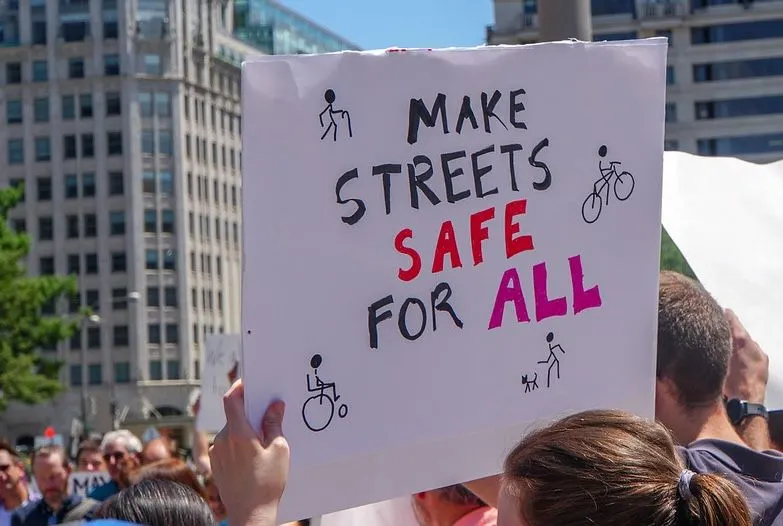
“The NIMBY contingent is usually a vocal minority,” Donahue notes. “We’re trying to promote YIMBY: yes in my backyard. Call your local officials. Tell them you want sidewalks, bike lanes, transit, more mixed use neighborhood amenities.”
A recent candidate questionnaire across several towns showed majority support for safer streets. Those elected embraced these changes. “We want people showing up to public meetings,” Donahue says. “It makes a difference.”
Reflecting on his early advocacy, he admits a lesson learned:
“Early in my career, I thought there was one right way to do things. But there isn’t. It’s important to realize we can reach the same conclusions through different methods. Live the experience of the people you’re making policies about. If you’re making bus policies, take the bus for a month. We become extremely fragmented in our lived experiences. It’s not obvious we’ll reach the same conclusion, but you have to identify your values and fight for them.”
A City Rewoven
Donahue’s path arcs from a rural upbringing to a global awakening to a Rochester in transition. Throughout, one conviction anchors him: every person deserves to move safely, freely, and with dignity.
He thinks of Dakar, where movement was communal. He thinks of Highway 20 in Oregon, where mobility required horsepower. And he looks at Rochester — slowly, collaboratively reimagining itself.
Rochester is being reweaved. Not just the roads. The relationships.
And for a city once carved apart to speed commuters, that may be the most transformative redesign of all.