![[PHOTO: Robert Torzynski]](http://www.rochestersubway.com/images/photos/transit-policy-cover.jpg)
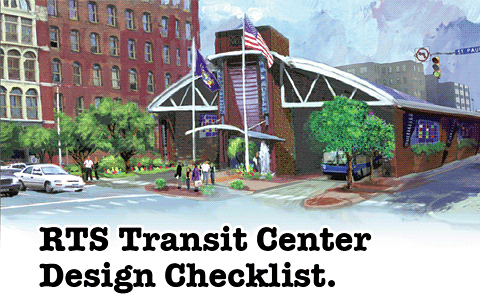
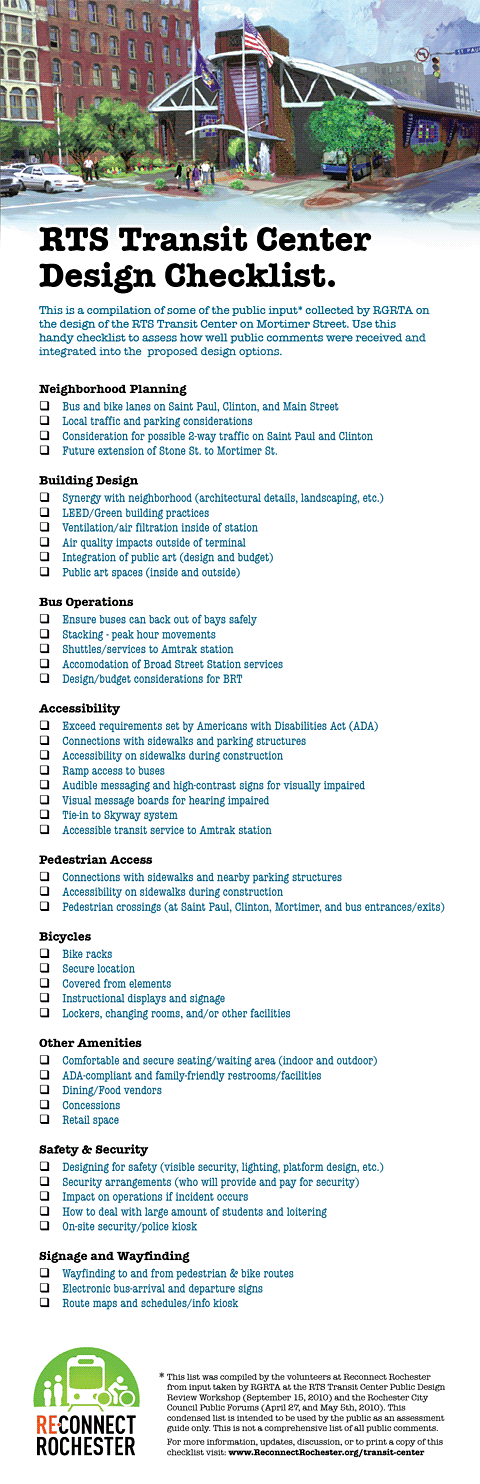
RTS Transit Center Design Checklist… TAKE ONE!
On Thursday, February 10, 2011, RGRTA will be hosting its Second Public Design Review Workshop inviting members of the community to review and react to design options for the RTS Transit Center  . This public review will take place at the Radisson Inn Riverside and the doors will be open to everyone from 6:00-7:30 pm.
Ideas and comments on the initial designs were taken by RGRTA at the RTS Transit Center Public Design Review Workshop (September 15, 2010) and the Rochester City Council Public Forums (April 27, and May 5th, 2010).
The volunteers at Reconnect Rochester have compiled this handy checklist for YOU (the public) to use as a guide to assess how well public comments were received and integrated into the newly proposed designs. Print it, share it, and use as a starting point to form your own opinions and ask the important questions…
Follow Reconnect Rochester on Facebook for updates on the RTS Transit Center and other local transportation projects and public meetings.
R Community Bikes needs Bicycle Donations
R Community Bikes Inc. (RCB) is a 501c3 charitable organization which provides refurbished bicycles to needy children and adults in our community.
This service is provided free of charge but RCB depends on the generosity of individuals who donate bikes.
If you have an old bike in your garage or basement please consider donating it to RCB.
Last year RCB provided 2,474 bikes to our brothers and sisters of Rochester.
For R Community Bikes to continue this ministry, more bikes are needed.
Visit www.rcommunitybikes.net, email to rcombikes@yahoo.com or call 865-9872 for more information.
Thank you.
2011 Rochester Bike Week Volunteer Meeting
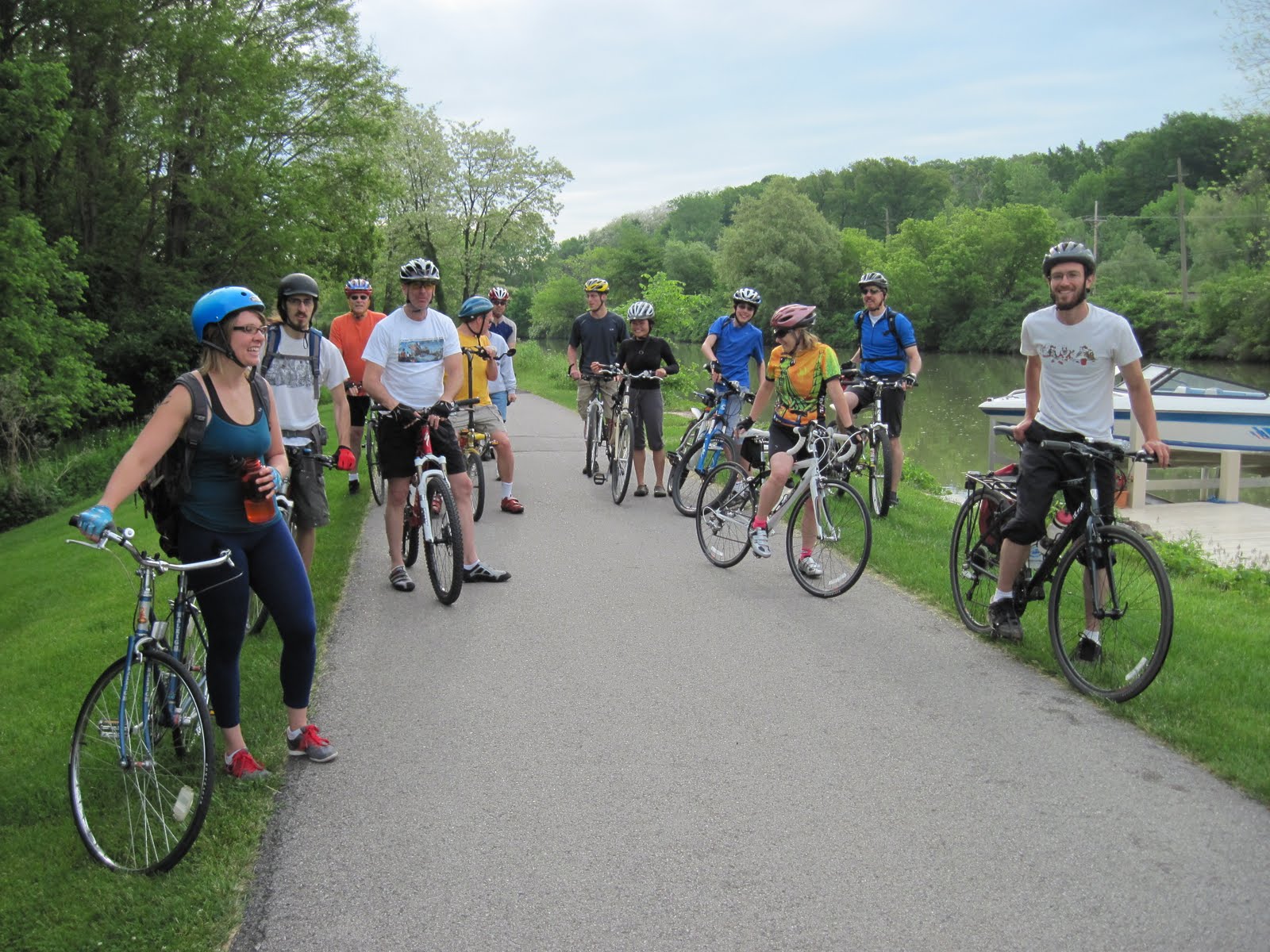
Rochester Cycling Alliance Advocates…
If you missed the volunteer meeting last Sunday you still have an opportunity to find-out more and participate in 2011. The next meeting will be held on Monday, February 7th at 7pm – LOCATION: RIT Center for Student Innovation RM: 1100.
RIT Center for Student Innovation.
Google Map Directions available at: http://maps.google.com/maps/
In line with our objectives for the 2011 Bike Week our volunteer needs will follow three main tracks:
Meeting details below.
Bike Week 2011 planning is upon us once again! As the Rochester Bicycle Master Plan Project (http://www.cityofrochester.
1. Bike Shop / Bike Club Ambassador (4 volunteers needed)
· (Duties) To make contact with all local bike shops and bike clubs to solicit the following: donations/sponsorships, ride and event support for Bike Week, and to secure distribution sites for Bike Week flyers.
2. Community Relations Ambassador (4 volunteers needed)
· (Duties) To identify and contact potential community and business partners that can benefit from helping Bike Week grow in their area. For example, Neighborhood Associations (NA) may be a good partner, due to their political influence and ability to disseminate information to their NA members. Once relationships are established we need to solicit the following: donations/sponsorships, ride and event support for Bike Week, and to secure distribution sites for Bike Week flyers.
3. Ride Leaders / Support (6 volunteers needed)
· (Duties) To lead and or support bicycle rides at their planned times. Make sure all participants are safe and accounted for. Leaders and support will also be responsible for maintaining an accurate sign-in sheet used for tracking and recording the number of participants on each ride, while also documenting the ride through photographs.
BIKE WEEK VOLUNTEER OBJECTIVES
Build Relationships
The Rochester Cycling Alliance is just that…an alliance of cyclists in Rochester. However, we cannot have a very strong alliance if we are not actively seeking and building support from the community of cyclists that live and work in Rochester. As volunteers connect with shops, clubs, businesses, and communities we want to inform our target communities about the RCA, Bike Week, and the Rochester Bicycle Master Plan Project, while providing multiple levels of involvement. The three volunteer positions listed above are very public positions and require volunteers that can leverage established relationships with our targeted communities or have the ability to develop the necessary relationships.
Secure Involvement, Donations and Sponsorships
Ambassadors will be supplied with our 2011 Bike Week Donation/Sponsorship letter to deliver to each potential bike week partner. The letter will detail how shops, clubs, businesses, and communities can participate at various levels and even financially or through in-kind donations (time or product). The letter should be delivered in person, rather than mailed, in order to help establish a face-to-face relationship with the potential partner. Our goal is not to make money with this effort, but to solicit involvement and funds to help cover the 2011 Bike Week event expenses. As the RCA develops into a 501c3 (non-profit entity) this year, we will be able to receive and appropriate tax deductible donations from contributing partners.
We look forward to seeing you at the Volunteers meeting! Please feel free to email me with any questions.
Thanks!
Jason Hammel
RCA Bike Week 2011, Director
Bike Week 2011 Volunteer Meeting
It may only be January, but the Rochester Cycling Alliance is already thinking ahead to Bike Week 2011, May 20-27. We want to build on the successes of last year’s Bike Week by expanding the event and bringing in more community partners to get the message out that bikes belong on Rochester’s streets.
But we can’t do it alone! We have several volunteer positions that need to be filled to make sure that Bike Week 2011 is a success. We’re holding a volunteer meeting this Sunday at 7 pm for anyone interested in helping out. Join us at the RIT Center for Student Innovation (map) to find out how you can help.
In line with our objectives for the 2011 Bike Week our volunteer needs will follow three main tracks:


Bicycle Sharing Systems
Alta Planning & Design, http://www.altaplanning.com/ announces its sister company Alta Bicycle Sharing, Inc. (ABS) launches bike sharing systems in Melbourne, Australia and Washington, D.C. There’s no question that the success of bike share programs rests upon not just great technology, as provided by companies like Bixi, but on top-notch operations management, as provided by ABS.

Greater Rochester Area Bicycling Map @ Google Maps
Greater Rochester Area Bicycling Map
Genesee Transportation Council — 2010
These ratings represent the opinions of experienced bicyclists on the rideability of major roads based on existing road conditions and features such as pavement width and quality, traffic volumes, presence and type of shoulders, and posted speed limits.
Please be aware that road conditions may change and bicyclists must always be aware of vehicular traffic, potholes, and other road hazards.
Further information is available at: http://www.gtcmpo.org/Bike_Map/BikeMapInfo.htm
http://maps.google.com/maps?f=q&source=s_q&hl=en&geocode=&q=https:%2F%2Fsites.google.com%2Fsite%2Fgreaterrochesterareabikemap%2Fmap%2Fv2GreaterRochesterAreaBicyclingMap.kml%3Ft%3Dp&sll=43.14183,-77.570686&sspn=0.067137,0.219383&ie=UTF8&t=p&lci=bike&ll=43.157297,-77.606306&spn=0.073381,0.181789&z=13
Greater Rochester Area Bicycling Map @ Google Maps
Greater Rochester Area Bicycling Map
Genesee Transportation Council — 2010
These ratings represent the opinions of experienced bicyclists on the rideability of major roads based on existing road conditions and features such as pavement width and quality, traffic volumes, presence and type of shoulders, and posted speed limits.
Please be aware that road conditions may change and bicyclists must always be aware of vehicular traffic, potholes, and other road hazards.
Further information is available at: http://www.gtcmpo.org/Bike_Map/BikeMapInfo.htm
http://maps.google.com/maps?f=q&source=s_q&hl=en&geocode=&q=https:%2F%2Fsites.google.com%2Fsite%2Fgreaterrochesterareabikemap%2Fmap%2Fv2GreaterRochesterAreaBicyclingMap.kml%3Ft%3Dp&sll=43.14183,-77.570686&sspn=0.067137,0.219383&ie=UTF8&t=p&lci=bike&ll=43.157297,-77.606306&spn=0.073381,0.181789&z=13
A new study of data from Lyon’s bike-share system could help planners
Grist by Sarah Goodyear 1 Dec 2010 10:24 AM
http://www.grist.org/article/2010-12-01-a-new-study-shows-that-bike-share-users-beat-average-car-speeds-
A couple of weeks ago, Elly Blue wrote here about the need for better data about bicycling here in the United States. In Lyon, France, the hugely popular Velo’v bike-share system is providing a source for at least some of types of bicycling numbers, having to do with travel times and routes.
The Lyon study looked at 11.6 million trips taken on the city’s bikes between May 2005 and December 2007. It shows, among other things, that . From an item on the Physics arXiv Blog of MIT’s Technology Review:
Over an average trip, cyclists travel 2.49 km in 14.7 minutes, so their average speed is about 10 km/h. That compares well with the average car speed in inner cities across Europe.
During the rush hour, however, the average speed rises to almost 15 km/h, a speed which outstrips the average car speed. And that’s not including the time it takes to find a place to park, which is much easier for a Velo’v bike than a car.
Other results reveal the habits of the urban cyclist for the first time. For example, there is a clear peak in average speed at 7.45 am and 8.45 am on working days, when presumably there is rush to get to work. The average speed drops to a more leisurely 10 km/h at weekends….
The data also shows that bike journeys between two points are shorter in distance than the corresponding journey by car. There are no bike lanes in Lyon so this suggests that cyclists use other techniques to make short cuts, say [the researchers]. Their shocking conclusion is that cyclists often ride on the pavement, along bus lanes and the wrong way up one-way streets.
That kind of information will be useful for urban planners. For the first time they have real data to show where to build cycle lanes and how well they will be used.
Bike-share systems now up and running in Denver and Washington, D.C., could be a source for similar data. Let’s hope it’s made available to researchers.
Presentation of Final Rochester Bicycle Master Plan 6pm-8pm Monday, Dec 13
The final resentation of the Rochester Bicycle Master Plan will take place on Monday, 12/13, from 6:00-8:00 PM at the Kate Gleason Auditorium of the Rochester Central Library – Bausch & Lomb Building (116 South Ave). Your attendence and input will be most welcome.
The final version of the report will be available on the Web approximately one week prior to the meeting on the Rochester Bicycle Master Plan Website:
http://www.cityofrochester.gov/bikeplan/
I hope to see you there.
Scott
Ithaca Bike Symposium and Bike Boulevards
With the Rochester Bicycle Master Plan almost completed, one of the options for providing access is bike boulevards as noted below.
Summary Jon Schull and Scott MacRae’s Trip to Ithaca Bike Symposium 11- 19 &20, 2010
We were fortunate to attend the Ithaca Bike Symposium. Unable to make the afternoon sessions, we joined the Bike & Beer Gathering Friday Night. We met some Ithaca bike advocates and were introduced as the “Rochester Brothers” because Jon and I both put Rochester after our first names.
The next morning Mia Burke, Alta Planning, former bike coordinator for Portland, Oregon 1993-1999 who now runs a 60 employee national bike consulting company gave a talk on Bicycle Boulevards” or “Neighborhood Greenways”. Here are the highlights.
60% of the population is classified as “Interested and Concerned” and these folks are that the population that responds Bike Boulevards appeal to. (There are the 1% young and fearless and 7% are enthused and confident, 30% are uninterested in bicycling.)
Bike Boulevards or Neighborhood Greenways, have been very successful in Portland but the first one is a challenge since the community does not know what to expect. The cost is $250,000/mile so they may not be cheep compared to the $10-20,000/mile for painting lanes. They are ideal to set up on streets that run parallel to preferred routes. The preferred traffic volume is 3,000-4,000 but 1,500 or lower is ideal. Some bike boulevards are now shooting for <500 cars/day.
There are different levels of commitment for Bike Boulevards or Neighborhood Greenways. The first level is signage and pavement markings. Another is prioritizing traffic so that the cyclists don’t have to stop frequently. They also traffic use traffic calming (slowing) techniques like elongated speed bumps, traffic circles and curb extensions to slow traffic ideally to 15-25 mph. A higher level of commitment is auto traffic diversion to a different street. Adjoining street dwellers often complain about this driving more traffic to their streets but this is typically less than expected because traffic disperses more to other non adjacent streets.
Public involvement is important and the process should not be rushed into. The neighborhood needs to be surveyed and canvassed as well as ride and public workshops all contribute to educating the neighborhoods on the positive effects. This includes the increase in land values of neighborhoods around bike boulevards.
They use median and refuge islands which are separate from the pedestrian islands to allow the cyclists to cross busy streets. A street may be blocked off from 2 way car traffic and become a one way street but allow bikes to go 2 ways.
A popular trend is to combine “bike boulevards” with “green streets” which includes bioswales and storm water management as well as green plantings to improve the livability for everyone. The park service people like this because it can create an atmosphere of a mini park in a park inaccessible area. Bike Boulevards are one part of the puzzle of making a community bike friendly.
A great video on Portland, Oregon’s Bike Boulevard Program is available at:
http://www.treehugger.com/files/2010/11/portland-mode-share-tops-7.php?campaign=th_rss&utm_source=feedburner&utm_medium=feed&utm_campaign=Feed:+treehuggersite+(Treehugger)
Scott

University of Rochester Bicycle Active Transportation Forum, Monday Nov. 15, 5:30pm SMH, Flaum Atrium Case Method Room
University of Rochester Bicycling – Active Transportation Symposium – Workshop
5:30 pm, Monday, November 15th, Case Method Room # 9576, 1st floor Adjacent Flaum Atrium off the Mezzanine
The University of Rochester Center For Community Health and the Rochester Cycling Alliance are sponsoring a forum on bicycling and active transportation with a specific focus on educating the audience on the successes of Northern cities like Minneapolis, Minnesota and Madison, Wisconsin as well as opportunities for Rochester.Dr. Brad Berk Strong Health Systems CEO, will be introducing a symposium on bicycling and active transportation. The City of Rochester is in the final stages of developing its Bicycle Master Plan that will be finalized in early 2011. The University of Rochester will play a critical role in the success of encouraging the Greater Rochester Community to promote bicycling and walking as economical, safe and healthy modes of transportation for adults and children.
The forum will present a concise overview of the safety, health, economic and lifestyle benefits of active transportation (bicycling and walking) and will invite the audience to comment on the barriers to promoting bicycling and walking both on and off campus. Transportation challenges of the University Master Plan and Rochester Bicycling Master Plan as well as logistics of bike commuting will be presented. The workshop is to educate and organize individual’s interest in promoting better access to biking and walking in Rochester.
This is the first of 4 progressively larger symposiums on bicycling and Active Transportation which will be held over the next 6 months.
For further information contact Scott MacRae via Scott_macrae@URMC.rochester.edu or Glenn Cerosaletti at Glenn.cerosaletti@rochester.edu
University of Rochester Bicycle Active Transportation Forum, Monday Nov. 15, 5:30pm SMH, Flaum Atrium Case Method Room
University of Rochester Bicycling – Active Transportation Symposium – Workshop
5:30 pm, Monday, November 15th, Case Method Room # 9576, 1st floor Adjacent Flaum Atrium off the Mezzanine
The University of Rochester Center For Community Health and the Rochester Cycling Alliance are sponsoring a forum on bicycling and active transportation with a specific focus on educating the audience on the successes of Northern cities like Minneapolis, Minnesota and Madison, Wisconsin as well as opportunities for Rochester.Dr. Brad Berk Strong Health Systems CEO, will be introducing a symposium on bicycling and active transportation. The City of Rochester is in the final stages of developing its Bicycle Master Plan that will be finalized in early 2011. The University of Rochester will play a critical role in the success of encouraging the Greater Rochester Community to promote bicycling and walking as economical, safe and healthy modes of transportation for adults and children.
The forum will present a concise overview of the safety, health, economic and lifestyle benefits of active transportation (bicycling and walking) and will invite the audience to comment on the barriers to promoting bicycling and walking both on and off campus. Transportation challenges of the University Master Plan and Rochester Bicycling Master Plan as well as logistics of bike commuting will be presented. The workshop is to educate and organize individual’s interest in promoting better access to biking and walking in Rochester.
This is the first of 4 progressively larger symposiums on bicycling and Active Transportation which will be held over the next 6 months.
For further information contact Scott MacRae via Scott_macrae@URMC.rochester.edu or Glenn Cerosaletti at Glenn.cerosaletti@rochester.edu
Rochester’s (inspiring) Old Railroad Stations
*Cross Posted by RochesterSubway.com
 Lots of news has been brewing lately over the future of Rochester’s beat-up, 32-year-old Amtrak station on Central Avenue.
Congresswoman Louise Slaughter recently announced that a $1.5 million federal stimulus grant has been awarded to New York state to plan for a new multi-modal station on the site. A $2.5 million appropriation to pay for the station design is expected to pass Congress next month. And Governor-elect Andrew Cuomo has just made it abundantly clear that New York will take whatever federal money is left on the table by newly elected GOP governors in Ohio and Wisconsin.
So for now, let’s just assume that something very interesting is in the works for our pitiful excuse for a train station. This is the perfect time to take a step back in time—to be inspired by Rochester’s grand old stations…
Don't Be Ridiculous! How one Swedish city gets people to trade silly car trips for bikes
Here is a Swedish video about how to motivate, cajole and humerously encourage people to use active transportation, biking and walking, rather than hopping into the car for short trips. They’ve used some non conventional techniques for social marketing. Scott
http://www.grist.org/article/2010-09-29-how-one-swedish-city-gets-people-to-trade-silly-car-trips-for-bi/
Dutch Cyclists Shun Helmets – Wall Street Journal Article
Dutch cyclist are fighting the recommendaton by health professionals to wearing helmets. This is a familiar controversy where some cycling advocates are wary of encouraging helmets because it sends a message that cycling can be dangerous. The other side argues that not wearing a helmet is risky behavior. I think we’ve heard this argument before but which ever side you are on you can read about it below in the motherland of cycling in Europe. I personaly perfer to maintain as many brain cells as I can. Link below: Scott
http://online.wsj.com/article/SB10001424052702304248704575574250616160146.html?mod=ITP_TEST
Don't Be Ridiculous! How one Swedish city gets people to trade silly car trips for bikes
Here is a Swedish video about how to motivate, cajole and humerously encourage people to use active transportation, biking and walking, rather than hopping into the car for short trips. They’ve used some non conventional techniques for social marketing. Scott
http://www.grist.org/article/2010-09-29-how-one-swedish-city-gets-people-to-trade-silly-car-trips-for-bi/
Dutch Cyclists Shun Helmets – Wall Street Journal Article
Dutch cyclist are fighting the recommendaton by health professionals to wearing helmets. This is a familiar controversy where some cycling advocates are wary of encouraging helmets because it sends a message that cycling can be dangerous. The other side argues that not wearing a helmet is risky behavior. I think we’ve heard this argument before but which ever side you are on you can read about it below in the motherland of cycling in Europe. I personaly perfer to maintain as many brain cells as I can. Link below: Scott
http://online.wsj.com/article/SB10001424052702304248704575574250616160146.html?mod=ITP_TEST
- « Previous Page
- 1
- …
- 23
- 24
- 25
- 26
- 27
- …
- 41
- Next Page »