The City of Rochester is requesting proposals for a scoping project . The project will inventory and analyze the site and corresponding buildings used by Amtrak, Trailways and Greyhound. The end product will be a Federal Railroad Administration (FRA) and New York State Department of Transportation (NYSDOT) compliant scoping document that lays the foundation for final design, build-out, and occupancy of a new Intermodal Transportation Center.
Reconnect Rochester is proud to be a stakeholder of this project. And BOY OH BOY do we have ideas we want to share.
Here’s a summary of what the City is asking from bidders:
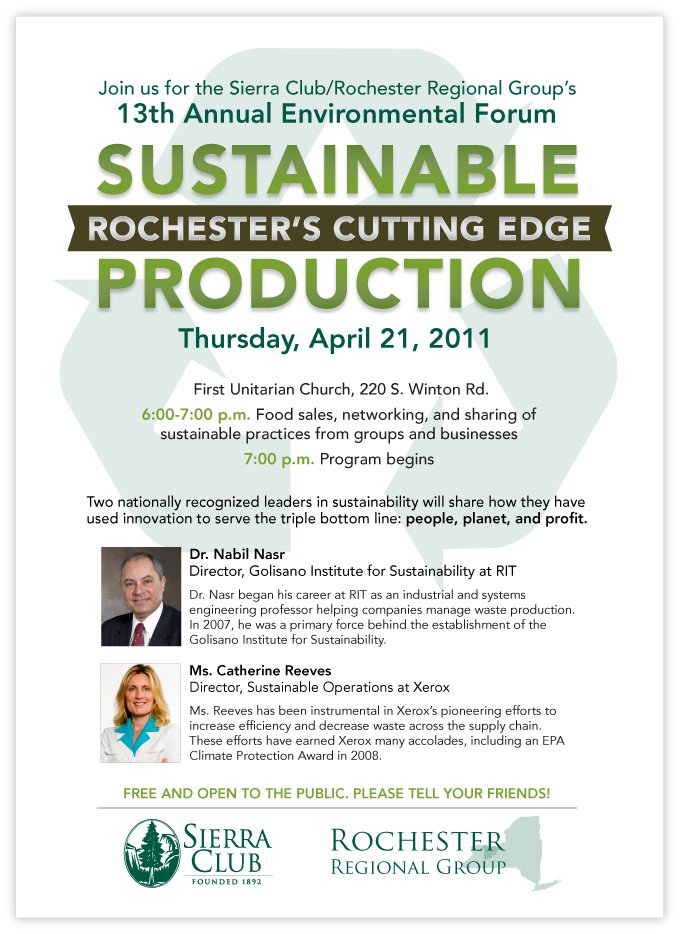
This Thursday evening Reconnect Rochester will be at the Sierra Club’s 13th Annual Environmental Forum, “Sustainable Production: Rochester’s Cutting Edge”. Come out and see us at our table and hear two nationally recognized leaders on sustainable production and manufacturing. Happy Earth Day!
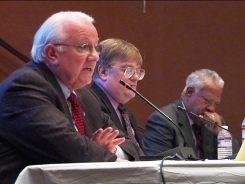
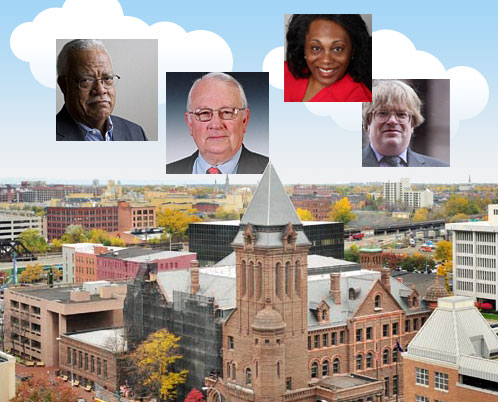
This past Tuesday evening Reconnect Rochester co-sponsored a Mayoral forum on issues related to land use, neighborhood urban planning, transportation, development and revitalization. Bill Johnson, Tom Richards, and Alex White went toe to toe and Rachel Barnhart (WHAM 13 News) moderated.
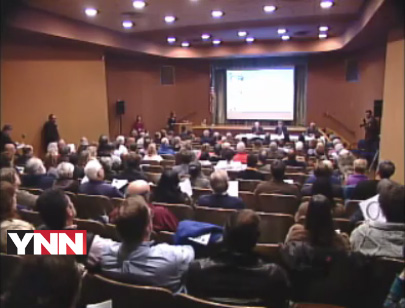
In all, well over 200 people turned out and submitted questions ranging from planning to poverty. The event was the first extended, in-depth forum of Rochester’s mayoral campaign and was covered by several local news outlets including YNN, WROC, and the D&C.
Now, in the famous words of sportscaster Warner Wolf, “Let’s go to the video tape!” And let us know what you think of the candidates’ responses in the comments section.
While Rochester searches for its next mayor to take office and begin the arduous task of planning the City’s future, Reconnect Rochester is taking the issues to the candidates and the candidates to the people.
Reconnect Rochester is a group of transportation advocates calling for the creation of a fully integrated multi-modal transportation network for our region. We believe the next Mayor has the opportunity to champion a dramatic shift in our transportation infrastructure. The transit system this city and region needs will require dedication of time, staff and resources.
We urge all candidates to pledge their commitment to this vision as part of their platform for candidacy.
Read what each candidate had to say about this document and the future of Rochester’s transit system below.
What follows is our reasoning and recommendations for the future Mayor to incorporate into his or her platform.
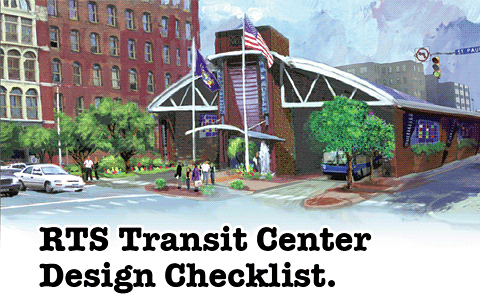
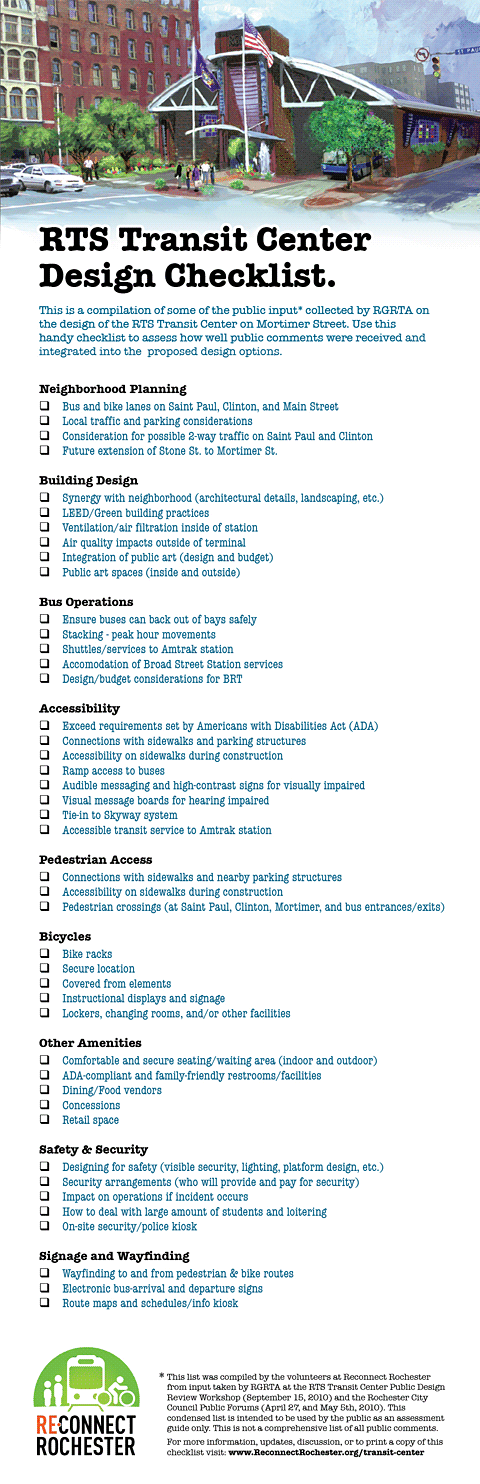
On Thursday, February 10, 2011, RGRTA will be hosting its Second Public Design Review Workshop inviting members of the community to review and react to design options for the RTS Transit Center . This public review will take place at the Radisson Inn Riverside and the doors will be open to everyone from 6:00-7:30 pm.
The volunteers at Reconnect Rochester have compiled this handy checklist for YOU (the public) to use as a guide to assess how well public comments were received and integrated into the newly proposed designs. Print it, share it, and use as a starting point to form your own opinions and ask the important questions…
Lots of news has been brewing lately over the future of Rochester’s beat-up, 32-year-old Amtrak station on Central Avenue.
Congresswoman Louise Slaughter recently announced that a $1.5 million federal stimulus grant has been awarded to New York state to plan for a new multi-modal station on the site. A $2.5 million appropriation to pay for the station design is expected to pass Congress next month. And Governor-elect Andrew Cuomo has just made it abundantly clear that New York will take whatever federal money is left on the table by newly elected GOP governors in Ohio and Wisconsin.
So for now, let’s just assume that something very interesting is in the works for our pitiful excuse for a train station. This is the perfect time to take a step back in time—to be inspired by Rochester’s grand old stations…
Project Selections Will Expand Obama Administration’s Livability Initiative Agenda, Fuel Economic Recovery for Local Communities
A $293 million investment announced today by U.S. Transportation Secretary Ray LaHood means that residents in dozens of communities nationwide will soon enjoy major transit improvements, including new streetcars, buses, and transit facilities.
The nearly $300 million investment is part of the Obama Administration’s livability initiative to better coordinate transportation, housing and commercial development investments to serve the people living in those communities. It is being made through two competitive grant programs, the Urban Circulator Grant Program and the Bus and Bus Livability Grant Program.
Tonight’s screening of Beyond the Motor City at the Dryden Theater was, in my opinion, a phenomenal event for Rochester. After the film, seven panelists discussed local transportation issues and took questions on the subject from the nearly full audience. Of course, in the allotted timeframe we were only able to scratch the surface, but this is a conversation that we will carry on in the months, and years ahead. If you’re not already, now would be a good time to make sure you’re following Reconnect Rochester on Facebook . And, in case you missed tonight’s event, here is Beyond the Motor City in its entirety. Enjoy…
To view this site, you need to have Flash Player 9
or later installed. Click here to get the latest Flash player.
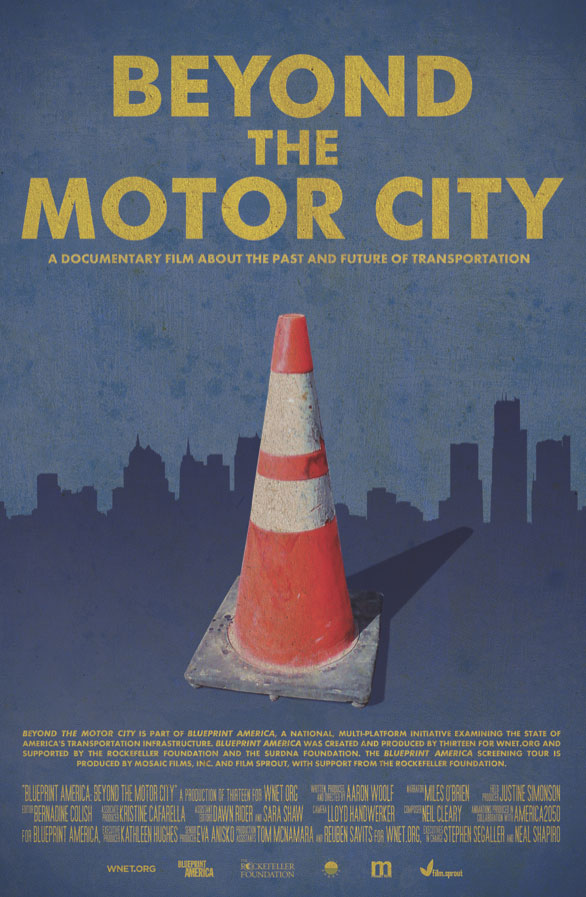
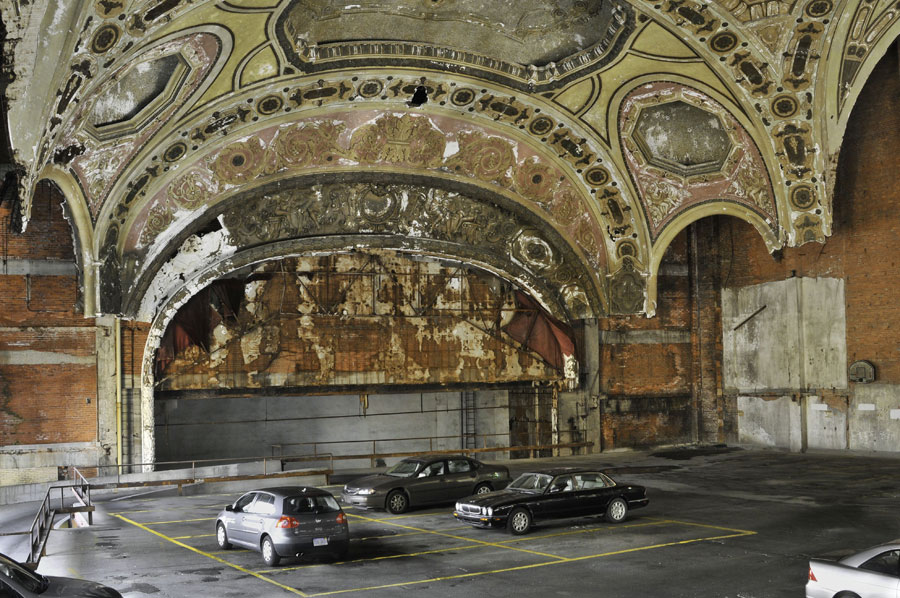
On Monday June 28 at 7:00pm you are invited to a FREE screening of PBS’s eye-opening film, BLUEPRINT AMERICA: BEYOND THE MOTOR CITY at the Dryden Theater. The documentary is touring cities across America to raise questions—and seek answers—about the future of transportation in America. Can we build the “infrastructure of tomorrow” today? Can the cash-strapped and car-dependent cities of the so-called Rust Belt become new models for fast, clean, public transit? The links and similarities between Rochester NY and Detroit MI are glaringly obvious—and I think you owe it to yourself to see this film.
New hopes for accessible, clean, and modern mass transit in America
The role of cities, and consumers, in shaping the next generation of transportation systems
A roadmap for revitalizing the way we move through our cities and neighborhoods
This will surely be a thought-provoking FREE event and a great opportunity for you to take part in a very important FREE conversation for our community. So mark your calendar and bring some friends. Did I mention this is FREE?!
More About the Film:
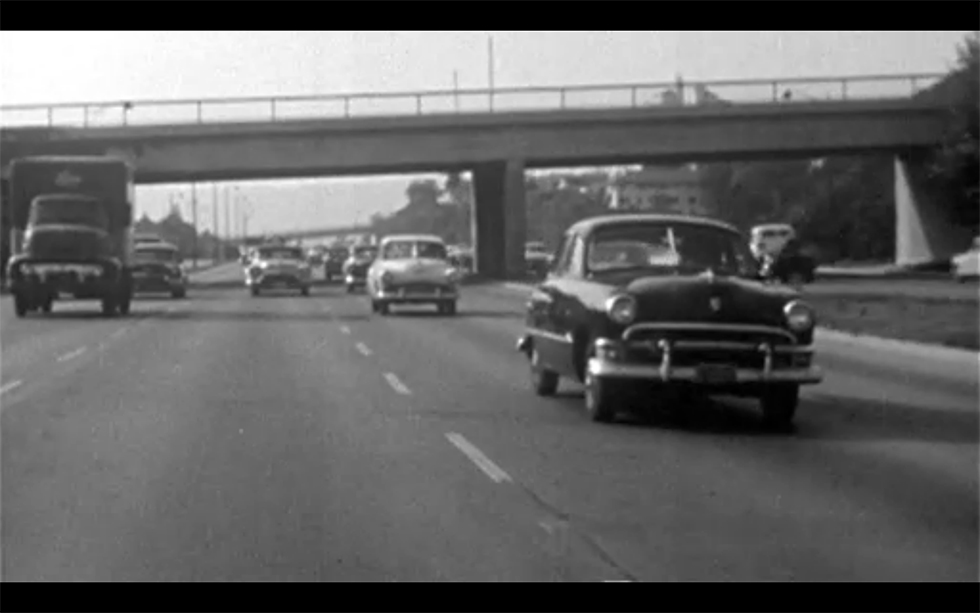
BLUEPRINT AMERICA: BEYOND THE MOTOR CITY examines how Detroit, a grim symbol of America’s diminishing status in the world, may come to represent the future of transportation and progress in America. Narrated by Miles O’Brien, the film explores Detroit’s historic investments in infrastructure—from early 19th- century canals to the urban freeways that gave The Motor City its name and made America’s transportation system the envy of the world.
But over the last 30 years, much of the world has left Detroit—and America—behind, choosing faster, cleaner, more modern transportation. In a journey that takes us into the neighborhoods of Detroit and then beyond to Spain, California, and our nation’s capital, BLUEPRINT AMERICA: BEYOND THE MOTOR CITY urges us to ask how we might finally push America’s transportation system into the 21st century.
BLUEPRINT AMERICA: BEYOND THE MOTOR CITY is part of Blueprint America, a national, multi-platform initiative examining the state of America’s transportation infrastructure. Blueprint America was created and produced by Thirteen for WNET.ORG and supported by the Rockefeller Foundation and the Surdna Foundation.
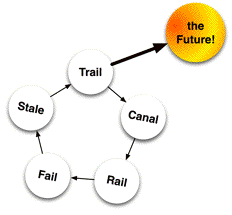
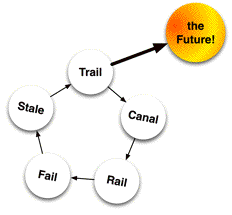
Rochester’s routes have shaped its history and will determine its destiny. From its Native American days to the present, Rochester’s historical pathways continue to shape and affect its vibrancy. We’ve come full circle.
Trail. Indian trails shaped today’s street arrangement. Instead of a simple urban grid we have Genesee Street, Plymouth Avenue and the trail along the east bank of the Genesee River. Canal. Our nineteenth-century canal system built on these Native American routes. The largely-forgotten Genesee Valley Canal followed closely South Plymouth Avenue and the Feeder Canal paralleled much of today’s Mt. Hope Avenue. The Erie Canal followed a curving West Broad Street route as it entered downtown. Rail. Starting in 1878, railroads began supplanting canals. Five different railroad systems operated in downtown Rochester around the early 1900s. Fail. But interstate highways, suburban development, governmental policy, and automobile lobbies eventually supplanted the dominance of the railroads. Stale. In the 1970s, urban redevelopment gave us the Inner Loop, suburban sprawl, and neighborhood separation. Subsequently, the city economi staled and people moved elsewhere. Many of Rochester’s core urban neighborhoods inherited surplus housing beyond reclaiming.
Trail! New hope now comes with the City of Rochester’s Project Green. The idea is to turn swaths of vacant and substandard housing into greenspaces that will enhance property values and quality of life. Some greenspaces would be used for community gardens. Some greenspaces would be “land-banked” for future development when the economy improves. And some greenspaces will be developed as linear parks for pedestrian and bicycle reconnecting neighborhoods, encouraing active living, reducing carbon footprints and parking pressures, combatting obesity, and generally making life better!
The Rochester Cycling Alliance strongly supports the City’s efforts to re-envision and re-provision former canal and rail routes, and to develop a bicycle master plan that uses them to reconnect and re-invigorate our city.
Rochester will blaze new trails by recovering old ones. Bike to the future!
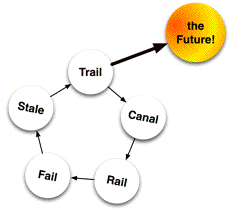
Rochester’s routes have shaped its history and will determine its destiny. From its Native American days to the present, Rochester’s historical pathways continue to shape and affect its vibrancy. We’ve come full circle.
Trail. Indian trails shaped today’s street arrangement. Instead of a simple urban grid we have Genesee Street, Plymouth Avenue and the trail along the east bank of the Genesee River. Canal. Our nineteenth-century canal system built on these Native American routes. The largely-forgotten Genesee Valley Canal followed closely South Plymouth Avenue and the Feeder Canal paralleled much of today’s Mt. Hope Avenue. The Erie Canal followed a curving West Broad Street route as it entered downtown. Rail. Starting in 1878, railroads began supplanting canals. Five different railroad systems operated in downtown Rochester around the early 1900s. Fail. But interstate highways, suburban development, governmental policy, and automobile lobbies eventually supplanted the dominance of the railroads. Stale. In the 1970s, urban redevelopment gave us the Inner Loop, suburban sprawl, and neighborhood separation. Subsequently, the city economi staled and people moved elsewhere. Many of Rochester’s core urban neighborhoods inherited surplus housing beyond reclaiming.
Trail! New hope now comes with the City of Rochester’s Project Green. The idea is to turn swaths of vacant and substandard housing into greenspaces that will enhance property values and quality of life. Some greenspaces would be used for community gardens. Some greenspaces would be “land-banked” for future development when the economy improves. And some greenspaces will be developed as linear parks for pedestrian and bicycle reconnecting neighborhoods, encouraing active living, reducing carbon footprints and parking pressures, combatting obesity, and generally making life better!
The Rochester Cycling Alliance strongly supports the City’s efforts to re-envision and re-provision former canal and rail routes, and to develop a bicycle master plan that uses them to reconnect and re-invigorate our city.
Rochester will blaze new trails by recovering old ones. Bike to the future!
The City has partnered with C&S Companies to analyze and make recommendations to enhance commuting, circulation, and parking in Downtown Rochester. Among the potential enhancements under consideration is a circulator transit service—a.k.a shuttle buses or streetcars. Listen carefully Rochester…
The RCA is trying to gather some basic information about how cyclists in Rochester use their bikes and what they think would make Rochester a better biking city. It’s not very long – please take a minute to fill it out and let us know what kind of cyclist you are!
The RCA is trying to gather some basic information about how cyclists in Rochester use their bikes and what they think would make Rochester a better biking city. It’s not very long – please take a minute to fill it out and let us know what kind of cyclist you are!
David Skinner, a friend of mine who has urged the city and the University of Rochester to open the Erie-Lackawanna Railroad Bridge to foot and bicycle traffic, passed along some good news on Friday. Tom Hack, a Project Engineer with the city, wrote to him:
“I have good news about the ELRR Bridge “Rails to Trails” Project. We have secured $1.2M from a 50-50 matching State Program. The State kicks in $600,000 and the City matches this with $600,000. We just received the agreement from the State, have signed it and it’s back on the Governor’s desk. The good thing with this is that it’s considered “old” money and should be sheltered from recent budget cuts. Our schedule at this point, barring anything crazy out of Albany, is as follows:
Solicit a Design Consultant…………….. Jan – Feb 2010 Undertake site reconnaissance and survey…..Feb -April 2010 Begin preparation of alternatives ………. April – May 2010 Host Citizens Advisory Meetings ………… May -June 2010 Layout alternatives …………………… June-July 2010 Host public meetings ………………….. August 2010 Finalize concepts …………………….. Sept 2010 Finalize design ………………………. Sept – Jan 2010 Issue Construction Contracts …………… Jan 2011 Construction phase……………………...April 2011 Open Bridge…………………………… Sept 2011
We’ve received a lot of community support along with the U of R’s direct support. This has helped a lot in allowing the funds to flow and the project to move forward.”
The bridge hasn’t seen any railroad traffic since the 1970s. Once opened to pedestrian and cyclist traffic, it will provide another link between the East and West-side river trails. The Genesee Transportation Council has a detailed report on the project at:
David Skinner, a friend of mine who has urged the city and the University of Rochester to open the Erie-Lackawanna Railroad Bridge to foot and bicycle traffic, passed along some good news on Friday. Tom Hack, a Project Engineer with the city, wrote to him:
“I have good news about the ELRR Bridge “Rails to Trails” Project. We have secured $1.2M from a 50-50 matching State Program. The State kicks in $600,000 and the City matches this with $600,000. We just received the agreement from the State, have signed it and it’s back on the Governor’s desk. The good thing with this is that it’s considered “old” money and should be sheltered from recent budget cuts. Our schedule at this point, barring anything crazy out of Albany, is as follows:
Solicit a Design Consultant…………….. Jan – Feb 2010 Undertake site reconnaissance and survey…..Feb -April 2010 Begin preparation of alternatives ………. April – May 2010 Host Citizens Advisory Meetings ………… May -June 2010 Layout alternatives …………………… June-July 2010 Host public meetings ………………….. August 2010 Finalize concepts …………………….. Sept 2010 Finalize design ………………………. Sept – Jan 2010 Issue Construction Contracts …………… Jan 2011 Construction phase……………………...April 2011 Open Bridge…………………………… Sept 2011
We’ve received a lot of community support along with the U of R’s direct support. This has helped a lot in allowing the funds to flow and the project to move forward.”
The bridge hasn’t seen any railroad traffic since the 1970s. Once opened to pedestrian and cyclist traffic, it will provide another link between the East and West-side river trails. The Genesee Transportation Council has a detailed report on the project at:
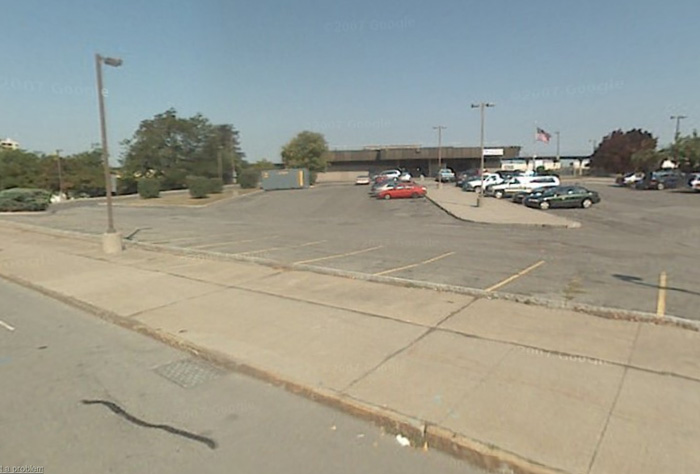
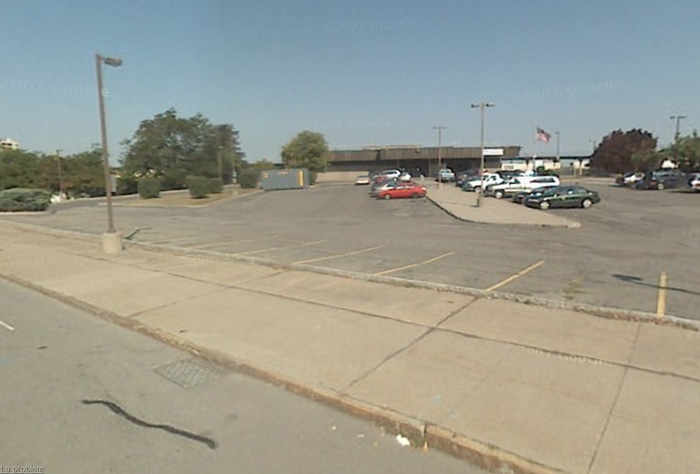
 . The project will inventory and analyze the site and corresponding buildings used by Amtrak, Trailways and Greyhound. The end product will be a Federal Railroad Administration (FRA) and New York State Department of Transportation (NYSDOT) compliant scoping document that lays the foundation for final design, build-out, and occupancy of a new Intermodal Transportation Center.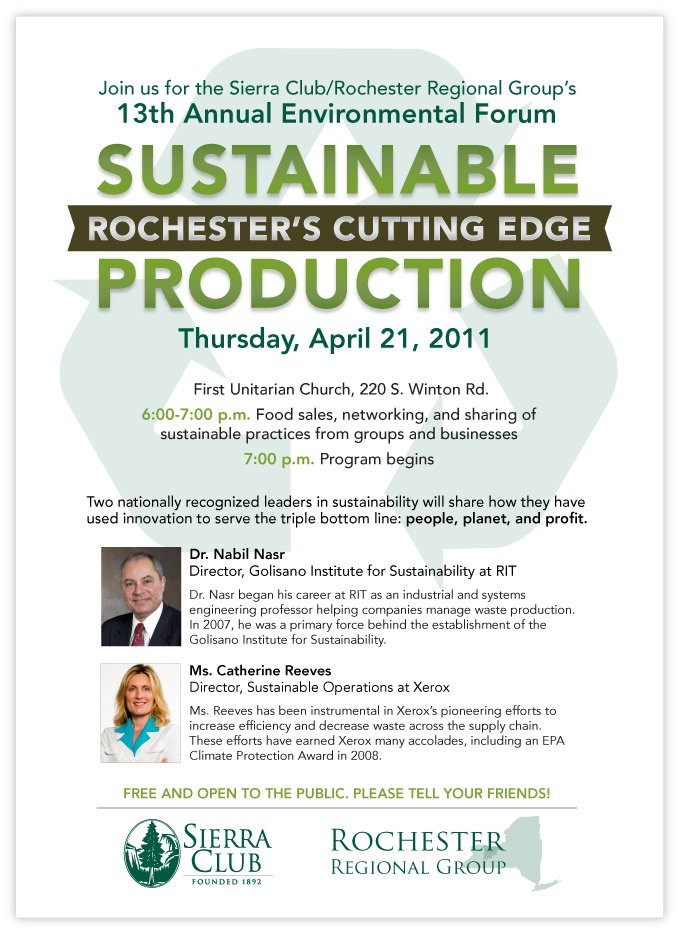


![[PHOTO: Robert Torzynski]](http://www.rochestersubway.com/images/photos/transit-policy-cover.jpg)

![The Federal Transit Administration announced Thursday that Charlotte was one of six U.S. cities to get streetcar grants. One-half mile of track is already in place on Elizabeth Avenue near uptown. [PHOTO: TODD SUMLIN - tsumlin@charlotteobserver.com]](http://www.rochestersubway.com/images/photos/charlotte-streetcar.jpg)