by No Comments

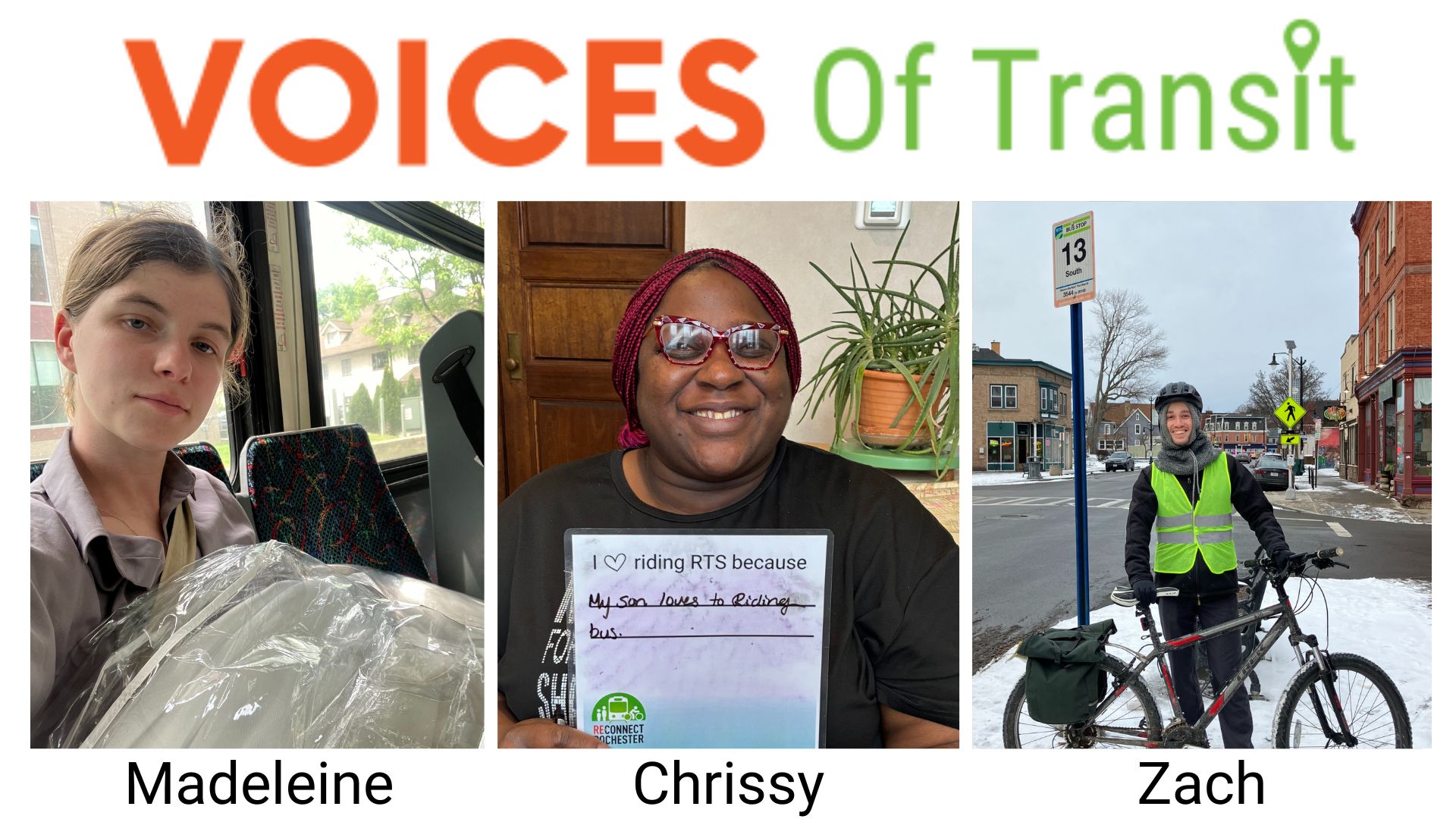
Voices of Transit 2026

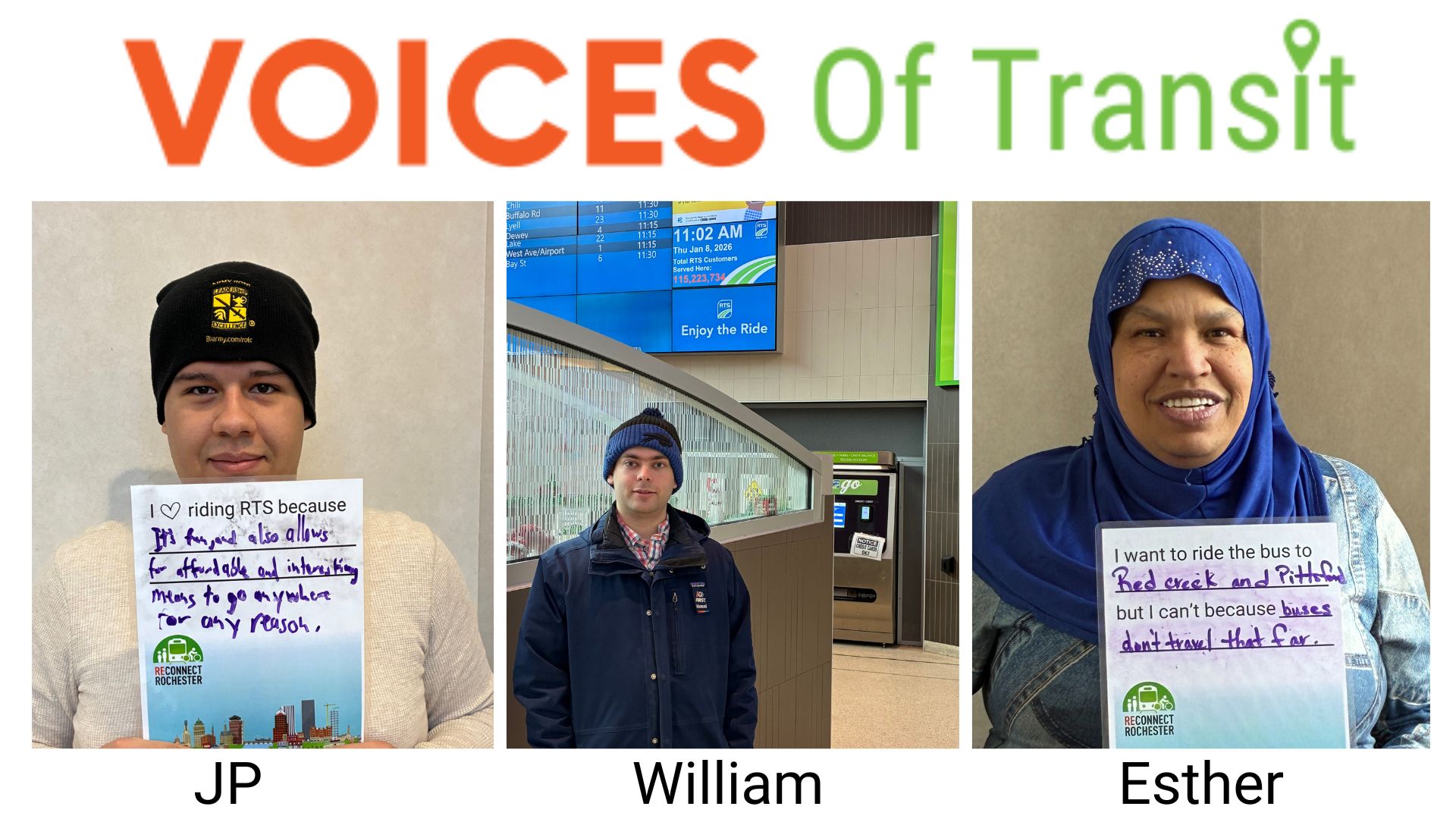
Reconnect Rochester presents Voices of Transit, an ethnography profile blog series that shows how our current bus system helps (and sometimes hurts) transit-dependent riders in their daily lives. Each year since 2023, we spend the winter interviewing RTS riders to hear about their experiences firsthand to share with state legislators in the name of funding public transit. Read more about how the initiative began in 2023 here.

Click on a name below to hear that rider’s story. 

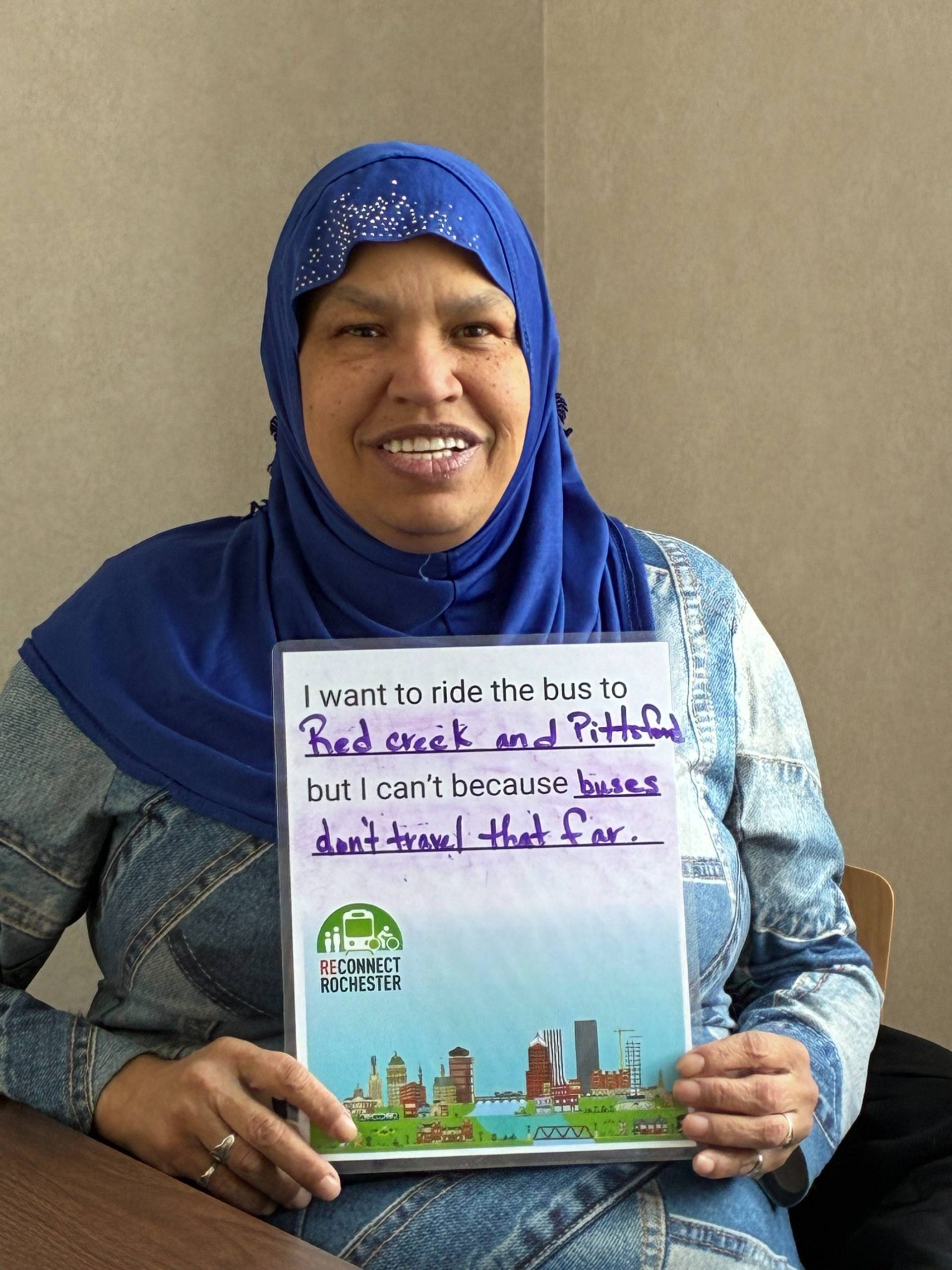
Esther
1. Did you grow up riding public transportation?


I didn’t ride transit until my 20s. I was born in Rochester and moved around a lot then didn’t use RTS until I came back in 1991. Back then the buses were really good. I was living out in Greece at Long Pond in and the buses took us to Irondequoit mall for $1 and you didn’t even have to transfer. It would take you downtown and I could get to a lot of places.


2. What RTS service and routes do you use?


I ride it maybe about 4 days a week.


I use the 13 (South Ave) bus a lot, the 12 (S. Clinton), the 41 (Culver/Goodman Crosstown), the 3 (Joseph) and the 4 (Hudson).


I would prefer to use the OnDemand bus but it doesn’t come downtown.


3. Do you own a car?


I used to. Now I will get rides when I can afford it.


4. How does RTS play a role in your day to day life?


I take it to work. It’s unfortunate because I’m a substitute [teacher] and this one school on Bryan St. kept offering sub jobs but I couldn’t get there because I can’t get a bus there. There are other schools too where I’ve had difficulty getting to jobs and I can’t work.


I used to work security near Marketplace mall but the bus went all the way around where I needed to go so I had to walk a while. It took a lot to get there but it was a good paying job but I lost it because I was late whenever the bus was late getting me there.


When I think of all the doctors appointments I go to, and I go to quite a few different areas, I don’t know many that are accessible by bus. RTS doesn’t go to Red Creek or Fairport, at least where I need it, so I have to get medical transportation which requires authorization from your doctor.


5. How do you pay for RTS? 


When I went to MCC I was happy to get an ID to pay for the bus. Now I am lucky because I have agencies that help me with monthly passes.


6. What doesn’t work for you about RTS service, and what would you change?


Why don’t we have better service to the suburbs? To use OnDemand, I have to get another bus to get to the zone and then I’m standing out in the cold again? We need to fix that because there are a lot of places people need to go.


There are a lot of organizations hiring but they’re out in the suburbs and people can’t get there. There’s a few buses to Fairport, East Rochester or Pittsford but they don’t go where the jobs are. I have friends who walk a mile to get to a job because the bus doesn’t take them all the way. That’s a lot to walk then work an eight hour job and then walk a mile back. We shouldn’t have to be stronger than our own transportation. If we had transportation to the hub, people would be able to do better and help themselves.


The 41 (Culver/Goodman Crosstown) should definitely be 15 minute service. Everyone uses that one. The 15 (Plymouth) bus goes out to the hospital but it takes forever. I don’t know why they did that. Or the 5 (Portland) which also goes to a hospital but they discontinued it. What if people don’t have money to catch an ambulance? If buses came every 15 minutes I wouldn’t be stressing about how to get to the emergency room. They also need more double buses like they have on Portland.


Or what about working off hours? There should be early morning buses for people who need to be at work early or late. Some buses run until midnight but what happens if I work at a bar and it doesn’t close until two? They should have buses near that area in Alexander with all the bars because you don’t want those people driving after being at the bar all night.


7. What works for you about RTS service?


I like that they go to grocery stores. The 4 (Hudson) goes to Walmart and the 12 (S. Clinton) goes to Tops.


I love that the 22 (Lake) goes to Charlotte beach which is great. It’s easy to get to schools like Nazareth or St. John Fisher or MCC which is nice for people who don’t drive.


It’s nice that you get to meet new people. I met this family going to School #12. Every time I ride there I get to see her and the kids. That’s a good feeling when you communicate with the community. You won’t get that in a car.


8. What are your thoughts on bus amenities?  


I live across from the Transit Center and that’s great but coming home is a hassle. Standing out in the snow with no shelter. I’m 54 now so it’s not easy to just stand on my feet for 20-30 minutes waiting. It’s very important to me to have benches.


Why did they take down all the shelters? I know homeless people are sleeping in there but what about the riders? I can’t stand for a long period of time. We’re out in the cold and there are no windows protecting you from the wind.


9. What is your hope for the future for public transportation in Rochester?


I’d really like to see the 15 minute service go back. And more coverage. They should look at where people need to get to and what’s more important for customers then put a bus there and back. There are so many buses that are not active all day that could be used.

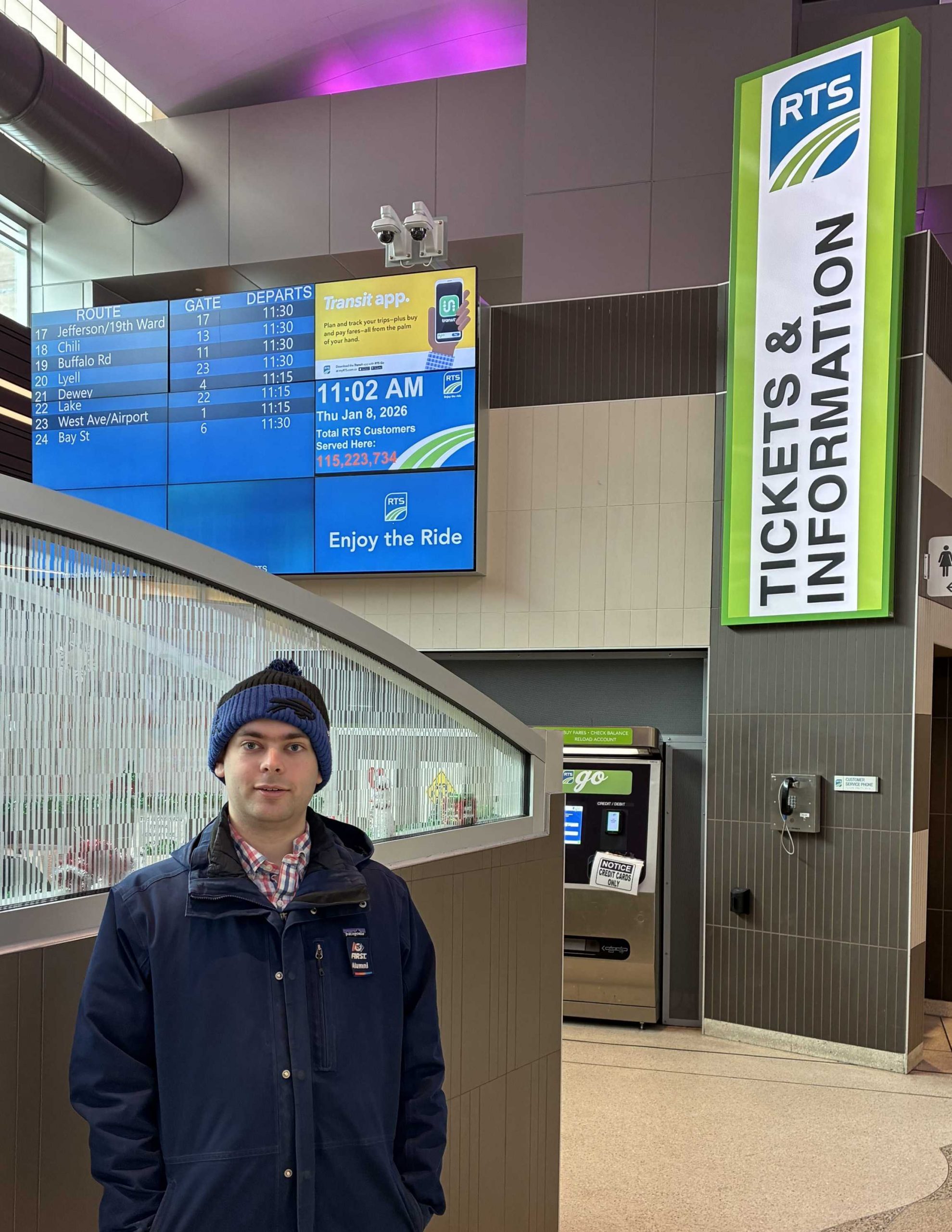
William
1. Did you grow up riding public transportation?


No, not until college where I used the Centro bus system in Utica NY. The campus I went to was a commuter campus so it was very car-focused. It had one bus stop and I would take that to get the train home. Before that I maybe used the bus in NYC once or twice visiting and maybe Boston as well.


2. What RTS service and routes do you use?


I started riding RTS around 2023 when I moved into an apartment in Rochester. I would often take it downtown to meet friends. I primarily ride routes 8 (E. Main) and 41 (Culver/Goodman Crosstown) which are both great. I haven’t had any problem with them. I don’t necessarily know if they followed the schedule because I just use the real time arrival tracking on the Transit app.


Yes I’ve used OnDemand, but I tend not to use it much because it just doesn’t work. It’s hard to book trips. When trips are booked I’ve been sitting at a location for 45 minutes before the driver showed up. I really can’t rely on using it to get to work. Also you cannot go from one zone into any adjacent area no matter how close they are. There’s no overlap. So if I want to go from Charlotte to Durand Eastman, I would have to go all the way to one of the connection hubs in Irondequoit. Now instead of it being a 5 min trip across the bridge to the location, it’s a 15-20 min drive across Irondequoit.


3. Do you own a car?


I do have a car but I wanted to try using the bus system here when I don’t have huge time restrictions. I ride RTS because I don’t want to drive. I don’t want to find parking. It’s definitely nice especially in the summer when I can combine it with my bike easily to not have to spend as much on gas money. Also I’m paying a minimum of $2,000 to own my car between maintenance and insurance. I would get rid of my car if I could reliably commute to work in less than 45 minutes.


I’ve taken my parents on the bus. Both times it was their first time ever riding the bus in Rochester. Mind you, they have both lived here for decades. Definitely the pains you come to expect between frequency and connections were there. Luckily we weren’t going too far; we were mostly going on the 8 (E. Main) to downtown and then out. But that was a neutral experience. The most recent time I went with my mother from my house, we left the car there and took the 8 to Eastman where we then walked to the Christmas market. We did end up taking a ride share back because we had just missed the bus and couldn’t wait 30 minutes for the next one.


4. How does RTS play a role in your day to day life?


My doctor’s appointments have a 5 minute window of arrival so I take the 41 (Culver/Goodman Crosstown) to the 40 (Ridge Crosstown) to go out to the Greece office and that works perfectly. It drops me right off in front and I make it to the appointment on time. If I have a strict time table then I choose to drive because I don’t want to be late.


I work at a U of R building on E River Rd. which is difficult to access from my location on RTS. There is a route close to the office but it doesn’t go to my building. It would probably be a 5 min walk but it would be down a busy street. It’s not exactly a low-stress environment to be walking there. So I take the 41 from Beechwood to College Town then I have to wait for the U of R bus to take me to my office. This makes transfers difficult because the different bus lines don’t sync their schedules. I can only take the U of R bus because I’m an employee so not everyone has this option.

5. How do you pay for RTS? 


I’ve been really happy since they introduced tap-to-pay. Before that I used the QR code scanning from the Transit app which I didn’t really like; it felt bulky and not very nice. Depending on your screen dimness or if my phone died, or the reader functionality it wouldn’t always work so I would always carry an RTS Go card on me connected to my account so it was the same balance.


6. What doesn’t work for you about RTS service, and what would you change?


Lack of bike capacity. Only being able to put two bicycles on the front of buses is quite a drawback. Last summer I biked to Brockport, which turns out is quite far, so I biked back to Greece before I decided to take a bus home since I was tired. The bus had two bikes on it so I just had to bike the rest of the way home.


A similar thing happened to another rider who I saw taking the number 7 out to Webster. I had just put my bike on the bus so now there were two and it was full. At the next stop was another person who couldn’t get on because they had a bike. They worked at the Walmart in Baytown. They now had to ride their bike down Empire Blvd. to get to their job. Unfortunately the other person who put their bike on got off at the last stop before going down that hill on Empire. It’s not a great place to ride.


There is a bus stop on the Empire hill on the Webster side. I don’t even think it should be allowed but the outgoing bus stop on the uphill section there you get thrown on the shoulder and then you have to cross 5 lanes of traffic to get to that housing development. I’ve talked to some people who will take the bus out to the end of the line and all the way back because they feel so unsafe getting off at the other side of the road.


7. What works for you about RTS service?


The reliability of RTS Connect is amazing. I can rely on it being there on the times when it says it’s there. I haven’t experienced much cancellation, really just one or two times. Knowing that I can take the bus when I want to is great.


8. What are your thoughts on bus amenities? 


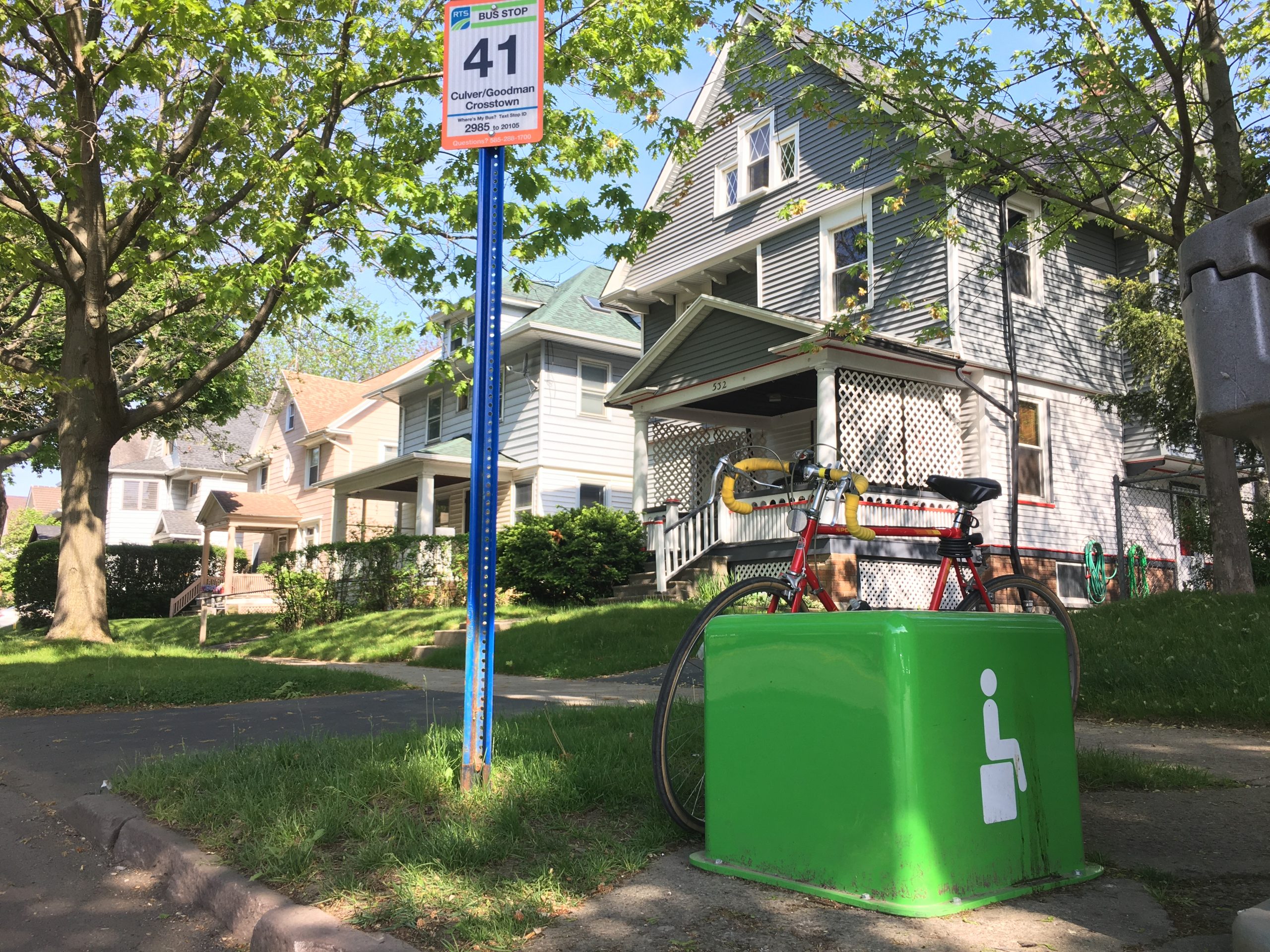
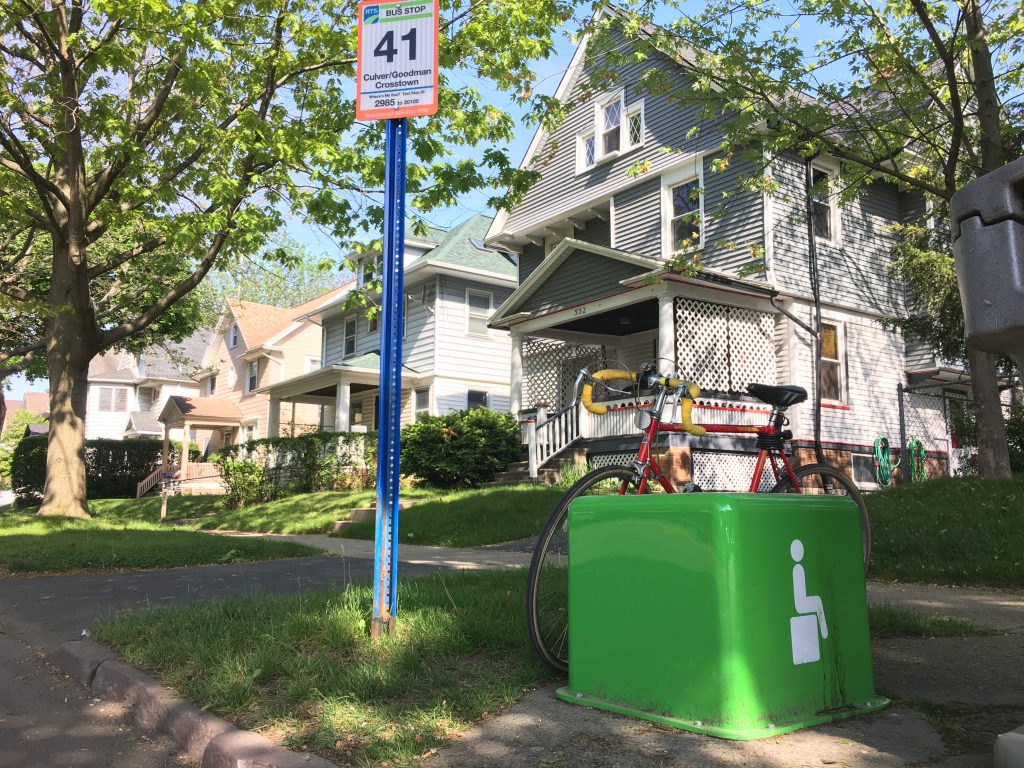
I wish there were more shelters. Also maybe some actual benches. The cube things are nice but they aren’t the most comfortable thing in the world. Plus they like to collect water. Over time people sit on them and they slowly deform. When it rains water pools on the cubes. It’s not great.


Another thing is the curb to the sidewalk could be better. I took the bus out to Brighton on Monroe Ave and the bus stop was right in a bush. Someone had planted something between the sidewalk and the curb and it looked really nice but the bus stop is there and I had to walk through it. I feel bad ruining someone’s garden.


I will say there are some very nice bus stops along Monroe Ave. in Brighton. They have a full shelter and a bench, not the standard RTS shelter, it’s more artsy. Then they had a full surface material like asphalt or reclaimed rubber between the curb and the sidewalk which was nice.

9. What is your hope for the future for public transportation in Rochester?


I really want to see higher frequencies. The network in my opinion has very good coverage but frequencies leave something to be desired. I’d also like to see more crosstown routes. The 41 (Culver/Goodman Crosstown) crosses University, East Ave and Park but it’s very difficult to transfer between 41 and one of those main routes unless you’re at the end point.


So there’s a 50 (Fairport/Penfield) out to Fairport that doesn’t connect to the 8 (E. Main). There’s a transfer point at Blossom which connects the 50 to the 9 (University) and the 10 (Park) but the 8 is a high frequency route that doesn’t connect with anything at the end. So if I want to go to Fairport, I either have to take the 8 to Winton then bike to the Blossom transfer or go all the way in to the Transit Center. It’s a lot of work so I’d love to see some kind of crosstown route that connects these routes.

Madeleine
1. Did you grow up riding public transportation?


I’m from Amherst and yes I did but pretty rarely. Those buses have a similar vibe to Rochester where they’re not terribly frequent and I lived farther away from a hub. I just had the B43 line that took you to North Hampton and I did take that on occasion. But once I got a car it was easier and faster.


2. What RTS service and routes do you use?


I ride RTS most days. Most everywhere except work because I work at U of R and there isn’t really a bus that [connects] from my [RTS Connect bus line]. The shuttle isn’t very convenient and I never know if they’re coming or not.


I take the 13 (South Ave) most frequently. Sometimes the 12 (S. Clinton) to get to Brighton. The 14 (Marketplace) to the Wegmans in Henrietta.  It was super convenient when I lived between the 13 and the 14. Essentially I had a 15 minute bus window to get downtown.


The 41 (Culver/Goodman Crosstown) is probably my second most-used line. It’s really efficient to get to Park Ave or East or University. You’ve got the Little Theatre, Red Fern, Stevers…that whole area.

3. Do you own a car?


My fiance and I collectively own one car. We got that car for free and we’re trying to use it as long as possible. We don’t want to pay for a new car and be on credit. Most of my friends who have cars are paying them off with a lot of money per month. We also both like being more ecologically responsible.


4. How does RTS play a role in your day to day life?


I use it for groceries, work, doctors appointments… I’ll use the 14 (Marketplace) or 41 (Culver/Goodman Crosstown) to go to Wegmans. Sometimes bigger bulk items make it difficult. I have a cart that I use but it can be unwieldy.


The 12 (S. Clinton) is best for my errands. It goes to my doctor, my dermatologist, and my dentist because they’re all in a line over there. Also my tailor which is in the strip mall where the Tops is.


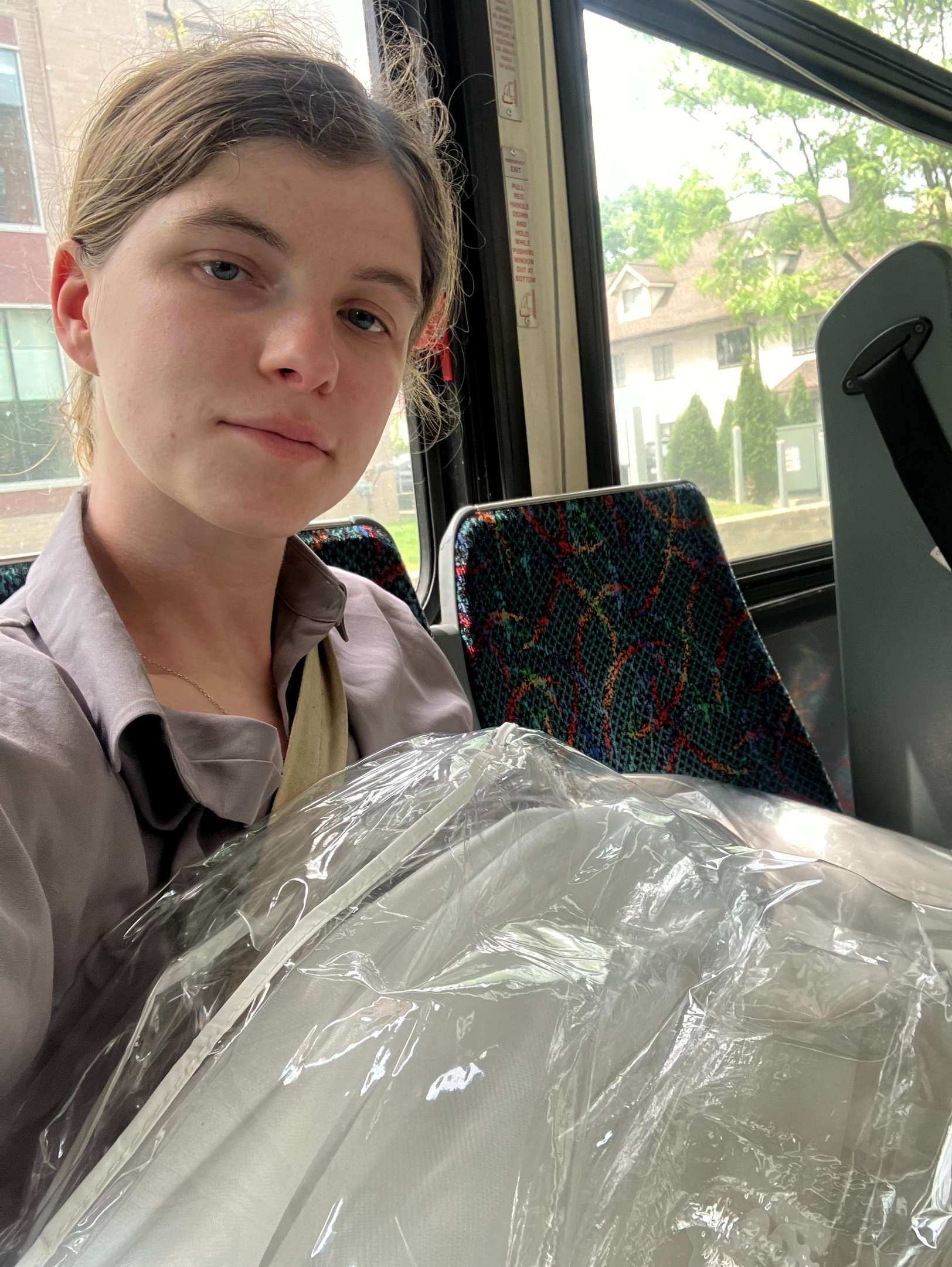
I took the 41 to get my wedding dress in a store that was there called Scarlet Bridal. It’s not there anymore. I took it home on the bus sitting in one of the seats holding it above my head so it didn’t trail on the floor.


5. How do you pay for RTS? 


I pay with my work [University of Rochester] ID because I have a U-pass (a universal pass that employers pay RTS for). [Before having a U-pass], I mostly paid with the app. I tried cash but it’s a pain.


6. What doesn’t work for you about RTS service, and what would you change?


The two biggest things that I would change are frequency and we need another crosstown line. Preferably more than one. Being near the 41 (Culver/Goodman Crosstown) has been such a game changer in convenience. It’s helped me avoid so many transfers or trips to the transit center.


It can be hard planning out all the details. It would be incredible to have regular buses every 10 minutes. Even 15 minutes would be great. Then you wouldn’t have to plan because you know another bus is close by. A lot of RTS routes only run every hour after a certain time. It’s difficult planning on weekends because it’s an hour wait. Imagine missing that bus.


If I’m taking a 20 minute bus ride and a 5 min walk, the difference between that and a 15 min car ride is negligible. But if it’s a 10 min car ride versus a 50 min bus ride with two transfers…then I get why people don’t want to choose the bus.


7. What works for you about RTS service?


I get to read on the bus which is great. I can mend a shirt. You can do stuff on a bus. So what if it takes 45 minutes to get there? If you get in a car for 20 minutes there’s nothing to do. Also I hate parking so much. Looking for it or paying for it. When we go to The Little Theatre or the Dryden, if we get on the bus we’re dropped off right there.


Also we have better conversations on the bus. In the car the driver is distracted while focusing on not crashing the car. I was getting on [the bus] the other day and I ran into a friend I hadn’t seen in a long time and I met his girlfriend.


8. What are your thoughts on bus amenities? 


Yeah most of the bus stops that I use most commonly have neither seating nor shelters. I think honestly probably seating is the bigger deal especially if it’s 60 minute service. I like Reconnect Rochester’s bus cubes.

9. What is your hope for the future for public transportation in Rochester?


I hope I can get people to use it more. I use it to get to most places. Our car was in the body shop for a month and a half last November. We were still able to get 95% of the places. We never had to use an Uber.


I just want more people to try transit! I want more people to see it as a valid option.

Chrissy
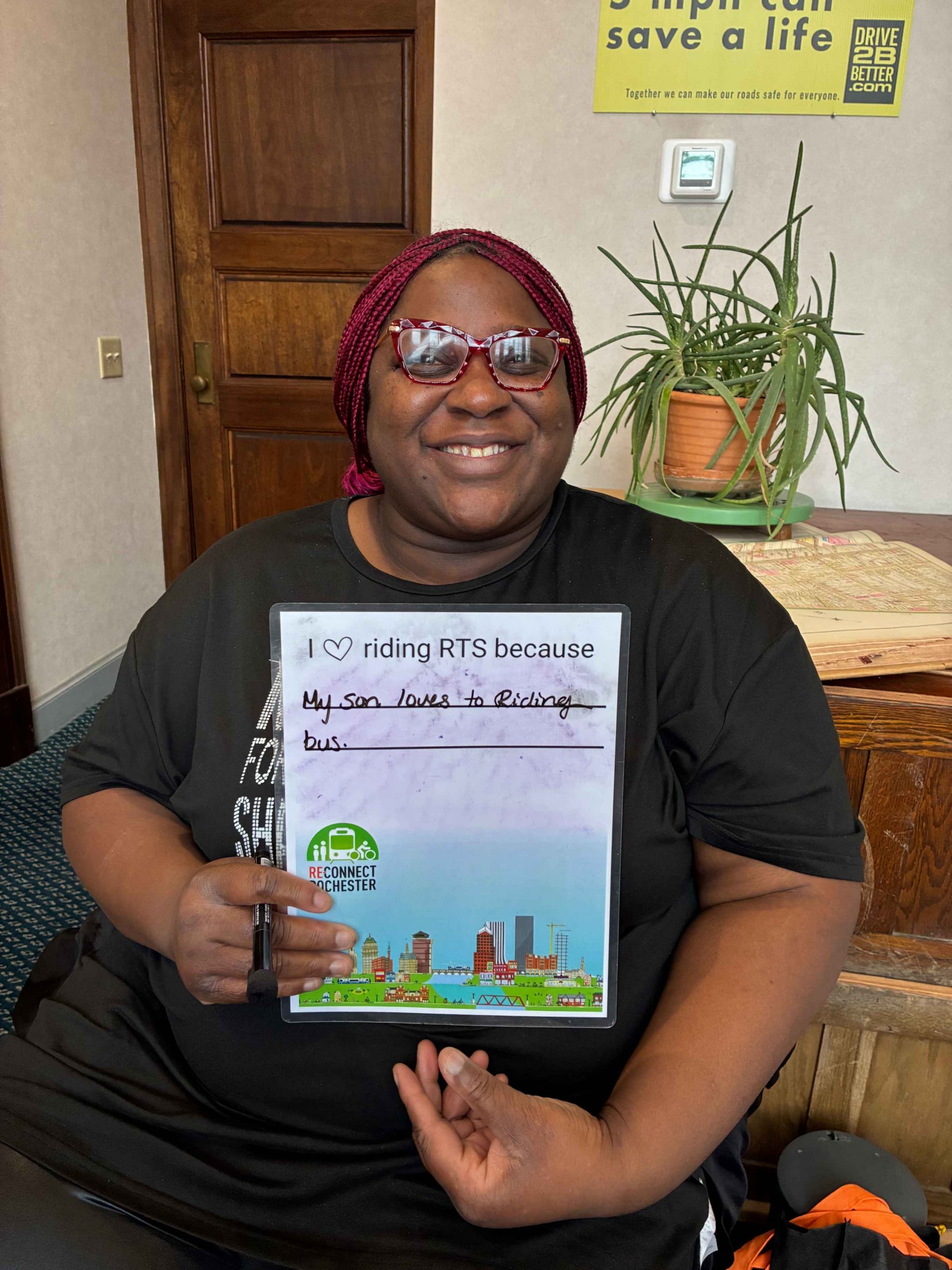
1. What RTS service and routes do you use?


I ride the 16 (Genesee), the 21 (Dewey), the 4 (Hudson), the 20 (Lyell) and the 1 (St. Paul).


OnDemand doesn’t work. If we’re trying to go to Victor or East Rochester, we have to travel so far and take 2-3 buses. Then after that we have to meet an Onemand bus? How do we schedule that? Why not just have buses run all the way out there? People from the suburbs need to come into the city and OnDemand doesn’t make sense to get them there. Anywhere people need to go should not be a struggle to get to.


2. Do you own a car?


No.


3. How does RTS play a role in your day to day life?


I take it to doctors appointments, for errands. I also take it to go to meetings for my kids’ school which is challenging because the superintendent hosts meetings at different schools and some of them aren’t accessible by RTS.


4. What doesn’t work for you about RTS service, and what would you change?


There are places the buses just won’t go and that’s challenging. They’re also discontinuing some of their stops which they should not be doing. Especially near some of the schools which is especially hard for parents.


Crowded buses are not cool. People have to stand up and that’s not right or there’s no room for wheelchairs or parents with strollers. We need better access for them. I understand there is a designated area but it needs to be better so parents can sit up front with their strollers without issue.


Also they need to stop shutting down the bathrooms at the transit center when something goes wrong. You should not shut down the bathrooms.

5. What works for you about RTS service?


I really like some of the operators who make us smile. When we say, “Good morning,” they’ll say it back. They’re willing to help us if we need. We have some really good operators out there willing to do their job. I like that.


6. What are your thoughts on bus amenities? 


It’s winter now and it’s so hard for everyone when bus stops aren’t shoveled out. Wheelchairs have to go on the side of the street and just sit there. It’s also not safe for people with walkers or canes or kids who have to walk on the side of the street since the sidewalk is not shoveled. The city needs to make that better. It doesn’t make any sense.


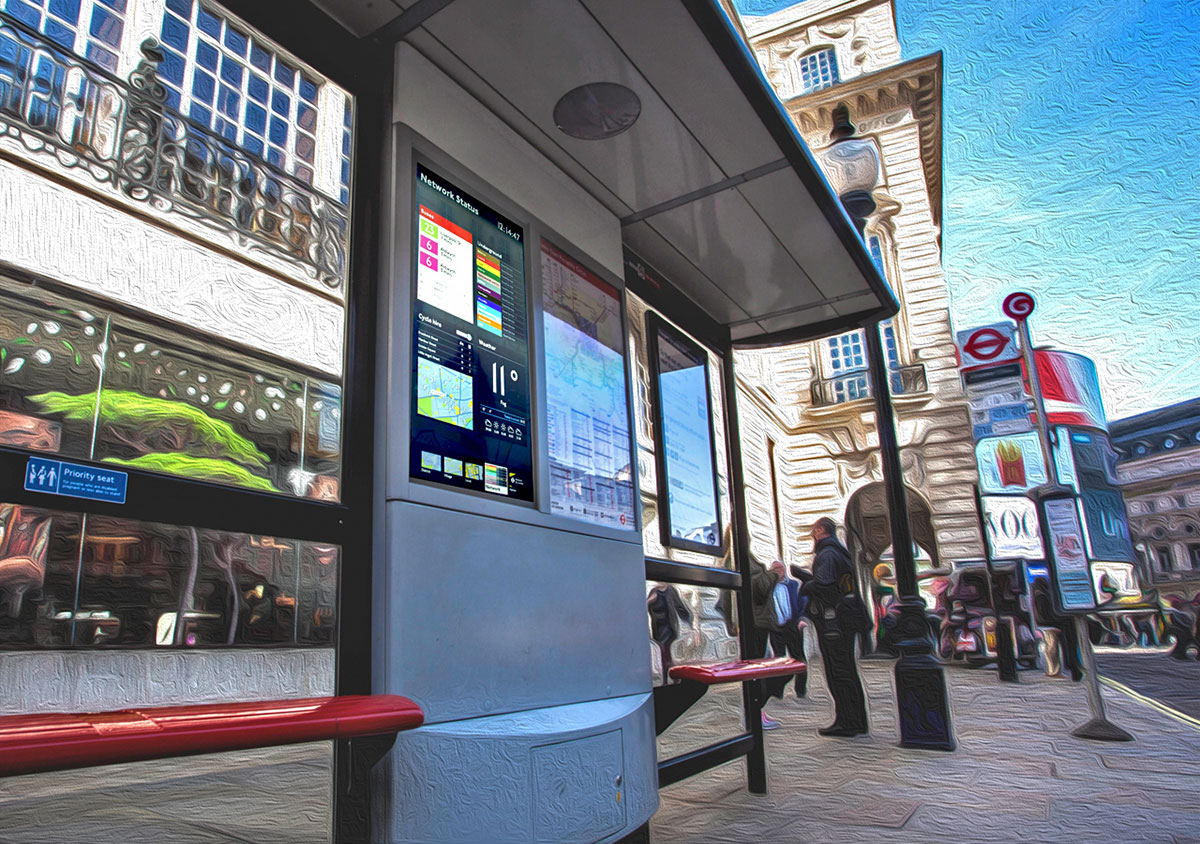
We need shelters. So many stops don’t have them. We need something to keep people warm especially when it’s cold out or when it rains. At the hospital they have a timer showing when the bus is coming. I’d like to see that at all the shelters. If the bus is running late they can let us know.


Some stops have the little square things (bus stop cubes) but a lot of people from the neighborhood just hang out on them and don’t get up for riders. So we need more seating all over.

7. What is your hope for the future for public transportation in Rochester?


We need it in our city, we need it in our suburbs. We need it all over. To help everyone. When you have single mothers, single dads, single grandparents without cars who don’t have money and they’re missing appointments or they can’t take their kids to school when they miss the school bus. They deserve better.


I’m asking and begging to get more help for RTS. For families that keep being denied RTS Access [RTS service for physically disabled]. My health is not great and I have a hard time going back and forth to bus stops. And going back and forth to my doctors. Make sure RTS works for everybody.

Zach
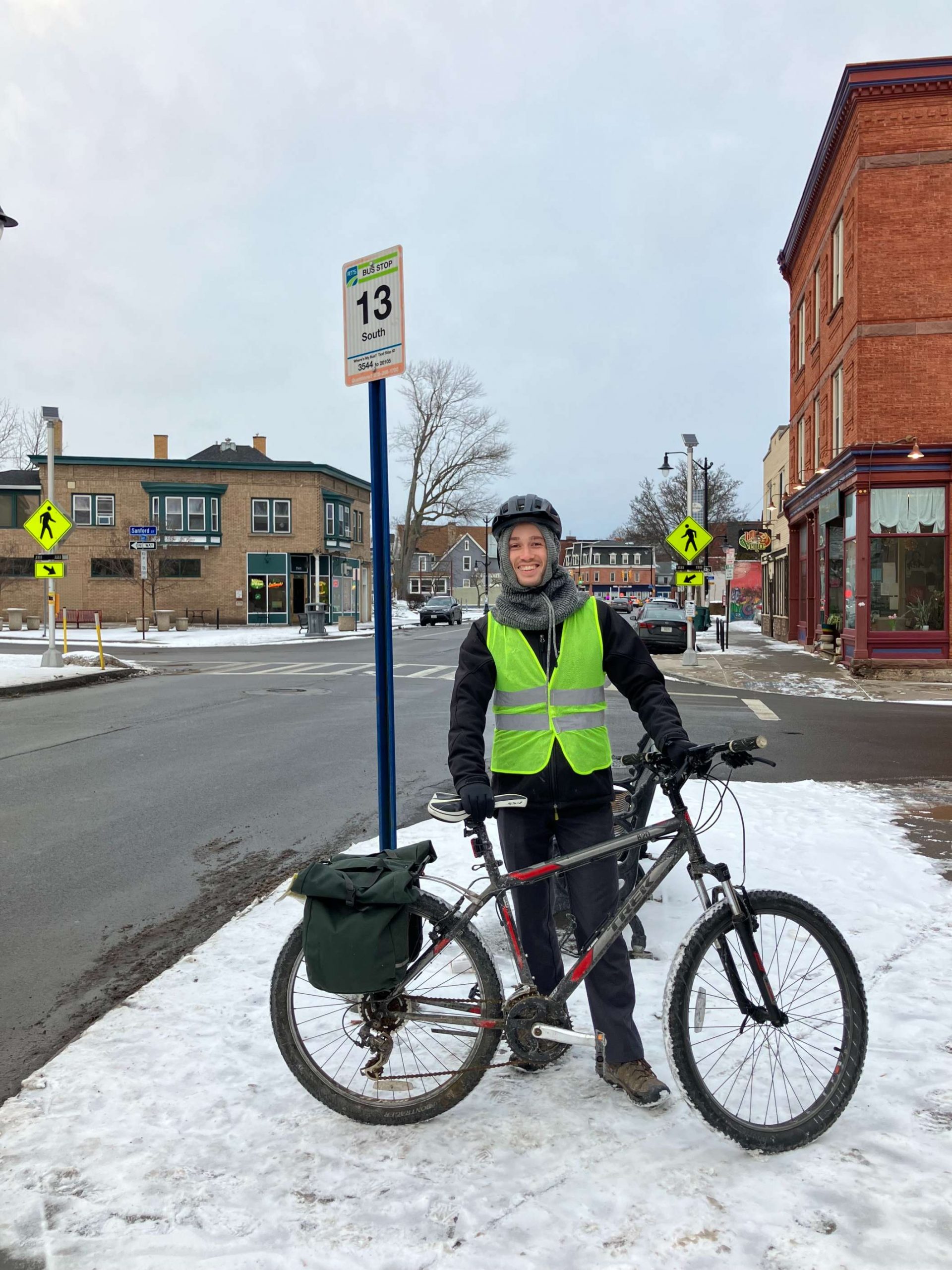
1. Did you grow up riding public transportation?


Not often. I grew up in a suburb with a couple bus lines in the town but I didn’t ride the city buses until I moved to Rochester for college. I started riding RTS to get to places I couldn’t get to by walking or biking. This way I didn’t have to bum a ride off a friend or get an Uber.


2. What RTS service and routes do you use?


On average I take it every other day but it’s weather dependent. I’ll bike when the weather works but when there’s three feet of snow on the ground or it’s raining, I’ll take the bus.


I ride the 13 (South Ave), the 4 (Hudson), the 41 (Culver/Goodman Crosstown), the 12 (S. Clinton), or the 14 (Marketplace). I’ll occasionally take 11 (Monroe) to the Pittsford Plaza area.


I have not ridden OnDemand.


3. Do you own a car?


I share a car and we don’t want to have to get a second car because of the financial burden. RTS allows us to make the most of our every day trips without having to use the car.


4. How does RTS play a role in your day to day life?


A big role. Especially in the winter. I use it to get to work. I also take it to get to other activities, to restaurants or stores…lots of places.


For my previous job, I took the 13 (South Ave). The office was downtown so I’d walk from the transit center. Now I have a longer bus ride in the morning. But it gives me time to sit on the bus and now I’ve been reading more books. It’s something I did a lot when I was kid in elementary and middle school and riding the bus has given me an opportunity to get back into that. I find that valuable.


5. How do you pay for RTS? 


I use the Transit app. I add funds to my account and scan the QR code. I find it to be pretty easy for route finding and tracking the bus.


6. What doesn’t work for you about RTS service, and what would you change?


For the most part I’m happy with the routes but I would like it if there were more crosstown buses. Specifically there is nothing to cross the Ford St. bridge which is a significant gap between Elmwood and downtown. Also along Winton Rd. running parallel to the 41 (Culver/Goodman Crosstown). I could see that to allow connection to the Twelve Corners Plaza and to North Winton Village.


Honestly, the biggest thing I would want to change is frequency. That is the biggest barrier that prevents me from riding RTS more often. For instance, I’m taking a flight tomorrow and it’s an 18 min drive but over an hour on RTS. If there were more lines that would enable a lot more people to see it as a better option.


Also having frequency cut in half after 6 or 7pm is a big issue for me. I would like to be able to go places conveniently in the evening. If I’m out to dinner and I miss the bus by a few minutes, I have to wait over an hour for the next one.


7. What works for you about RTS service?


The buses themselves are really pleasant to ride. I almost never have an issue getting on to the bus or finding a seat. You could say that that’s a downside since it shows how the ridership could be higher. But the buses themselves are comfortable. The operators are by and large quite nice.


Since I’ve been commuting on the bus more recently I’ve been getting to know the people on my route. I’ve built some of those acquaintances. The environment encourages that sort of thing.


I find biking part of the way then putting my bike on the bus really helps me get anywhere. I can bike to work one way and take a bus to go home if it’s raining or something. Or if I want to reach a destination that is not on a bus line, I can bring my bike to avoid a lengthy walk to get there. It’s a really powerful combination especially at night when RTS is less frequent.


8. What are your thoughts on bus amenities? 


My bus stop has a bench. It’s on a sidewalk with a nice curb which works for me. However there is a wheelchair user at my stop and even though there is a curb cut, when it’s snowy and they don’t plow the sidewalks it’s an issue. When RTS puts out the ramp it goes on the snow and she has to roll over the snow. Some better winter maintenance on the pads and bus stops is important. Also making sure each bus stop has those concrete pads so people can get on the bus without having to walk through the mud and snow.

9. What is your hope for the future for public transportation in Rochester?


I would be thrilled if we had some kind of light rail at some point. We used to have the subway here. I think that’s a relic of a time when public transportation was seen as the first choice and I think that we should work to go back to that.

JP
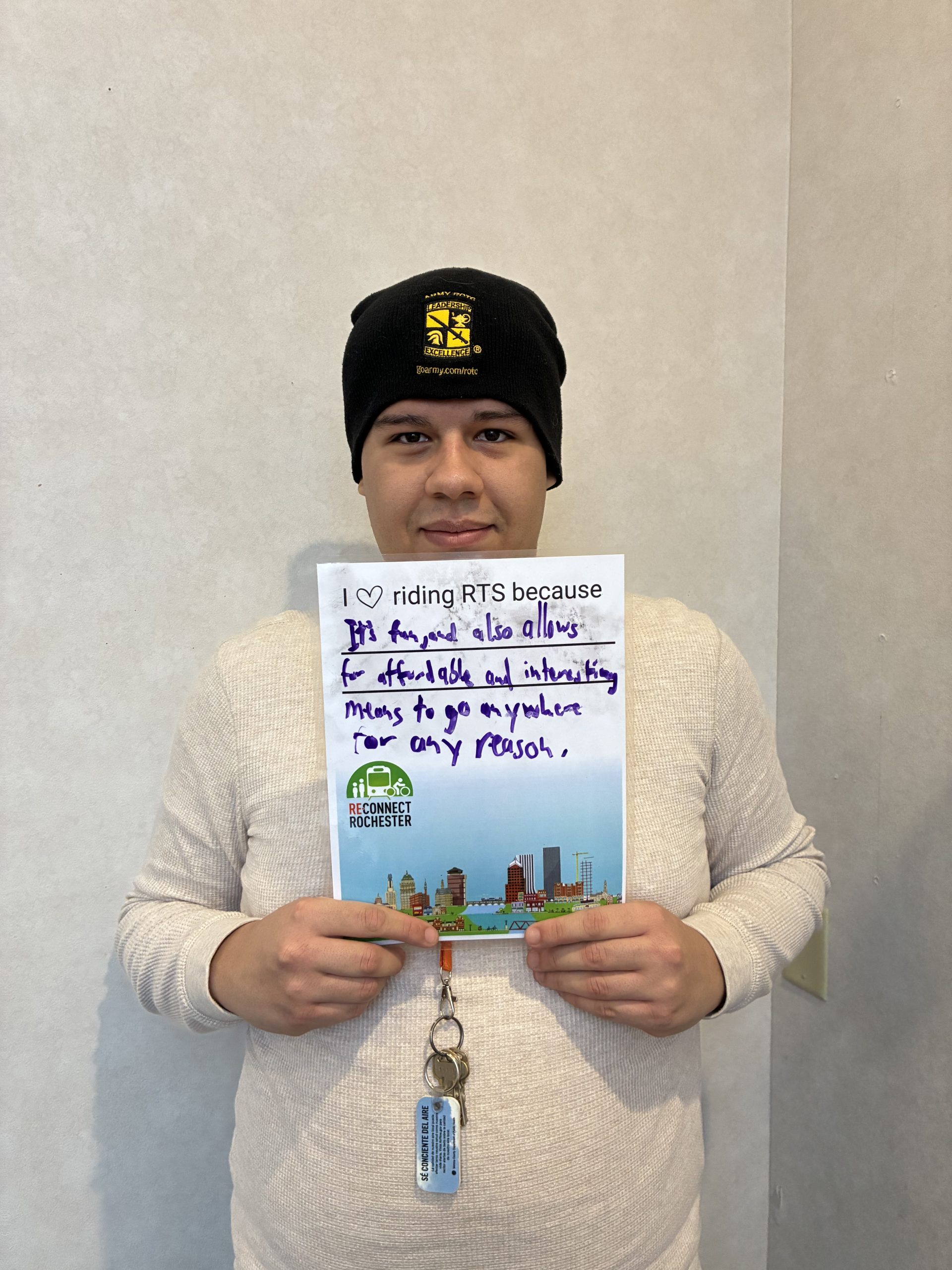
1. Did you grow up riding public transportation?


I was born in NYC and I rode transit a lot. When I moved here I realized how much I missed the transit there. I wouldn’t say RTS is terrible they just need more orbital or cross town routes.


When I was in high school back in 2021, the yellow school buses for RCSD had a huge driver shortage. We were stranded until RTS had to step in and help students get to school. This resulted in resource shortage for RTS where only four of the eight frequent routes are running every 15 minutes. My school happened to be one of those schools briefly until they got one of those yellow bus operators for us. This snowballed into me riding RTS. That same school year I attended after school programs and would take RTS fixed routes from school to home. I’ve been a frequent rider ever since.


2. What RTS service and routes do you use?


I basically live on the 6 (N Goodman) though if I miss it I use the 5 (Portland) to get home albeit with a longer walk. I take the 13  (South Ave) for school. To get home, the 41 (Culver/Goodman Crosstown) takes the throne and the 2 (N. Clinton) as well. The other routes are just for exploration.


I don’t use OnDemand though the fare increase did annoy me somewhat. People rely on this. By increasing it to $3 it may turn away some people who can’t afford it or they may decide a car is better. With fixed routes you can just show up at a stop and go which is better.


3. Do you own a car?


No. I bike as well but that’s it.


4.  How does RTS play a role in your day to day life?


I use it mostly for school during the day. In the evenings after 6pm the headways get way worse. But it’s a decent experience.


5. What doesn’t work for you about RTS service, and what would you change?


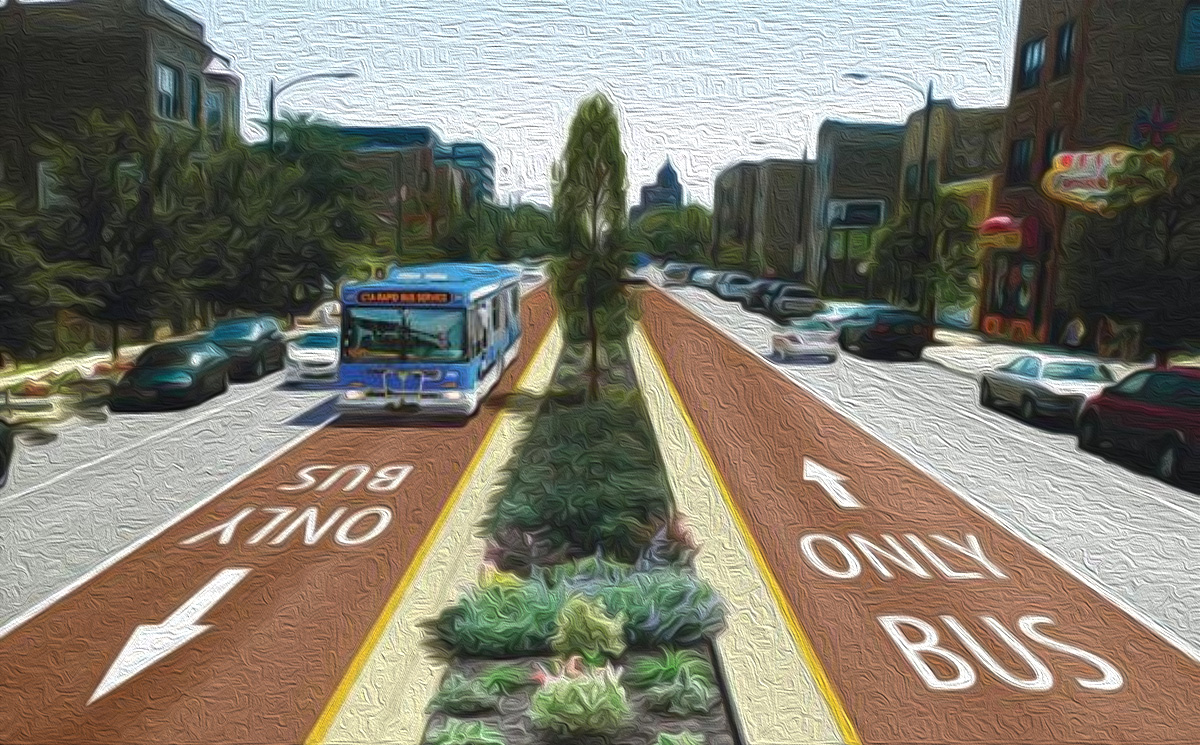
Controversially, I would convert some of Main St. into a bus-exclusive street at least in the downtown area. It is the busiest corridor. I would like to see transit signal priority as well, especially at the transit center, so the buses don’t have to wait so long to get out of there. Transit signal priority is when a bus arrives at an intersection the signals detect the bus is there and turn green sooner or remain green if it’s about to turn red.


I also don’t like how the routes feel a bit more “suburban-y” with big parking lots and big houses and not even a curb for bus riders to use when getting off.


6.  What works for you about RTS service?


It’s a nice way to get to know the city. On weekends I’ll head to the transit center and ride a random route. Recently I took the 23 (West Ave/Airport) to the airport to see how it would work. I just like public transit in general as a service and I definitely would like to see it funded more.


Since I’m an MCC student, I can ride for free. I can save money for things that are more important like equipment for college or other things.


7. What are your thoughts on bus amenities?


A countdown clock like what Chicago has with their ink paper displays could be helpful. Also some bus stops are way too close together. Merging them would help those on board so we can all go quicker.


8. What is your hope for the future for public transportation in Rochester?


I want more frequency but all things considered they do a decent job of providing a service for what I need. Though I’d definitely like to see more routes. If I’m pushing it, I’d like more suburban routes with double decker buses. As controversial as it sounds, we can use highways for public transit corridors. We can connect people in the city with those in the suburbs. Maybe once we have higher ridership, we can introduce a light rail to connect the city from one line to another.

Reconnect Rochester would like to thank all of the RTS riders for the time and effort they’ve dedicated to our community, and for taking the time to answer our questions. We are proud to elevate these voices and ask for the funding RTS needs to expand service.
by 1 Comment

Lake Avenue Bus Rapid Transit: A Catalyst for Safety and Transit-Oriented Development

UPDATE as of May 2025: Thanks to the efforts of Senate Transportation Chair Jeremy Cooney, the New York State Budget secured $250K for RTS to study a bus rapid transit corridor on Lake Avenue, which would lead to lower wait times and more frequent routes on one of the busiest RTS routes. This is also in alignment with the ROC Vision Zero plan! 

In June 2024, Rochester Mayor Malik Evans announced the ROC Vision Zero Initiative to eliminate traffic fatalities and serious injuries on the city’s streets. Among the 10 priority actions announced was an effort to tackle Lake Avenue, one of Rochester’s most dangerous streets. The plan calls for making Lake Avenue a multimodal safety corridor equipped with a “Bus Rapid Transit” line or BRT for short. What is a BRT and why would a fast-moving bus lane make Lake Avenue a street safer? 🤔

BRT is a high-quality-bus-based transit system that delivers fast, efficient and frequent service along a corridor by implementing dedicated bus-only lanes, signal priority, bus stations with off board fare collection and elevated platforms. The City’s proposal is in early days, so we don’t have anything specific to react to, but we do hope they’ll go for the BRT Gold Standard. Gold standard BRT also includes designing for universal access for people of all abilities and pedestrian access and safety on the street. We should strive for the best and avoid what advocates have termed “BRT Creep”, when elements of good BRT are removed to save on costs and the line becomes unrecognizable from a standard frequent service line. This will take a healthy mix of up-front capital investments (to build out the infrastructure) matched with operational dollars that keep the service running frequently (for more on operating funds, see our February letter to Governor Hochul).

Only a few systems across the US have achieved bronze or better including Albuquerque’s ABQ RIDE (Gold), Clevland’s Healthline (Silver), and Pittsburgh’s Dr. Martin Luther King Jr. East Busway (Bronze). More locally, Albany’s Capital District Transportation Association has upped their BRT game with 3 BRT lines connecting Albany, Schenectady and Troy. Our friend the Urban Phoenix had a lot of good things to say about his experience using the system. Recently, a big step forward for Buffalo’s east side is the proposed Bailey Avenue BRT treatment, a 7.5 mile corridor connecting the City’s south side to north side destinations and the metro rail. 

We could see our BRT line going from the Transit Center all the way to Lake Ontario, about 8 miles. Rochester’s initiative on Lake Avenue wouldn’t just add a BRT line to the existing street. It would redesign the street to enhance and advance multi-modal safety. BRT would be a component in a design that would enhance pedestrian and bicycle facilities while improving access to the transit system. While we don’t have formal designs yet, the National Association of City Transportation Officials (NACTO) thinks it could look something like this:

Courtesy of NACTO https://nacto.org/publication/urban-street-design-guide/street-design-elements/transit-streets/dedicated-median-bus-lanes/ 

Planners often frame BRT as a potential catalyst transit project and on this one, we agree. BRT can offer Rochester a unique opportunity to connect Edgerton, Maplewood and Downtown with faster and more efficient bus service, and provide opportunities to invest in more transit-oriented development along the corridor. Basically, that means dense, walkable, mixed-use development near the bus stops that adds amenities closer to where people live and use the bus. 

Currently, the City of Rochester is building a transit-oriented development in the Bull’s Head area where West Main St. meets Genesee St., Brown St. and Chili Ave. Local credit union ESL committed to being the first tenant in the redevelopment, bringing back banking services to the 19th Ward for the first time in a decade.

The City of Rochester identified Lake Avenue as a top transit-oriented development (TOD) corridor opportunity in the 2018 Transit Supportive Corridors Study. While improving transportation is a core goal, BRT on Lake Avenue goes beyond simply moving people. It’s a strategic investment with a ripple effect of positive outcomes:

  • Economic Development & Housing: BRT is a proven catalyst for transit-oriented development (TOD). By providing faster, more reliable service, it attracts businesses, housing, and services to the corridor. This is especially promising near underutilized parking areas around Kodak/Eastman Business Park, where BRT could spur valuable development and create a mixed-use hub.
  • Activating a Key Corridor: BRT will amplify Lake Ave’s potential, transforming the corridor into a thriving destination with increased foot traffic and economic activity.
  • Addressing Safety Concerns: The current state of Lake Avenue presents a barrier and many safety risks for residents accessing the Genesee River and other destinations. BRT will prioritize safety improvements for pedestrians, cyclists, and drivers, making the corridor safer and more inviting for everyone.
  • A Stepping Stone to the Future: BRT is not an endpoint but a stepping stone. The infrastructure built for BRT can serve as the foundation for future transit options like streetcars or light rail. This approach allows Rochester to incrementally build towards a more robust and interconnected transit network.

Safety, better transit options, economic stimulus. What’s not to like about BRT? Detractors in some places have promulgated fears that adding dedicated bus lines would create car congestion. As with most multimodal improvements, the opposite is shown to happen: Studies have consistently shown that BRT does not worsen traffic; in fact, it often improves traffic flow by prioritizing efficient transit and encouraging more people to leave their cars at home. The current levels of congestion on Lake Avenue is primarily limited to peak commute hours, and BRT will help alleviate this by providing a reliable alternative for commuters.

What’s it going to take to launch the BRT planning process? Well, RTS has gotten things off to a good start by announcing last September that the 22 Lake Ave line is getting restored to 15 minute service as was envisioned in Reimagine RTS. The next step is to get a study underway to scope the project. Lake Avenue BRT represents a transformative opportunity for Rochester. It’s a chance to create a more connected, equitable, and sustainable city – one where everyone has access to opportunity and a vibrant public realm.


At Reconnect, we’re always working to improve mobility access in our community. Sign up for Mobility Action Alerts for tangible advocacy and volunteer opportunities involving transportation, safe streets, and bike infrastructure. 

by No Comments

Voices of Transit 2025

Reconnect Rochester presents Voices of Transit, an ethnography profile blog series that shows how our current bus system helps (and sometimes hurts) transit-dependent riders in their daily lives. In the winter of 2024-2025 we interviewed RTS riders to hear about their experiences firsthand. Read more about how the initiative began in 2023 here.

Click on a name below to hear that rider’s story. You can also watch some of their interviews on YouTube!

Sasha


1. Are you a Rochester native? If not, what brought you to Rochester?

I came to Rochester in 2008. My friend lived here and she invited me to visit and I am still here.


2. Are there any big differences you’ve noticed between RTS and other public transportation infrastructure?

I grew up in New York City and Rochester was quite an adjustment. But both transportation systems have improved a lot.

In NYC the buses are a lot more frequent. There are more routes. There are more points of connection so there are lots of ways to get where you want to go regardless of where you cut through. And I think that’s the biggest difference I saw.


3. Do you use the RTS OnDemand service?

I have recently started using the RTS OnDemand service. For the most part it’s worked. But I have had some times where they did not have enough buses and so a couple of times they had to call and cancel at the last minute.

I think it’s a great service and it really saved me a lot of money. Before OnDemand I had to find alternate means like Lyft to get places like Pittsford which gets very expensive.

The app can be tricky booking a round trip if I’m not going to the same destination that I left but there’s a support number that you can call in and have the people at RTS book the trip for me. It’s good knowing that service does exist for people who need it.


4. Do you own a car?

I don’t own a vehicle. Even thinking about the cost and everything else, RTS is just better for my life.


5. What do you like about RTS? What works for you?

The operators are great. They are very kind and helpful.

I also love the Transit app where you can track the buses in real time. That works really great. Then I only have to wait a couple minutes before the bus gets there so I’m not waiting in the cold during the winter. I like paying with the app so you’re not scrambling looking for change.

I’ve traveled to quite a few places and this is the most affordable transportation I’ve ever seen. In NYC it’s more than 3 times the cost.


6. What don’t you like about RTS? What doesn’t work for you? What would you change?

Culver is one of the major streets that runs through Rochester. Why isn’t there a direct route up and down Culver? My one hour commute would be cut to 20 minutes if that was the case.

I would love more frequent services. I think it’s kinda tricky because unless you get more people, you can’t really pay for it. But unless you do it you’re not gonna get more people.

Or instead of adding an additional bus per hour, they should try to work out the schedules so that the connections are better. So when I’m transferring from one bus to another I’m not waiting half an hour for the next bus.


7. How has riding RTS impacted your life?

How we go grocery shopping and when we do it is based on the scheduling is determined by the transportation that’s available. It also determines where we go out or exercise because if there’s not an accessible route to the gym you have to find somewhere else.

For jobs I’ve had to think, am I going to work there? Is it worth it? Is it going to be worth it at the end of the day paying for a personal vehicle?

I definitely change how I commute in the winter. I don’t necessarily have to go to the RTS Transit Center but in the middle of the winter I’m definitely going to there because I’m not waiting outside in 10 degrees for the next bus.


8. What are your thoughts on bus amenities? 

They have varieties of bus shelters. Downtown they have stops with multiple seats and they are enclosed with heating. I would love to see more of that. At least more of the overhead shelters like they have in Brighton. If I’m waiting 20-30 minutes in between buses I would like something to account for the elements. Some type of shelter even if it’s not heated would be helpful.


9. What is your hope for the future for public transportation in Rochester?

Public transit has been a good service to me. My hope would be that we develop it to a place where people who want to do so can take public transportation. Especially if it’s economically convenient. I thought it was an opportunity when we had those super high gas prices. I was really hoping we would jump on that. There are people who it was a pain point for them and there are people who would have definitely given public transportation a try if they saw it as a benefit. But even then I don’t think numbers went up because I don’t believe that people saw it as convenient. It’s not just about cost, it’s about what works for their lives. So my hope is that we develop a system where the people who want to, are able to use the public transportation system that we have.

Trudy


1. Are you a Rochester native? If not, what brought you to Rochester?

I was born in Geneva, but raised in Canandaigua. I moved to Rochester in 2023 because of the people and the community. I’ve met some wonderful people here.


2. Are there any big differences you’ve noticed between Rochester’s and other public transportation infrastructure?

Canandaigua needs help. Their buses stop really early so if you’re out at night you could not get any transportation and living in the country you need transportation.


3. Do you use the RTS OnDemand service?

Yes. It’s a good system. One good thing about that is they check up on you. You call, you make the appointment and they call to verify it and then when you’re actually waiting for the bus, they let you know how close it is so you don’t miss it.

I’m grateful that they have it because that’s how I get to Canandaigua. I go to St John Fisher, and from St J Fisher I take an RTS OnDemand bus to Eastview mall. From there I take a bus to the race track. And from the race track I take another bus to Canandaigua.

I just wish we had more of them where we could accommodate more people. I know a lot of people who take them for work. So sometimes you may have to go to work an hour earlier because they can’t schedule you in. They also need more OnDemand buses to help with the people out in the suburbs. I have a lot of trouble getting to my church in West Henrietta.


4. How do you pay for RTS? Cash? Transit App? RTS Go Card?

I like the RTS Go Card. You don’t have to worry about fumbling around with money; I download money on my card and that way I can monitor how many rides I have and what I’m doing so I can budget it out for the month. I’m also glad that they have discounts for senior citizens.

I don’t use the Transit app. I’m not very good with doing stuff on the internet and stuff like that. That’s why I always call the RTS Customer Service when I have questions.


5. Do you own a car?

I did but I gave it to my daughter who lives in Farmington, NY when she had to walk home 13 miles from work one day. I don’t miss it because Rochester has reliable transportation. I can depend on RTS.


6. Did you grow up riding public transportation? Or did you start riding transit as an adult?

Growing up in Canandaigua I always just rode in cars or a taxi. After that I lived in NYC for years so I am used to public transportation. It has been a major part of my adult life. Even though I’ve owned vehicles, I am definitely used to relying on transit.


7. What do you like about RTS? What works for you?

Those people on University, bus number 9, are very good on that route. Most RTS routes they are. I can depend on the #9, so once I start working again I know I can get to work on time. I love that you can call and they will tell you when the bus is coming.

Overall, we have some really good bus operators. Most of them are very nice, courteous.

I’m glad that RTS does run really late. I used to work at Rochester Regional, at Unity, and I could get to work at 6-7 am and I could get home at 11-12 at night. RTS has a really good system.


8. What don’t you like about RTS? What doesn’t work for you? What would you change?

It’s really tough taking the bus on the weekend. If you miss that one bus, or if the bus is running late, you lose your connection. You’re sitting down for an hour or an hour and a half. Same with holidays.
We need more Customer Service people because sometimes while you’re waiting to find out where your bus is, you miss the bus! I also think they should have somebody working Customer Service at night. They leave about 5-6pm so if you’re there about 8-9pm and you don’t know where you’re going, you have to talk with a supervisor or security guard. Sometimes the security guards don’t know what they’re doing. One time they gave me the wrong gate and I had to sprint to the right spot.
They need more buses out to the suburbs like that one bus going to St John Fisher. I believe that more people in the suburbs would take the bus if it were convenient. Most commute with their cars. Who wants to drive in traffic all the time when you could take the bus?


9. What are your thoughts on bus amenities? Does your bus stop have seating? A Shelter? What would make you more comfortable?

We need more shelters. Or at least a bench. I like the shelter in front of the Walmart on Hudson. That’s really nice.
On East Ave they’ve got a couple benches where you can sit down. But I think every stop should have a bench especially for the elderly. And in the winter time. If they have an option where people could donate a bench in honor of a loved one or something that would be great.


10.What is your hope for the future for public transportation in Rochester?

As you get more people in the City, you’re going to need more routes or more frequent times. I love the 15 or every 30 minutes, it’s nice, but if we could cut it down that would be good. I think shorter waiting times for the buses, especially in the winter time would be wonderful.

Octavio


1. Are you a Rochester native? If not, what brought you to Rochester?

I was born in Mexico City. I came to the US for my job. First I was in Miami then they promoted me to Director and I had to move to the headquarters here in Rochester.


2. Are there any big differences you’ve noticed between RTS and other public transportation infrastructure?

Rochester is the smallest city I’ve lived in. Mexico City has buses and a subway. They also have these peseros which are basically like a car or a taxi where they charge you a small fee. In Rochester they only have the bus but they do seem to work here.


3. Do you own a car?

Yes I do have a car but right now it’s in the shop.


4. What do you like about RTS? What works for you?

RTS is very punctual. If you look at the schedules you can rely on the time table. Sometimes they are earlier which is unusual but I usually try to be there 5-10 minutes before the scheduled time. I don’t remember waiting more than 15 minutes for a bus.

The bus operators are very helpful.


5. What don’t you like about RTS? What doesn’t work for you?

There are some places that are not covered by the RTS so I have to take a bus to the closest bus stop and then walk for a mile or more or I’ll just use a different transportation method. There is a new U of R building-I can’t remember the name of it – but there are no buses there so I have to walk all the way through the hospital or just take Uber or Lyft. I would like to be able to take a bus there directly.

In general the buses are clean but in the winter it’s more difficult to maintain. Sometimes you cannot see through the window through the combination of salt and snow.


6. What are your thoughts on bus amenities? 

One of the things that I admire is that they have facilities in the bus for people who use a wheelchair. They have the ramps to the buses, they have an assistant to lift up the seats and give space to the people to secure for safety reasons. I like that. They don’t have that in a lot of other cities.


7.What is your hope for the future for RTS?

More routes. As we’re becoming a bigger city we will have more traffic issues with all the cars. It should be easier to ride the bus.

Jillo


1. Are you a Rochester native? If not, what brought you to Rochester?

I am from South Sudan in Africa. But I’ve been here long enough to where I pretty much am a Rochester native.


2. Are there any big differences you’ve noticed between RTS and other public transportation infrastructure?

RTS is much easier because of the schedules. There is a time frame so I know when the bus is coming. Buffalo only has a bus running every hour and it’s difficult to rely on.


3. Do you use the RTS OnDemand service?

Yes. I used the RTS OnDemand service when I used to work out of Brockport. Before I knew about the RTS OnDemand app it took me a lot longer to get there so it helped a lot.

One challenge is that it runs until 10 pm but there isn’t anyone working at the RTS customer service past 7 pm. It would be nice to have someone working in that time frame in case they’re running late or if you have a question or something.

I would also love to see them use customer data from the app so they can figure out who is using RTS OnDemand the most and where they are going. Then they can prioritize regular users who depend on it and keep the service running.


4. Do you own a car?

Yes I do own a car. Unfortunately I can’t drive it right now that’s why I’m relying heavily on RTS.


5. Did you grow up riding public transportation? Or did you start riding transit as an adult?

I grew up riding RTS to get to school in the city. It’s very beneficial because it teaches these young adults how to learn different routes vs a yellow school bus with designated routes.


6. What do you like about RTS? What works for you?

They do a great job keeping up with the Transit app and giving you the information in the palm of your hands. Plus if you ever have any questions you can call the operating number or you can keep track of where your bus is at the exact time and the exact moment. I like that.

When you take the same route each day you see the same faces every now and then and just starting conversations with them makes the ride that much better. You’re getting some in person interaction which we all need from time to time. And we’re missing out on it these days. I’ve built some genuine friendships on RTS.

I’ve also been able to network on the bus. I met another male model and I don’t remember how the conversation started but he was able to give me a few pointers. He was excited to run into someone who was in the same field that he was.


7. How has riding RTS impacted your life?

It affects my schedule big time. I’m someone who likes to get to work on time. If I were to miss one bus then that would throw my whole schedule off now because now everything is pushed up 15 or 20 minutes longer than when I expected.


8. What are your thoughts on bus amenities?

The majority of my bus stops do have seating. I wouldn’t want them to go out of their way to build a shelter unless it’s a more popular spot where a lot of people would need it. I do like those cubes they have so if they can’t build a shelter the cubes are good.

Faye


1. Are you a Rochester native? If not, what brought you to Rochester?

Born and raised in Rochester, NY.


2. Do you own a car?

I don’t own a car but my significant other does and I have insurance so I do have the ability to use the car as needed. I only usually do that when I’m going places that RTS does not go.

When I stay in the city it’s a lot easier without a car. When you’re going out towards the suburbs that’s where things get more difficult. If my significant other needs to work but I need to go to a doctor’s appointment (because I have a lot of appointments due to my heart condition), I’ll bus over to his job which up til now has been in the city. I’ll take the car, do what I need to do then I’ll pick him up later. That will be much harder now because his new job is going to be in Henrietta.


3. Did you grow up riding public transportation? Or did you start riding transit as an adult?

I grew up using RTS buses in high school at Rochester City Schools. I started using actual RTS transit when I was 16. I had a car in college but have relied on RTS for the last 5 years.


4. What do you like about RTS? What works for you?

I like that you meet a lot of people that you see all the time. When you’re waiting for the bus or at the transit center or you’re riding the bus with them. Some of them know me by name. They’ll say “Hey! You’re crocheting! What are you making this time?!” so there is some sense of community there.


5. What don’t you like about RTS? What doesn’t work for you? What would you change?

The 13 just utilizes a standard bus when there’s way too many people for a standard bus it really should be a double bus.

I think a lot of buses need to be turned into double buses. Because there’s a lot of crowding on certain lines like the South Ave bus. I know that the Marketplace bus tends to be a double bus. That’s a good one. People think if you’re going to a really popular space, like the mall, tons of people are gonna go and you’ll need a bigger bus. But those smaller places, even the 3 that I take on Clinton Avenue, get crowded too. Everyone in that area is using public transportation. It’s not just like peak times, it’s all day.

The Transit app is great but when they make changes to the route they should put a notification on the app. They’ll post in the RTS Transit Center or at bus stops but those are things that people can take down and not everybody goes to the transit center. I was having issues with the Park Ave bus because there was a huge delay and rerouting from construction. It would come through then turn from Goodman at East Ave and then onto Park Ave. But it wouldn’t do that on the return ride and there wasn’t any signage indicating that it wasn’t picking people up on Park. People were missing the bus and it’s a 5-10 minute walk to get to the other stop depending on one’s physical ability to get there.

They only have one primary line that goes to Henrietta. They used to have more stops but they got rid of them. Henrietta’s not as bus accessible as I think it should be given how many businesses are out there.

Or if I have a doctor’s appointment in Greece or need to go to Unity Hospital it’s hard. There’s a line out there but if it’s one of those random buildings to the side it would take you like 45 minutes to walk there.


6. How does relying on RTS impact your life?

I don’t mind walking but I have a heart condition which makes it difficult. I seem perfectly able bodied but there are days when I can’t do as much as I could other days. Having bus access to get places in 2 minutes that would otherwise be a 20 minute walk is important for me. Because I don’t like being dependent on other people. RTS is an important tool for people who don’t have access to personal private vehicles.


7. What are your thoughts on bus amenities? 

I would like to see more shelters every few bus stops along each route. Also lights. I would prefer to have a light source when I’m waiting for a bus at my job that starts at 6AM.

More places to sit at the bus stops would be good and also in the RTS Transit Center. Because they have benches but they don’t have benches for every single terminal. So you find people standing everywhere. Especially when it’s busy. You know the seats that fold up on the bus? They should put some of those in the transit center so people can access them if they need.


8. What is your hope for the future for public transportation in Rochester?

If corrections and improvements were made it would be such a great resource for everybody. The stigma would die down. Reaching out to the people who don’t utilize it and finding out why would be a good place to start. Everyone has preconceived ideas of public transportation; that it’s for poor people or it’s not safe. My hope is that it becomes accessible for the rich, for the poor, for the young, the old, the disabled; for everybody.

Denise


1. Are you a Rochester native? If not, what brought you to Rochester?

I am not from Rocheser. I moved here eight years ago from the suburbs for the very reason of transportation. Down in the Southern Tier, our bus would run from 6 am to 5 pm which is not adequate when you do not drive and you have to get to grocery stores or other errands. So one of the biggest factors for me to have independence was to move to a bigger city where I had better transportation services.


2. Do you use the RTS OnDemand service?

I have never used the RTS OnDemand services – I find it confusing. And most of the time when I need to get anywhere, it’s been on the main bus routes.


3. How do you pay for RTS? Cash? Transit App? Go Card?

The Transit app. I love it. It makes life so much easier. It actually shows you right where the bus is so you can plan and know when to leave your house. And you can see how many people are riding now. I love that they are asking for surveys on the app.


The only downside I see is that you cannot pay for more than one person through the app at one time. It would be great to have it prompt you to choose if you’re riding with two adults or if you’re riding as an adult with a child. It does have the ability to select if you’re a senior or have a disability. That’s great.


4. Do you own a car?

I’ve always used public transportation. At 46 years old I’ve never had a driver’s license and never wanted one. Plus I’ve not been privileged to have enough funds to get a driver’s license or a vehicle. I’ve always depended on bus transportation to get around – for appointments, for fun, shopping, and getting laundry done. It’s very important to have those services.


5. What do you like about RTS? What works for you?

The buses are unlimited for $3 a day. That’s huge. You cannot fill your gas tank for $3 a day. For $60 a month you can’t even pay for your insurance on your vehicle for that price or the maintenance but you can get a monthly pass for less than that. I would encourage people to look into riding the buses. Especially during events like the Lilac Festival. Bus 41 goes right to the lilac festival. Why take a car? Now you’re worrying about where you’re going to put it. They go right downtown for the Jazz Festival for Fringe. I would encourage people to look into the option.

I love that they are willing to adapt and make improvements with their schedules. Believe it or not the 41 wasn’t designed to go to Brighton. We used to have to take three buses just to get out to MCC’s Brighton campus but now there is a direct line. Which is huge.

The same thing with Walmart because of the 41 we can go directly to Walmart or Aldi. It really opened a lot of doors.

I don’t have kids but I do have nieces and nephews and when they visit I can take them to the Strong Museum of Play or the Science museum. They love to ride the accordion bus and we get to go out to the movies. It’s great.


6. What you like to see changed?

Trying to get to the Public Market on a Saturday is a problem for me. It’s a jewel of the City and more routes should allow us to get there. I have to go from 41 to Bay St, and Bay St all the way up. If you’re two minutes past, the bus is already gone and you’re waiting another hour.


7. What are your thoughts on bus amenities? 

My biggest thing is when you’re transferring, not all the bus stops have adequate spaces for seating. I have neuropathy in my feet, so standing for long periods of time is really hard. ADA compliance is needed in our city as far as bus stops go. We also don’t have enough lighting.


8. What is your hope for the future for RTS?

During the weekdays you can catch a bus in 20 minutes, a half an hour at most, but on Saturdays and Sundays you’re waiting an hour which is hard. I think we need to do a little better on weekends and holidays. I get that no one wants to work those days but it’s so important.

Reconnect Rochester would like to thank all of the RTS riders for the time and effort they’ve dedicated to our community, and for taking the time to answer our questions. We are proud to elevate these voices and ask for the funding RTS needs to expand service.

by No Comments

Stuck in a Bus Rut, But We Still Believe

Reconnect Rochester meets with the team at RTS on a regular basis. We listen and ask questions. We share feedback from transit riders and offer ideas. We seek to understand and strive to be a good community partner.

Many of you might be wondering what’s going on with all the service changes over the last few years. We want to share our latest understanding with the general riding public, and anyone else who cares about having reliable public transportation in our community. Read on for our take on what happened, what’s happening, and what to expect.

As an advocacy organization, it’s important for us to collect input and channel it to the ears of RTS leadership so they can better understand the impact of their decisions on transit users. To that end, we’ve constructed a survey to find out from RTS riders how your experience has changed (for better or worse) since the implementation of the Reimagine RTS system redesign last spring. We also want to hear from former RTS riders about why you have stopped riding and what it would take to get you back.

We’ll be collecting this input through the month of August online and in-person, and then we’ll collate it and pass it on to RTS leadership. Please help us out by sharing this survey with your friends!

_______________________

What’s the current situation and what can we expect?

We’ll give it to you straight first with no sugar added, and then add a dash of hope and sweetness later.

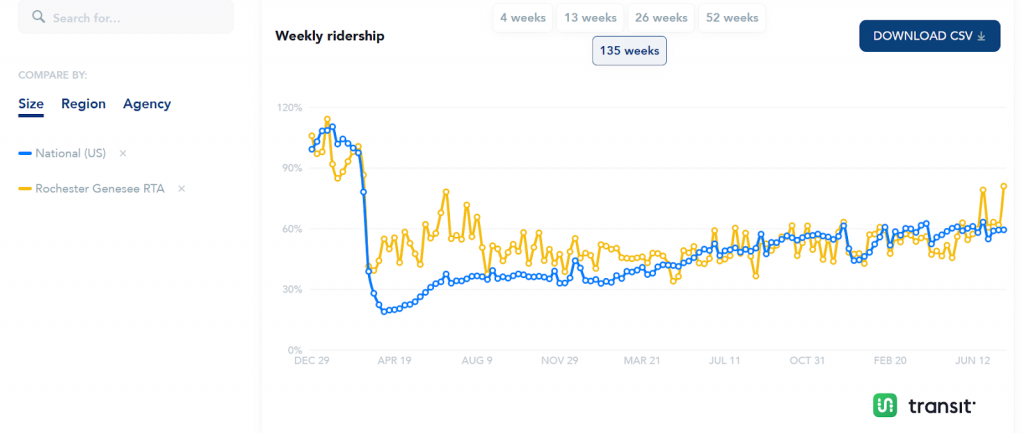
RTS ridership is still hovering around 65-70% of pre-pandemic levels with no sign of an upturn.

On-demand service in the mobility zones is exceeding demand, resulting in a service denial rate of 30-35%. The service management platform has been problematic. This combination has made service in the towns and suburbs of Monroe County often frustrating and unreliable.

Five (5) of the seven (7) 15-minute frequency routes in the core service area – the big promise of the Reimagine RTS system redesign – reverted back to 30-minute frequency. The result is worse service for some riders than they had before.

RTS doesn’t expect any of this to change or improve until at least January 2023, when new buses and vans arrive, enough drivers are hired, and a new on-demand technology platform is put in place. 

Who is impacted most?

The unfulfilled promise of Reimagine RTS of more frequent and robust service is a burden that falls squarely on transit dependent people in our community. It stands to reason that transit dependent folks make up most of the 70% of riders who are still on the bus. Unlike “choice riders” who were able to choose another way to get around, this group of folks don’t have another option than to rely on the bus. 

Bus Stop

With the system as it is, a commute time that was already long, is made longer. Those who live or need to get to work in the mobility zones are especially hard hit. Because demand is far outpacing service capacity, there is a new unreliability that is arguably worse than the service that existed before. At least then you knew a fixed route bus would be coming along at a set time, even if only every 60 minutes.

How did we get here?

The pandemic took a huge toll on RTS. In June 2020, the long-awaited Reimagine RTS system redesign launch was postponed as RTS focused on pandemic response, health safety on buses, and pitching in to meet emergency transportation needs. Reimagine RTS finally launched almost a year later in May 2021.

A few months later (Sept 2021), a shortage of private contract bus drivers created a crisis with RCSD school bus transportation. RTS stepped in and provided service so that kids could get to school. However, to free up buses and drivers, they rolled back the 15-minute frequent service that had been the hallmark of Reimagine RTS.

For the last year, RTS has been struggling to get the buses and drivers in place so they can add back the frequency in regular service and meet the unexpectedly high demand for on-demand service in the mobility zones. The good folks at RTS want to restore the frequent service as much as anyone and are working overtime to problem-solve the situation.

There are two things standing in the way: 1) Supply chain issues have prevented vans and buses, ordered more than a year ago, from arriving. 2) Steep competition in the labor market has made it more challenging to hire RTS drivers. In April 2022, due to ongoing equipment and staffing shortages, RTS announced service changes that included “pausing” the new Rt 42 crosstown, another rollback of the Reimagine RTS system redesign.

It’s little comfort, but we are not alone in this. Transit ridership is down everywhere in the wake of the pandemic. Equipment and bus driver shortages are plaguing transit systems across the country, and have led to even more severe service cuts in neighboring Buffalo and Syracuse over the past year. 

Bus Ridership
Dec 29 2019 – July 30 2022 National Data (APTA Ridership Trends dashboard)

Is there any good news?

Yes, there is plenty. 

A host of Reimagine RTS service improvements were successfully implemented and have made a big difference for many riders. Things like increased weekend service hours and frequency, the Rt 40 & 41 crosstown routes, newly added 30-minute frequency routes, and two 15-minute frequency routes (E. Main & Dewey Ave) that were reinstated.

This spring, the RGRTA Board approved a new service management platform in the mobility zones to replace the problematic one, so that fix is on its way.

Ridership data collected from the 15-minute routes has proved beyond a shadow of a doubt that frequency = increased ridership. Unexpectedly high ridership in the mobility zones shows there’s a strong demand for public transit in the towns and suburbs. What’s the takeaway? When we can restore the promises of Reimagine RTS, we will see huge gains in ridership.

Thanks to advocacy efforts led statewide by NYPTA and locally by Reconnect Rochester, as well as our Albany delegation’s support for public transportation, State Transit Operating Assistance funding for RGRTA will be increased by 15.17%. This removes funding as a barrier to service expansion & restoration (the problem is that money can’t solve the immediate problem of staffing and equipment shortages).

Many would say the Transit App has been a bright spot. Anyone who uses it can attest to the awesome design and functionality to guide transit riders in moving around.

RTS is leading New York State in the conversion to electric buses and also just got State funding to add hydrogen fuel cell buses to its fleet in the coming years. That’s a great thing for the environment and the quality of the air we breathe.

Finally, there’s also hope for expansion of bus amenities to improve the riding experience. Reconnect Rochester just got 23 more bus stop cubes on the ground, bringing the total to 54 bus stops around the city. Even more exciting, the City of Rochester with support from RTS, is applying for a $2M State funding grant to make a sweeping investment in bus stop amenities. This could mean shelters, benches, and bus stop cubes installed at hundreds of stops in the city that currently have no seating. Keep your fingers and toes crossed!

Rochester Bus

What can RTS do?

We wouldn’t be a very worthwhile advocacy organization if we didn’t point out some ways that RTS can do better even under the current constraints.

We challenge RTS to acknowledge what its customers are really experiencing minus any positive spin. Be transparent and communicate what’s happening. As transit riders, we’d like to know what’s going on. Share ridership statistics and denial rates with the community and explain why. Tell us what you’re doing to resolve the service issues. How many drivers are in the pipeline? How many buses are on order? What’s the timeline for the new user management system for the mobility zones? You get the idea.

What can we/YOU do?

Fill out our survey to share your experience.

Whether you’re a current rider or a former rider that has stopped riding the bus, we want to hear from you. We promise to deliver your thoughts to RTS leadership in the hope that your voice will impact future decision making.

If you ride RTS regularly, keep sending them your feedback.

They might not be able to make major changes happen, but they have been responsive to small improvements when they hear a sensible adjustment that can be made. Positive feedback is important, too. If RTS does something that improves your situation, let them know! Also, driving a bus can be a difficult and stressful job. A friendly greeting to the driver when you enter the bus, and thanking them for getting you to your destination safely can make a difference. You can play a part in driver retention!

Ditch the car and ride RTS whenever it works for your schedule.

Mary at Reconnect talking here. My own personal commute improved significantly thanks to the new Route 41 crosstown, which gets me to the office in 17 minutes door-to-door. In those 17 minutes, I get to enjoy some fresh air and a little exercise, check my inbox, give and take smiles (even if only with the eyes) with fellow passengers, and save gas money leaving the car at home.

Bus Arriving

Wondering what your bus commute would look like? Visit myrts.com or download the Transit App to find out!

We still believe

Reconnect Rochester has long advocated for a public transit system that delivers frequency. We still believe that the Reimagine RTS plan – when fully implemented – will set us on a path to a more frequent and robust system. There are tradeoffs, yes, but it will be a net positive overall.

At Reconnect Rochester, we look forward to when we will see the full promise of the new system fulfilled, and can truly welcome in a new day for public transportation in Rochester. We look forward to bringing back our Roc Transit Day event to showcase the changes and attract busloads of new choice riders – because choice ridership enriches the whole system, making it better for everyone. We look forward to the day when public transportation can serve as an integrating, rather than segregating, force in our community.

by No Comments

Rolling Out the Changes: A Transit Ambassador’s View on the New RTS System

Guest blog by Nicholas Russo; an RIT graduate, civil engineer, & passionate urbanist

On May 17, 2021, a re-imagined Regional Transit Service kicked off in Rochester. As a hired Transit Ambassador for the first week of the rollout, I had a firsthand view of how the new bus routes and infrastructure were set up and how they functioned, and also got to hear the thoughts and experiences from transit users. In this post, I’ll recount my time visiting three of the new Mobility Hubs around the metro area, as well as my car-free week in Rochester! I am currently living in Massachusetts, so I was excited to have an excuse to visit my old college town, and get paid for it!

For those who may be unfamiliar, the Reimagine RTS initiative began several years ago, with the ultimate result of more efficient bus routes, including three new Crosstown lines (which I made extensive use of during the week), and an all-new On Demand service. The On Demand service is like micro-mass-transit, with shared vans that can be called for pickups and drop-offs anywhere inside specific On Demand zones. There are no fixed routes or bus stops in the On Demand zones. 
The existing fixed-route bus service is named RTS Connect. The RTS Connect fixed-route services that run to On Demand zones now terminate at Mobility Hubs. These are more formalized bus connection points that are all served by an On Demand zone, as well. Here’s the map to help you visualize the new system.

The Week Begins

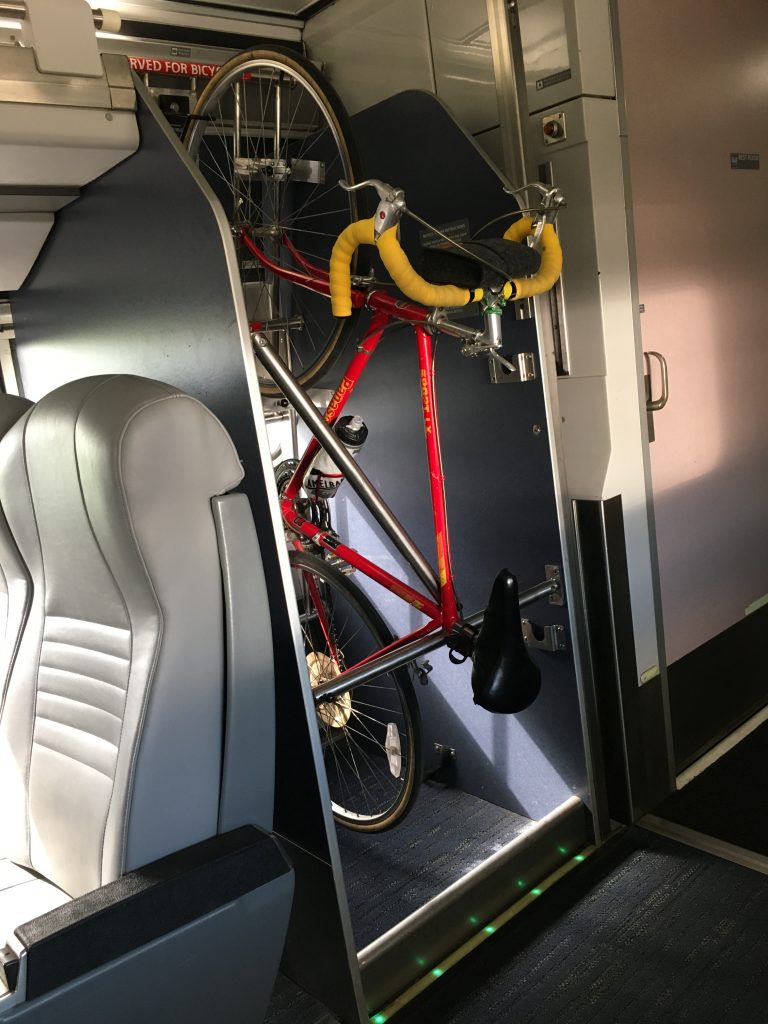
My journey started at the Albany-Rensselaer train station, where I finally got to try the roll-on bicycle storage service. I packed a week’s worth of supplies into my camping backpack, and climbed on board the train. Once I arrived in Rochester, it felt great to throw my backpack on, hop on my own bike, and get myself over to my host’s house for the week. No waiting for an Uber or walking to the Transit Center. I was very grateful to also make it to the Flower Pedal Populaire Sunday bike ride to kick off my week. It was great to catch up with so many people, and see how the city has grown over the past few years!

On-board bike storage on the Empire Service

My RTS Transit Ambassador schedule for the week was one for the early birds: 5:00am-1:00pm for Monday and Tuesday, then 6:00am-9:00am the remainder of the week. Reporting for 5:00am at the Hylan Drive Mobility Hub meant that I needed to plan my alarm time for the 45-minute bike ride to Henrietta with a little buffer time, and time to get out of bed and get ready for the day. 3:30am it was. My bike rides took me mostly on a straight line along Winton Road, which was eerily quiet at 4:00 in the morning.

The standard Ambassador uniform for the week was a blue RTS-branded apron, black RTS-branded mask, and a lime green RTS-branded visor. Hopefully it was clear that I wasn’t someone just loitering all day at the bus stop. Each Ambassador also received a small swag-bag with sunscreen (thank you!!), sanitizer, and information about the new bus lines and On Demand zones.

Showtime

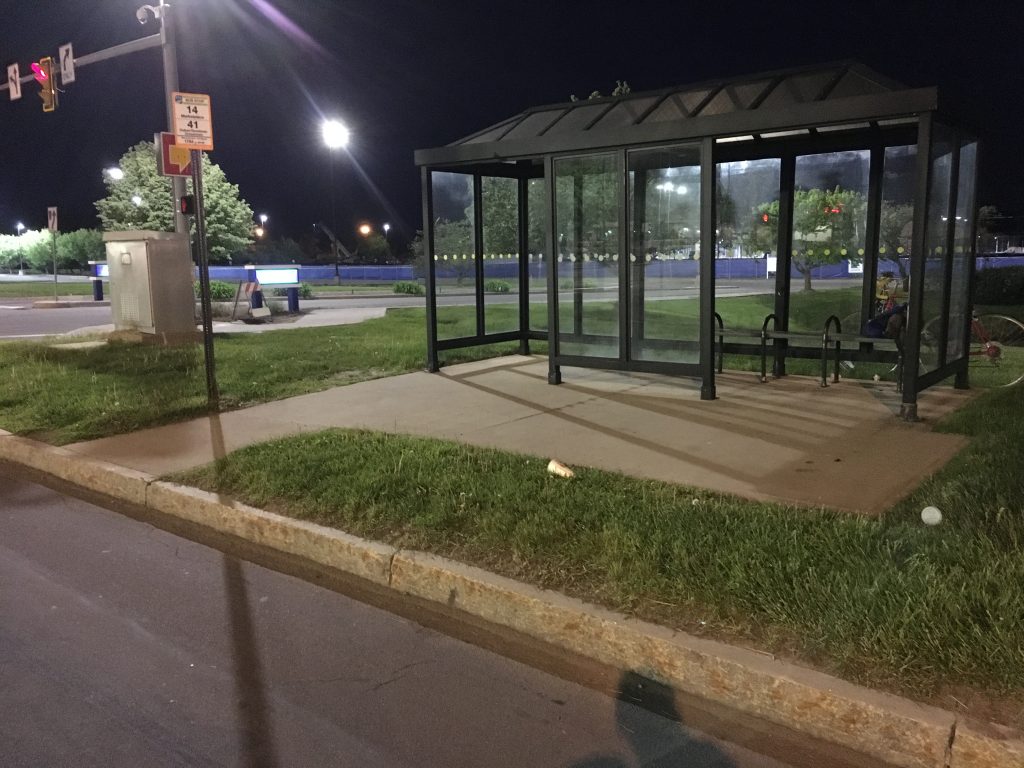
Monday morning started quiet, dark, and empty at the Henrietta Transit Hub on Hylan Drive, where I was assigned. The Hub consists of two metal and plexiglass shelters facing each other across the street at the Wegmans driveway entrance. The shelters are enclosed on three sides, with the side that faces the street open except for a center plexiglass slat. 

For being on a suburban arterial, it was incredibly quiet and peaceful watching the sunrise and listening to the hundreds of seagulls and geese making their morning rounds. As the way went on, though, the traffic and noise levels became dangerously high at times as cargo trucks zoomed by at 40 miles per hour no more than twenty feet away from my seat. I would honestly suggest flipping the shelters around and having the opening face away from the street. Keeping the noise and fumes out would create a much better ride experience.

My home base for the first half of the week

The first customer of the morning was a recent graduate from RIT, and an even bigger fan of transit than I was. He informed me as he walked up to the bus shelter at 5:50am that he wanted to be the first customer to try the new On Demand service. The On Demand hours begin at 6:00am, and at that hour two RTS-branded passenger vans drove up and staged at the far edge of the Wegmans parking lot. The customer boarded and went off to continue riding the new bus system for the day.

I was also happy to be joined by fellow Ambassadors across the street, and an RTS supervisor who was on duty for the day at the Hub to make sure things ran smoothly. As the morning progressed, I was extremely grateful that he was there and had direct access to dispatch communications, as I’ll explain.

Connection Hub-Bub

Many of us are used to having first-day jitters, bugs, and hitches with new programs and initiatives, and Reimagine was no exception. Being a completely new service, On Demand had a quiet start on Monday morning. Those who did try out the passenger vans sometimes found themselves waiting at the Hub long beyond their scheduled pickup time, but with no clear reason why. When someone called customer service, the representative found that they were indeed scheduled to be picked up at the Hylan Connection Hub at their specified time. But the On Demand vehicle was nowhere to be seen. 

Luckily, RTS’s supervisor who was assisting us that day was able to speak directly with dispatch and the operators. It turned out that the location of the Connection Hub was incorrectly placed on the vans’ GPS units as being at the terminus of the bus routes (at Walmart on Clay Road), and not at the Hylan Drive shelters. So, operators were driving to Walmart when instructed to pick up a passenger at the Hylan Connection Hub. This was ironed out as the week went on.

Another change that was unexpected by some passengers was RTS Connect bypassing the Marketplace Mall entrance, which was where the fixed-route buses previously would pass through. The new routes were laid out to run directly down West Henrietta Road to Hylan Drive, without diverting into the mall property. While this was more efficient from a bus scheduling standpoint, the change proved to be less efficient for many passengers who were taking the bus to the mall. They now had to walk from the Hylan Drive Hub, and then halfway around the outside of the mall, to get inside. This feedback was passed along to operators who then updated the route by Tuesday morning to once again pass through the mall entrance.

Hopping Around Hubs

I offered my flexibility to the Ambassador supervisors during the week, and they took me up on the offer. Besides Henrietta, I helped to staff the Connection Hubs at Dewey Ave & Ridge Road, and Irondequoit Plaza. Each offered their own unique logistics that show just how diverse the neighborhoods around Rochester are. 

On Wednesday and Thursday morning, Dewey Ave proved to be an important Connection Hub for commuters who work at the industrial centers on the west side of the city. This hub really served as a stress-test for the On Demand service, which had an On Demand zone comprised of all of the industry on the west side between Ridge Road and Lyell Ave. The flexibility of the On Demand service meant that pick up and drop-off times were not guaranteed, and it became apparent early in the week (before I was at that hub) that passengers would need to book additional “buffer” time for pick-ups and drop-offs to be on time for work. It was an evolving situation as the week went on. 

Another piece of the puzzle involved the “long” and “short” fixed-route lines that served the Dewey Connection Hub. The long and short lines are basically overlapping bus lines, with one line running all the way to the far end of Dewey Ave at Northgate Plaza, and another stopping short at the Dewey Ave Connection Hub at Ridge Road.

My bike at a bus stop with a Reconnect Bus Cube

Irondequoit Plaza was the quietest hub of the week in my opinion, mostly since I was stationed there on a Saturday morning. There were not any commuters to speak of in this bedroom neighborhood, and a smattering of early-morning Wegmans shoppers did alight from the fixed-route buses that terminated here. It was a good opportunity to chat with some of the bus operators as they laid over at the hub.

Finally, I ended my week on Sunday morning back where I began, at the Hylan Drive Connection Hub in Henrietta. 

As I reflected on the week during the sunny and quiet Sunday morning, I was grateful to be on the ground to see how this system worked in the real world. As someone from a city so small that our buses only run once an hour, it was so much fun to get fully immersed in a city-wide bus system serving thousands of passengers a day. I’m looking forward to my next return visit, when I can be a full-time passenger on the RTS buses, and remember how vital our public transit is for a healthy and strong city.

by 1 Comment

What Should Transit-Supportive Development Look Like in Rochester?

As part of its new Comprehensive Plan, Rochester 2034, the City of Rochester is studying which major streets have the best potential for “transit supportive development” in Rochester.  Transit supportive development encourages a mix of complementary activities and destinations (e.g., housing, work, shopping, services, and entertainment) along major streets and centers. This kind of development helps create compact, vibrant communities where it’s easier for people to walk, bike, and use public transit to get around. Read more

by 12 Comments

Our Suggestions for a Reimagined RTS

[ Make your voice heard. Take the Reimagine RTS survey. ]

Last week RGRTA announced a plan to “Reimagine RTS.” Reconnect Rochester believes this is a once-in-a-lifetime opportunity for our community to get mass transportation right. We all have a stake in the success of our public transportation system and it is critical that RGRTA and its project team have access to thoughts and ideas from every demographic and every corner of our community. To help, we have compiled our ideas and recommendations, and we are asking you all to do the same.

But first, we need to understand how we got here.

Rochester’s public transportation network was originally designed to carry people between downtown and densely populated surrounding neighborhoods. As our residential population, commerce, and jobs spread outward with the adoption of the automobile, RGRTA attempted to follow this migration by extending service outward. With lower population densities in the suburbs, the stretched transit company found itself facing an impossible choice: expand service to reach fewer customers, or maintain its existing service area for a dwindling urban population.

After decades of attempting to do both, the quality of service in Monroe County has suffered. Those who rely on transit are underserved, and those who might choose to ride rather than drive do not. We hear complaints from riders about infrequent service, long trip times, perceived safety issues, and the need to walk great distances to reach their bus stop or final destination. Clearly, we need systemic changes to improve service and increase the viability of our public transit network.

RGRTA recognizes these issues and is now taking a bold step to design “a new transit system from the ground up.”

Our Top 5 Recommendations to Make Rochester Transit Great (again)

Reconnect Rochester has surveyed its members on how to improve Rochester’s public transit system to serve the greatest number of people. Our recommendations are prioritized below.

1. Make service more frequent and consistent.

Reimagine RTS

Current routes and schedules are too complex and inconsistent. To build confidence and make people believe they will have a ride available when they need it:

  1. Vehicles should run every 30 minutes or less throughout the entire system.
  2. Vehicles should run every 15 minutes or less on key routes during peak hours.
  3. Routes, schedules and frequencies should be consistent throughout the weekday and on weekends.
  4. Vehicles should depart from the terminal on time.
  5. Even spacing should be maintained between buses.
  6. The number and placement of new bus stops should follow the recommendations outlined previously in the RTS Bus Stop Optimization Study (2014) to strike a balance between pedestrian accessibility and system performance.
  7. Outlying routes or segments that cannot support 30 minute frequency (either with ridership or private sector funding) may need to be eliminated, or serious consideration should be given to servicing these areas by other means.

2. Make routes more direct.

Bus Rapid Transit

Many routes currently have unnecessary turns and deviations, meaning most trips take much longer than they should. The current hub and spoke layout also makes it difficult to transfer between routes without going downtown. To improve efficiency and provide the fastest possible trip time:

  1. Routes should be designed to take the most direct path between major destinations. Twists, turns and “zig-zags” should be eliminated.
    • Buses should not run into and through office complexes and strip mall parking lots. Instead, municipalities need to work to make sure transit access is provided by direct and convenient pedestrian access through a site to the edge of the public right of way.
  2. It should be possible to switch (or transfer) between routes from any point in the network.
    • Adjacent routes should be placed within walking distance from each other and service staggered to make it easier for riders to switch from one bus to another on a nearby route.
    • Provisions should be made for other modes of travel at major bus stops or satellite hubs (i.e., ridesharing and bike share stations, safe and accessible pedestrian infrastructure, information/signage, etc.).
  3. It should be possible to travel between the county’s four quadrants without transferring downtown.
    • Crosstown or orbital routes should be added near the perimeter of the city where radial routes diverge.
    • Work with other transit providers to make existing crosstown routes (e.g., U of R’s Orange Line) available for riders.
  4. Work with the City and DOT to design streets that prioritize transit (as well as pedestrians and cyclists) over private motor vehicles.
    • Install curb extensions at transit stops (as opposed to curb cutouts) to eliminate time spent weaving in and out of traffic.
    • Optimize traffic signals to improve reliability by allowing buses to maintain a constant speed, and reducing time spent at red lights.
    • Utilize dedicated lanes to move buses more quickly through crowded streets.

3. Right-size the service.

Comfortable Bus

Many routes receive high ridership near the core of the network, resulting in overcrowded, slow moving buses there and nearly empty buses for the remainder of the routes. To relieve overcrowding and improve service in high demand areas:

  1. Some routes may require express and local access service.
  2. Consider eliminating outlying routes or segments where demand is low.
  3. Vehicles should be selected according to demand.
    • Heavily used routes within the core of Monroe County should be serviced by 40’ or larger vehicles, while lesser used routes could be serviced by vans or other systems altogether (i.e., ride-sharing).
  4. Where necessary, transit vehicles should be outfitted to accommodate more bicycles.

4. Make transit accessible and easy to use.

Bus Stop with real-time information

In recent years RGRTA has added several systems and technologies that have made it easier and more enjoyable to use transit. These include the fully enclosed RTS Transit Center, fare kiosks, Tap & Go fare cards, digital signage, and a mobile trip planning app. The following recommendations would make RTS even easier to use and more welcoming to new customers:

  1. Improve integration with other modes and transit systems.
    • Institute an integrated payment solution so that one “currency” can be used across a variety of transportation systems (i.e., one stored-value pass to pay for bus fare, rideshare, taxi, or bike share that could be replenished online or at a kiosk).
    • Include data from other transportation companies within the RTS mobile app.
    • Share data and synchronize service between other transit providers such as college bus systems, Amtrak, and intercity buses.
  2. Work with municipal staff and land use boards in development review and site design. Employment locations, services, retail, and higher density residential development should occur within a half mile of transit corridors. The details of site design such as building placement and internal pedestrian circulation networks are critical in supporting transit.
    • A dynamic transit frequency map should be published for municipalities to evaluate whether transit is a realistic mobility option for a given development or not. There’s a huge difference in a site served by buses every 2 hours versus one served by buses every 20 minutes. Frequency information is not captured on a typical system route map (see for example these maps by Reconnect Rochester and this article by Jarrett Walker).
  3. School routes (currently designated with an X) should not add complexity to the published schedules.
  4. Provide basic amenities for transit riders at all bus stops.
    • Safe and accessible sidewalk connection from curb pick-up
    • Route map and information
    • Seating
  5. Provide enhanced amenities for transit riders at heavily used stops and hubs.
    • Shelter
    • Trash receptacle
    • Bike rack
    • Heat
    • WiFi
  6. Work with municipalities to enact a maintenance plan for all bus stops.
    • Trash pickup
    • Snow removal
    • Accountability
  7. Provide riders with real-time information
    • Countdown clocks with real-time information should be installed at all major transit stops and hubs (i.e., URMC, colleges, Airport, Rochester Intermodal Station, Irondequoit Plaza, etc.).
    • Work with municipalities and property owners to display real-time information screens at highly visible locations such as schools, shopping centers, arenas, office and apartment buildings (i.e., TransitScreen).
  8. Provide additional off-board and cash-free fare payment methods (i.e., kiosks at major transit stops where passengers can buy Tap & Go cards, mobile ticketing via the RTS app or a 3rd party app such as Token Transit, etc.).
  9. Explore ways to allow boarding at both front and rear doors.

5. Stay competitive through innovation.

RTS Streetcar

A business succeeds by staying ahead of the competition. Beyond the recommendations outlined in sections 1-4, it will be imperative for RTS to:

  1. Continually monitor customer needs and local market conditions in order to identify areas for improvement, industry trends and opportunities to attract new customers.
    • Offer classes or seminars on “how to ride the bus.” Many people are reluctant to try the bus, in part, because they are unfamiliar with it.
    • Have a bike rack mock-up device so people can practice loading a bike into the rack without the pressure of a bus full of people watching.
  2. Expand offerings by studying the feasibility of new systems and upgrades such as:
    • Fixed guideway and/or bus rapid transit on core routes
    • Smaller self-driving vehicles for local or on-demand service
  3. Work with the City and County to manage land use in a way that complements service patterns. Future service can then be planned based on land use decisions.
  4. Work with municipalities, key neighborhood groups, and large employers to establish Transportation Demand Management entities and co-promote public transit as a solution to congestion and costly parking.
  5. Step up marketing efforts and always maintain a fresh image reflecting the unique selling points of RTS.
    • Develop example language/assistance for municipalities, event planners, retailers, employers etc. that highlight the ability to use transit to access the event. Too often events or meeting notices provide parking information without information about public transit. Rochester International Jazz Festival does a good job of this.

Share Your Suggestions

We hope our suggestions will give you a framework from which to craft your own thoughts for RTS. Please feel free to steal our list straight away. Or if you have ideas not mentioned above, we’d love to hear them in the comments section below.

We also urge you to attend the first public meeting for this project on October 25th from 6:00-7:30PM at the Brockport Metro Center. And don’t forget to visit www.myRTS.com/reimagine to submit your comments and stay updated on this important project over the next 12 months.

by 6 Comments

“Reimagine RTS” – A fresh start for Rochester’s Transit System?

Moments ago RGRTA announced plans to study sweeping changes to the RTS (Monroe County) transit system. The effort is being called Reimagine RTS and the goal is to develop a set of recommendations to address the community’s mobility needs, increase transit ridership, and position RTS for long-term financial sustainability.

Read more

by 4 Comments

RTS Introduces New ‘Tap & Go‘ Card, PLUS Text & Email Alerts

RTS Tap & Go Card

This week RTS introduced a new Tap & Go! RTS Fast Pass. The new fare card lets customers simply tap it on the fare box (on the bulls-eye) when boarding. When the fare is accepted the fare box will beep or you will hear “fare deducted” to know you have successfully paid your fare.

https://youtu.be/muZL60K_RZU

If customers make use of the new Tap & Go! cards they should make boarding a lot faster which would be a good thing for everyone. Currently, riders insert their fare card into a slot and then must wait a moment for the card to pop back out – or worse, fumble for change. And when you serve thousands of riders every day, those seconds add up.

In addition to quicker boarding times, RTS CEO Bill Carpenter says the new technology at the fare box also lays the groundwork for improved payment options in the future. “The information and experience we gain from the Tap & Go! passes represents the first step toward technological improvements that may include refillable bus passes, fare boxes that accept credit card payments, mobile payment options on smart phones, and a Tap & Go! smart phone app.”

For many of us transit fans, those features can’t come fast enough. But for now, here is what customers need to know about Tap & Go!:

  • Tap & Go! passes are available for purchase online at myRTS.com, or one of the ticket vending machines at the RTS Transit Center or the RTS Administration Building.
  • They are available as a 5-Day Unlimited, 31-Day Unlimited, and stored value pass.
  • The pass is activated with the first tap on the bus.
  • Customers can check their card balance at any RTS ticket vending machine.
  • Tap & Go! RTS Fast Passes are not currently refillable.
  • The old magnetic fare cards in other denominations are still available.

Also… New Text Message and Email Alerts

RTS Alert

And in case you missed it, last month RTS introduced another way for customers to receive service and schedule announcements: via email or text message. Transit riders with smartphones and the RTS Where’s My Bus App already receive timely alerts and information through the app. Text and Email alerts now give customers another option.

To sign up, you can either fill out the subscription form online or in person at the Transit Center.

Or simply text the words “OPT IN RTS ALL” to (585) 433-0855. If you only want alerts for a specific route, replace the word “ALL” with your specific route number. For example, to sign up for text message alerts for the Route 1 Lake, text “OPT IN RTS 1.”

You can also opt-in for information outside Monroe County. Simply follow the same instructions above, but use your county code listed below:

  • RTS Genesee: “OPT IN GEN ALL” or “OPT IN GEN 1”
  • RTS Livingston: “OPT IN LIV ALL” or “OPT IN LIV 1”
  • RTS Ontario: “OPT IN ONT ALL” or “OPT IN ONT 1”
  • RTS Orleans: “OPT IN ORL ALL”
  • RTS Seneca: “OPT IN SEN ALL” or “OPT IN SEN 3”
  • RTS Wayne: “OPT IN WAY ALL”
  • RTS Wyoming: “OPT IN WYO ALL” or “OPT IN WYO 1”
by 3 Comments

What’s the frequency, RTS?

How would the RTS coverage map look if we considered the actual frequency of bus service. [IMAGE: Regional Transit Service]
Posted by: Mike Governale, president and co-founder of Reconnect Rochester

The map above shows Rochester’s public transit network. Looks impressive with all of its lines stretching out across Monroe County. From Webster to Chili; Greece to Penfield; there’s a bus or two to get you there. On the other hand, if our transit network were really as good as it looks on this map, why are less than 2% of all trips in Rochester made using public transit?

Hmmm… Maybe because parking is cheaper than air here in Rochester?

Well, yes. But also, this map might be overstating the effective reach of RTS. Remember, a transit system is only good if it’s there when you need it…

Read more

by No Comments

Rochester’s transit system – in the palm of your hand

The new RTS 'Where’s My Bus?' mobile app is now available!
A new RTS mobile app is now available for download in the Google Play Store external link and Apple iTunes App Store external link.

The app was first introduced to the Rochester Institute of Technology (RIT) community in February and is now being rolled out to the full RTS ridership. In a statement sent to Reconnect Rochester, RGRTA said, “We received great feedback from students at RIT which allowed us to incorporate additional features to this version of the RTS Where’s My Bus? mobile app.” The resulting app is a reliable and convenient tool that will make the bus riding experience easier than ever. Here are some of its features…

Read more

by No Comments

‘How to Ride the Bus’ Workshop, April 29

RTS has scheduled a 'How to Ride the Bus' transit orientation for Tuesday, April 29. [PHOTO: RGRTA]
Getting on a bus for the first time can feel awkward for some. If the last bus you took was a yellow school bus, you might be due for a refresher course. RTS has scheduled a “How to Ride the Bus” transit orientation for 10 a.m. to noon, Tuesday, April 29, at Rochester Genesee Regional Transportation Authority (RGRTA) John G. Doyle Jr. Administration Building located at 1372 East Main Street external link. The orientation is the first of a series designed to help guide first-time riders of any age or those who might need a brush up. All are free and open to the public…

Read more

by No Comments

Proposed Schedule & Route Changes for RTS

The new RTS Transit Center will be opening on November 28th, 2014. Coinciding with the transit center opening, RTS is also proposing changes to bus routes and schedules. [PHOTO: RGRTA]The new RTS Transit Center will be opening on November 28th, 2014. Coinciding with the transit center opening, RTS is also proposing changes to bus routes and schedules. This is to accommodate the additional time required to travel through the Transit Center…

Read more

by 2 Comments

Route 52 – RTS’ New Crosstown Connection

Give the new RTS route 52 a try...
Immediately after Labor Day, RGRTA CEO Bill Carpenter was on hand for the inaugural voyage of the newest addition to RTS’ stable of bus routes. A route planned with the University of Rochester Medical Center’s parking situation in mind, Route 52 crosses through the heart of the vibrant Monroe and Park Avenue communities before terminating at the brand new East Avenue Wegman’s store.

This new alignment, which follows a rigid 30 minute departure schedule external link from 6-10AM and 2:30-7PM (with a single midday trip), has had us at Reconnect excited for some time. We’ve finally crunched the numbers to bring the public an idea of just how much this development is enhancing service…

Read more

by 7 Comments

Rochester’s Case for a Streetcar Line

The following article was published at RochesterSubway.com on 2010/02/16. Two weeks later 6 citizens got together and Reconnect Rocheseter was born.

Photo simulation of a new Rochester streetcar on Main Street.

America seems to have taken a renewed interest in mobility. Maybe due to President Obama’s recent commitment to high speed rail—or perhaps the positive results seen in towns like Portland and Denver have caught our collective attention. Whatever the reason, from the top down, people are rethinking our automobile-oriented culture—and getting excited about the possibilities.

There’s also good reason to focus on transportation as a way of jump-starting economic development. Industry requires access to people. And people need to have easy access to centers of employment. Continually improving access makes further development possible. Interrupting access will have the opposite effect. Likewise, doing nothing or simply maintaining existing infrastructure for an extended period of time will also hinder development.

For 30+ years Rochester has relied on the infrastructure choices it made in the 1950’s, 60’s, and 70’s. At that time we made development choices that encouraged our population to emigrate from the downtown core. We scrapped our extensive streetcar system, choked off downtown with the construction of the inner-loop, and paved super highways to take us from the city to the NY State Thruway and beyond. Since then that’s exactly where our money, our workforce, and our future have gone—down I-490 and out of state.

Read more