by No Comments

Where They Stand: 2026 Monroe County Candidates for Congress, State Legislature, and Town & Village races

Reconnect Rochester surveyed all candidates with a primary election for US Congress, State Legislature, and Town & Village races to learn where they stand on issues related to transportation and mobility. 

Questions were designed to give the candidates the opportunity to share their opinions, ideas and vision for a well-connected and accessible community.  We contacted every campaign by email or mail to request a response. 

This questionnaire only covers candidates with a primary election. We will cover all general election candidates in another questionnaire later this year. New York has a closed primary election meaning only registered members of an official party are eligible to vote. The races we cover have primary elections in the Democratic, Republican, and Working Families Parties and are grouped by party below.

Click on the candidate names below to read their full, unedited responses. Candidates appear in the order presented on the Monroe County Board of Elections Certification of Candidates list. If you are interested to learn more about how we conduct our candidate questionnaire, feel free to take a look at our methodology dropdown below.

We hope this information will help you make an informed decision when you head to the polls! Early voting for the primary election starts Saturday, June 13th and runs through Sunday, June 21st. Click here to find early voting sites!

To check if you are registered to vote, confirm your polling location for the June 24th primary election, and even see a preview of what your ballot will look like: click here.


Our Methodology & Process

Reconnect Rochester has run a campaign questionnaire for several years with the goal of informing our audience where candidates for elected office stand on issues related to transportation and mobility. In the past we have focused on elections in the City of Rochester Mayor & City Council, Monroe County Legislature & Executive, NY Senate & Assembly, and our Congressional District (NY-25). To match our commitment to all municipalities in Monroe County, last year we expanded the questionnaire to cover town and village races. 


For the 2026 election year, we are running two candidate questionnaires to cover the primary election and the general election. 


For the primary election, we surveyed 21 candidates from across our region. We began by referring to the list of certified candidates provided by the Monroe County Board of Elections. With a list of all primary candidates, we located campaign emails and websites to send our questionnaire. 


All candidates initially received our questionnaire in the mail. We then sent several reminder notifications to encourage candidates to participate. Candidates with functional campaign webpages and emails received at least two reminders digitally. The hyper local nature of some elections often made finding the email addresses of candidates difficult. Many candidates run campaigns from Facebook pages or through word of mouth. Candidates without clear digital contact methods received a second copy of the questionnaire in the mail to the address the candidate filed with the Monroe County Board of Elections. 


Regardless of the contact method, candidates received at least two communications explaining our questionnaire asking for responses. The majority of our outreaches were sent on the week of May 7th, May 19th and June 8th with a deadline of June 10th to give us time to upload the responses to this webpage. 


If you have any questions about our candidate questionnaire, please feel free to contact us. Thank you for taking the time to see where your candidates stand and for voting.

Democratic Party Primary Election Candidates

Democratic Primary Candidates for US Congress (NY-25)

Robin Wilt

Political Party: Democratic

Candidate Email: campaign@robinforus.com

Website: RobinForUS.com


1.  What do you think are Rochester/Monroe County’s greatest transportation challenges?


Monroe County and Rochester have an outmoded and outdated public transportation system that is neither accessible, nor practical for many of its residents. Moreover, although slowly improving, cycling infrastructure tends to lack connectivity and sufficient safety measures to make it a practical alternative for most commuters and across all demographics. Our car-first mentality has created a mindset where increasing access to multimodal forms of transportation is an afterthought, not the priority it should be.


2. Currently, Congress is debating the details of Transportation Reauthorization, the bill which largely shapes our nation’s transportation system investments over the next 5 years. It is currently unclear if the Reauthorization bill will be passed in 2026 or 2027. Will you commit to ensuring that the following program elements are included:

– Robust funding for Transportation Alternatives 

– Legislative language of the Sarah Debbink Langenkamp Active Transportation Act and the Magnus White and Safe Streets for Everyone Act

– Reauthorization and fund for the Safe Streets and Roads for All grant program

Yes. I am familiar with Safe Streets for All initiatives and wholly back their implementation. As indicated in my previous answer, I believe that transportation alternatives should be a priority, not an afterthought, especially from intersectional and equity standpoints. I would also back the Safe and Affordable Transit Act, which aims to expand and subsidize public transit to make it more affordable and reliable including: 1) Expanding transit funding to underserved communities; Reducing fare costs for low- and middle-income riders; Supporting multi-modal transit and active transportation (walking, biking) as part of safe streets goals.

3. In the U.S., pedestrian fatalities are up 83% since 2009. In Monroe County, an average of 12 bicyclists and pedestrians die on our streets every year and thousands more are injured. Rochester recently announced a commitment to “ROC Vision Zero” aiming to eliminate traffic deaths from our streets. If elected, would you support this program and if so, how?

Yes. I was examining a Vision Zero plan for the Town of Brighton, and I would definitely support it for Rochester and Monroe County. I would spearhead efforts to expand the Vision Zero discussion from just the city to the County level, which would address some of the skepticism currently being raised.

4.  Emissions from Transportation make up over 40% of Co2 emissions in Monroe County. To meet our climate goals, personal vehicle trips will have to be reduced. How will you support transportation options such as walking, biking and public transportation in our community, and improve accessibility to jobs and resources for residents who don’t own or want to use a car?

For me, as often is the case with issues involving the environment, it is not only a matter of sustainability, but also a matter of equity to improve multimodal transportation opportunities within our community. The communities most directly impacting by CO2 emissions are often the communities most vulnerable from a wealth and ability to mitigate perspective.

5. Why should Monroe County residents who care about safer streets, better mobility, and better public transit vote for you?

As a Town Councilmember, I consistently championed safe street initiatives within the Town of Brighton, and it remains a priority for me at every jurisdictional level. I would work with my partners at all levels of government to make streets safer, improve mobility and increase public transit alternatives.

Joseph Morelle

Political Party: Democratic 

Candidate Email: paul@votemorelle.com

Website: votemorelle.com


1.  What do you think are Rochester/Monroe County’s greatest transportation challenges?


Rochester and Monroe County continue to face several key transportation challenges, including aging infrastructure, limited transportation options in some communities, and persistent pedestrian and cyclist safety concerns. Many residents still lack safe and convenient ways to access jobs, healthcare, schools, and other essential services without relying on a personal vehicle.


We also face the challenge of modernizing our transportation network in a way that reconnects neighborhoods, reduces emissions, and creates safer streets for everyone. Addressing these issues requires sustained investment in infrastructure, public transit, and multimodal transportation options that improve mobility and quality of life throughout our community.


2. Currently, Congress is debating the details of Transportation Reauthorization, the bill which largely shapes our nation’s transportation system investments over the next 5 years. It is currently unclear if the Reauthorization bill will be passed in 2026 or 2027. Will you commit to ensuring that the following program elements are included:

– Robust funding for Transportation Alternatives 

– Legislative language of the Sarah Debbink Langenkamp Active Transportation Act and the Magnus White and Safe Streets for Everyone Act

– Reauthorization and fund for the Safe Streets and Roads for All grant program

Yes. I support robust funding for Transportation Alternatives programs and the continued authorization and funding of the Safe Streets and Roads for All program. These investments have already made a significant difference in our community.

In 2024, I helped secure $23.7 million through the Safe Streets and Roads for All program for the City of Rochester, the largest award of its kind in New York State. That funding is helping improve safety and accessibility throughout our transportation network and making some of our most dangerous roadways safer for pedestrians, cyclists, and motorists.

As Congress considers the next transportation authorization bill, I will continue advocating for investments that improve safety, expand mobility, strengthen public transit, and help communities build transportation systems that work for everyone.

3. In the U.S., pedestrian fatalities are up 83% since 2009. In Monroe County, an average of 12 bicyclists and pedestrians die on our streets every year and thousands more are injured. Rochester recently announced a commitment to “ROC Vision Zero” aiming to eliminate traffic deaths from our streets. If elected, would you support this program and if so, how?

Yes, and I have already worked to support many of the goals behind ROC Vision Zero.

Eliminating traffic deaths requires coordinated investments in safer road design, improved pedestrian and bicycle infrastructure, better transit access, and data-driven safety improvements.

These investments help make dangerous roadways safer and more accessible while connecting residents to jobs, healthcare providers, community centers, and other critical resources. I will continue working with local leaders and advocates to secure the federal resources needed to make Rochester’s Vision Zero goals a reality.

4.  Emissions from Transportation make up over 40% of Co2 emissions in Monroe County. To meet our climate goals, personal vehicle trips will have to be reduced. How will you support transportation options such as walking, biking and public transportation in our community, and improve accessibility to jobs and resources for residents who don’t own or want to use a car?

Expanding transportation options is essential both for reducing emissions and ensuring that all residents can access economic opportunity.

In Congress, I have supported legislation including the Energy Innovation and Carbon Dividend Act, which would significantly reduce carbon emissions, and the Environmental Justice for All Act, which would strengthen protections for communities disproportionately impacted by pollution and environmental hazards.

I have also worked to secure federal investments that support sustainable transportation here in Monroe County. In 2025, I helped secure nearly $100 million for the Inner Loop North Transformation Project, which will reconnect neighborhoods divided by highway construction and improve mobility throughout Rochester. I also secured $850,000 for RGRTA to improve the efficiency of its growing hydrogen-powered bus fleet, helping modernize public transit while reducing emissions.

By investing in public transportation, safer pedestrian and bicycle infrastructure, and projects that reconnect communities, we can reduce emissions while improving access to jobs, services, and opportunity.

5. Why should Monroe County residents who care about safer streets, better mobility, and better public transit vote for you?

I have a proven record of turning these priorities into action.

Throughout my time in Congress, I have worked to secure federal support for projects that improve roadway safety, strengthen public transit, and reconnect communities that have too often been left behind. From supporting Rochester’s Safe Streets and Roads for All initiative to helping advance the Inner Loop North Transformation Project and investments in cleaner public transit, I have consistently fought for transportation investments that make our community safer, more connected, and more accessible.

I also recognize that transportation policy is about more than infrastructure. It is about whether people can safely get to work, access healthcare, reach school, and participate fully in their community. That’s why I have supported legislation such as the Energy Innovation and Carbon Dividend Act and the Environmental Justice for All Act, because transportation decisions should promote both opportunity and sustainability.

I will continue working to ensure the Rochester community has transportation systems that are safe, reliable, accessible, and built for the future.

Sherita S Traywick

Political Party: Democratic

Candidate Email: pastortraywick@gmail.com

Website: Sheritatraywick.com


1. What do you think are Rochester/Monroe County’s greatest transportation challenges?


One of the greatest challenges is the lack of reliable and equitable public transportation access, particularly for seniors, individuals with disabilities, low-income residents, and workers who depend on public transit to access jobs, healthcare, grocery stores, and essential services.


Transportation affordability is another growing concern. Rising vehicle costs, insurance rates, fuel prices, and maintenance expenses place financial strain on working families, while limited transit options leave many residents with few alternatives.


2. Currently, Congress is debating the details of Transportation Reauthorization, the bill which largely shapes our nation’s transportation system investments over the next 5 years. It is currently unclear if the Reauthorization bill will be passed in 2026 or 2027. Will you commit to ensuring that the following program elements are included:


– Robust funding for Transportation Alternatives 

– Legislative language of the Sarah Debbink Langenkamp Active Transportation Act and the Magnus White and Safe Streets for Everyone Act

– Reauthorization and fund for the Safe Streets and Roads for All grant program

Yes, I support the inclusion of these priorities in the next Transportation Reauthorization bill.

Transportation policy should be about people, safety, and opportunity. Every year, too many pedestrians, bicyclists, and motorists lose their lives on roads that can and should be safer. We have a responsibility to invest in transportation systems that help people get where they need to go safely, regardless of how they travel.

I support, robust funding for Transportation Alternatives to help communities build and improve sidewalks, trails, bicycle infrastructure, safe crossings, and other projects that expand transportation choices and improve safety.

The goals of the Sarah Debbink Langenkamp Active Transportation Act and the Magnus White and Safe Streets for Everyone Act, which seek to make our transportation systems safer for pedestrians, cyclists, and other vulnerable road users.

Reauthorization and continued funding for the Safe Streets and Roads for All (SS4A) grant program, which provides critical resources to local communities working to reduce traffic deaths and serious injuries.

As a mother, I want my children and all children to inherit communities where they can safely walk, bike, and play. As a former school board member and community leader, I understand that transportation safety is connected to public health, educational access, economic opportunity, and quality of life.

I also believe transportation investments should be equitable. Too often, low-income neighborhoods, communities of color, seniors, people with disabilities, and transit-dependent residents bear the greatest burden of unsafe infrastructure and limited transportation options.

3. In the U.S., pedestrian fatalities are up 83% since 2009. In Monroe County, an average of 12 bicyclists and pedestrians die on our streets every year and thousands more are injured. Rochester recently announced a commitment to “ROC Vision Zero” aiming to eliminate traffic deaths from our streets. If elected, would you support this program and if so, how?

When elected, I would support federal funding and policies that help communities like Rochester implement evidence-based safety improvements, for example Better street lighting, particularly in high-risk corridors and intersections. Clear, visible signage, crosswalk markings, and traffic signals. Safer road designs that reduce dangerous speeding and improve visibility. Sidewalk and pedestrian infrastructure improvements in underserved neighborhoods. Protected bicycle infrastructure where appropriate.

Improved accessibility for seniors, children, and people with disabilities. Investments in Safe Routes to School programs so children can travel safely. Modernized road safety education and stronger emphasis on pedestrian and bicycle awareness in driver education and road testing.

I also believe enforcement alone is not enough. We must combine engineering, education, and community engagement. Residents often know exactly where the dangerous intersections, missing sidewalks, poor lighting, and unsafe crossings are located. Their voices should help guide transportation decisions.

As someone who has worked in education, disability advocacy, and community service, I understand that transportation safety is also an equity issue. Children walking to school, seniors crossing busy roads, people with disabilities, transit riders, and working families all deserve safe access to their communities regardless of where they live.

4.  Emissions from Transportation make up over 40% of Co2 emissions in Monroe County. To meet our climate goals, personal vehicle trips will have to be reduced. How will you support transportation options such as walking, biking and public transportation in our community, and improve accessibility to jobs and resources for residents who don’t own or want to use a car?

As a mother, this issue is deeply personal to me. I have children, and I want them to inherit an Earth that is healthy, sustainable, and safe. I don’t want future generations to face increased health risks, poor air quality, or environmental conditions that could have been prevented through thoughtful action today.

At the same time, I believe environmental stewardship and economic opportunity must go hand in hand. Families should not have to choose between protecting the environment and getting to work, school, healthcare appointments, or the grocery store. In Congress, I would support federal investments that help communities like Monroe County expand transportation options beyond personal vehicles. That includes improving public transit, creating safer sidewalks and crosswalks, supporting connected bike and pedestrian infrastructure, and ensuring transportation systems are accessible for seniors, people with disabilities, and working families.

I also believe transportation planning should focus on connecting people to opportunity. Reliable transit can improve access to jobs, education, healthcare, childcare, and community resources while reducing traffic congestion and emissions.

As the former Chief of Staff at the Center for Disability Rights, I have seen firsthand how transportation barriers can limit independence and opportunity. Any transportation system we build must be accessible and usable for everyone.

5. Why should Monroe County residents who care about safer streets, better mobility, and better public transit vote for you?

One of my main priorities is public safety. I care deeply about these issues. In Congress I will support expanding access to affordable, reliable public transportation. Investing in safer streets for drivers, pedestrians, bicyclists, and children. Improving infrastructure that connects people to jobs, healthcare, and education. Supporting accessible transportation options for seniors and people with disabilities and ensuring federal transportation dollars are spent efficiently and transparently.

Democratic Primary Candidates for NY Senate 54th District

Scott Comegys

Political Party: Democratic

Candidate Email: scott@electscottcomegys.com

Website: https://www.electscottcomegys.com/

1. Across Upstate New York, transit agencies are facing a fiscal crisis due to a lack of dedicated funding while the costs of operating transit continue to rise. In 2025, lawmakers fully funded the MTA while without addressing shortfalls upstate. Lawmakers have proposed raising STOA contributions from the general fund and increasing dedicated revenue streams directed to transit. Will you commit to ensuring that RGRTA and all upstate transit authorities are fully funded in your next term?


Yes. I am especially interested in making the investments to help surrounding rural counties have a better public transit system.


2. Amtrak’s Empire Service has far exceeded pre-pandemic ridership numbers and trains to and from NYC regularly sell out Thursday-Sunday. As a state supported rail service, Amtrak operates the Empire Corridor as decided by the New York State Department of Transportation. What actions by the NYS legislature will you take to support the expansion of rail service and make other improvements to inter-city travel in upstate New York?


Better rail service connecting the regions in New York State has been a goal of mine since I moved to Palmyra in 2006. This is one of the best ways we can address better public transit between communities, cut down on transportation emissions from automobile traffic, control costs, create jobs, expand markets for local businesses. As a NY State Senator I would support expanding investment in rail to have more trains running, ensuring that the schedules better coordinate with public transportation operations within the local municipalities (including making bike and car share services available), and making sure that fares were affordable so the services can be accessible to everyone. The investment would also include expanding stations in more communities so more people could access service.


3. In 2024, Reconnect Rochester successfully advocated for $18 million dollars to be included in the New York state budget to bring Inter-City buses to Louise M. Slaughter Intermodal Station. As of now, the project has not started. What will you do as a legislator to move this project forward with NYSDOT and Amtrak to ensure that intercity bus riders are given dignified amenities?


We need to see what the barriers are to the project moving forward. I know with that station there have been security concerns, traffic concerns, and capacity concerns. The capacity concerns I believe may be spurious. As with all issues, I would move forward with quickly identifying the actual barriers and proposing and funding solutions to overcome those barriers so the station can be the hub that can better serve the entire community as envisioned. That will involve working with City partners to bring about the correct solutions. I realize that this language is vague and it would be better to have specific solutions, but that will require some more investigation on my part with the station, which I will do in the near future.


4.  In 2024, a Brookings report examining state DOT planning, investment, and accountability practices ranked New York 49th in the country, only outpacing Alabama. NYSDOT continues to prioritize the flow of vehicle traffic in the majority of its projects, has slow-walked strategic reform processes/plans, and keeps data such as crash reports out of the public eye. Proposed bike lanes on state roads are often symbolic and not safe or connected. Reconnect Rochester sits on both the New York Safe Streets Coalition and the New Yorkers for Transportation Equity Coalition which are advocating for systemic NYSDOT reforms. How will you work to advance NYSDOT transparency and accountability reforms in the legislature?


There really is only one answer to this question, and that is, as a State Senator, I will commit to holding the hearings necessary and directly reporting the findings to the public in order to be as transparent as possible. Lack of transparency in our processes causes distrust in the community and that is the most significant barrier to any program being successful. Public trust in every government has eroded so much that just about every initiative and project is brought to a standstill, and that only serve s a very few parties who make money due to stagnation in our society. I would be joining a few State Senators who actively engage with the public, give out all of the information about a project or program, and build trust so those programs can succeed by demonstrating the benefit of the program. We cannot shy away from telling people when things may cost more, but should, as we reveal those costs, argue why those costs will benefit the community and actually create a more affordable society. So, unlike the incumbent in the 54th State Senate district, I will spend my time with putting out more communications about reforms, convening stakeholder groups to discuss reforms, conducting town halls about reforms, and actively engaging to make those reforms work.


5. Many residents of the Rochester area either can’t, or can barely afford to own a car. Before the war in Iran caused gas prices to skyrocket, AAA estimated that car ownership costs over $11,500 a year. How will you support affordable transportation options such as walking, biking and public transportation in our community, and improve accessibility to jobs and resources for residents who don’t own or want to use a car?


We must get back to the idea that our communities should have services local to the communities and reduce the need for automobiles in the first place. This will not be an especially popular view, but it is the most realistic view. We need to encourage community development plans that ensure that grocery stores, pharmacies, healthcare facilities, schools, hardware stores, clothing stores, and other retail are within easy walking distances. At the same time we should make public transportation more accessible and reliable for people, which can be readily accomplished through expanded use of developing technology with cell phone apps and better planning for routes and stops.


We can invest in infrastructure to make bike travel (both standard and electric) safer, with better barriers to keep cars out of bike lanes and having more bike paths that don’t involve shared traffic space with automobiles. However, this will require some enforcement of bike safety laws on bike riders as well, but I feel this can be accomplished in a way that encourages a better relationship with bikers rather than an antagonistic one. Investment in communication infrastructure, specifically broadband internet communication, is one of my top priorities. Making sure that every area, regardless of population density or economic vitality, has access expands the ability for people to engage in remote work. During the COVID pandemic we witnessed that we can have more people be more productive with remote work, saw a sharp decrease in traffic, and, to the dismay of a few people with obsessive need for personal control, revealed a way for people in communities far and wide to have expanded access to jobs that previously were inaccessible to them. Someone working in Lyons may now consider a job in Rochester, Syracuse, or even Los Angeles, California, a job they can have locally. By encouraging remote work we actually create opportunities for people, reduce costs for both people and companies, and create opportunities to turn previous commercial areas into walkable, mixed use communities. Ultimately, it makes life more affordable.


6. Why should Monroe County residents who care about safer streets, better mobility, and better public transit vote for you?


I am someone who is dedicated to sustainability for our communities, and the most sustainable communities are those where services, goods, and jobs are available locally, where people are able to safely walk, bicycle, or drive safely, and where more options exist for when people need to travel farther for whatever reason they need. We have been living for a long time in a world created to divide us – home developments cut off from one another and often not allowing for a mix of age, income, racial, spiritual, or other demographics, abandoning communities to create commercial zones miles away from residential zones, and not connecting urban and rural communities in ways that make the best use of both regions.


Yet we have the potential to connect everyone while at the same time recognizing and respecting a person’s choice to live where they do, work as they want, and be a vital part of the community in their own way. By making the sorely needed investments to redesign our communities and how we develop, in the infrastructure necessary to support and connect people and services, and by encouraging different approaches to service and goods delivery, we can become a better, more sustainable, more affordable society. We can become the United States we are meant to be.

Michael Mills

Political Party: Democratic 

Candidate Email: 

Website: 


We did not receive a response from this candidate.

Democratic Primary Candidates for NY Assembly 130th District

Carl Fitzsimmons

Political Party: Democratic

Candidate Email: friends@friendsofbutch.com

Website: fitzsimmonsforassembly.com

1. Across Upstate New York, transit agencies are facing a fiscal crisis due to a lack of dedicated funding while the costs of operating transit continue to rise. In 2025, lawmakers fully funded the MTA while without addressing shortfalls upstate. Lawmakers have proposed raising STOA contributions from the general fund and increasing dedicated revenue streams directed to transit. Will you commit to ensuring that RGRTA and all upstate transit authorities are fully funded in your next term?


Yes, I commit to that — and I want to explain why this is not just a transit issue, but a fundamental question of fairness.


The numbers tell a clear story. Upstate transit aid has grown 115% over the past 15 years while downstate aid grew nearly 150%. Non-MTA systems like RGRTA receive state revenue that is 80% lower per resident than what the MTA receives. In the most recent budget, downstate systems received a 7% STOA increase while upstate got 3.4% — less than half. And RGRTA is staring down a structural deficit that will balloon over the next several years if state assistance stays essentially flat, potentially forcing service cuts to the people who need it most.


That is not an accident. It is the result of upstate transit having far fewer dedicated revenue sources. The MTA has 18 dedicated funding streams. Upstate systems have four. Closing that structural gap — through increased STOA, new dedicated revenue streams, and equitable capital investment — will be a legislative priority for me.


I also want to be direct about the path this investment should take: I support transitioning RGRTA’s bus fleet to electric vehicles as part of this funding effort. The state has already invested in non-MTA zero-emission programs, and RGRTA should be a full beneficiary of that pipeline. Electric buses cost more upfront, but reduce long-term operating costs and align with the state’s own climate commitments. Funding upstate transit and electrifying it at the same time is not a contradiction — it is the smarter long-term investment.


But I want to go further than buses. Rochester once had something remarkable: a subway system built in the bed of the old Erie Canal that opened in 1927 and connected the city with surrounding communities — Greece, Brighton, Pittsford — running on electric overhead wires for nearly 30 years. It was abandoned in 1956, not because it failed the public, but because highway policy and the politics of the automobile era made it easier to fill the canal bed with expressways than to invest in what we already had.


We made that mistake once. I don’t think we should accept it as permanent.


Modern light rail — the kind operating today in Buffalo, Seattle, and dozens of other cities — is exactly the subway-style rapid transit Rochester once had, updated for the 21st century. A well-designed light rail corridor connecting Rochester’s core to surrounding towns would reduce traffic, serve residents who don’t own cars, and give car owners a genuine alternative for commuting and recreation. It deserves serious study and serious advocacy at the state level, and I will bring that to Albany.


Fully funding RGRTA, electrifying the fleet, and beginning the long work of building rapid transit that extends into the surrounding towns — these are connected goals, not competing ones. The question is whether we have the political will to pursue all three.


2. Amtrak’s Empire Service has far exceeded pre-pandemic ridership numbers and trains to and from NYC regularly sell out Thursday-Sunday. As a state supported rail service, Amtrak operates the Empire Corridor as decided by the New York State Department of Transportation. What actions by the NYS legislature will you take to support the expansion of rail service and make other improvements to inter-city travel in upstate New York?


Thank you for raising this — rail service between upstate New York and NYC is something our family knows well. We’ve taken the Empire Service many times over the years and have always appreciated the convenience and scenery. I’ll admit, we do miss the dining car experience from years past — there was something special about having a proper meal while watching the Hudson Valley roll by!


You’re absolutely right that the Empire Service’s ridership numbers tell a compelling story. When trains are selling out Thursday through Sunday, that’s the market speaking loudly, and Albany should be listening.


In the legislature, I will actively support and advocate for:

  • **Increased state funding** for the Empire Corridor through the DOT budget, ensuring New York lives up to its obligation as a state-supported service and doesn’t leave federal matching dollars on the table.
  • **More daily frequencies** — the current schedule leaves too many travelers without options. Adding runs, particularly mid-week and early morning departures, would reduce sellouts and open the service to more commuters and occasional riders alike.
  • **Station improvements** across upstate cities like Rochester, Buffalo, Syracuse, and Albany — modernizing platforms, improving accessibility, and creating true multi-modal hubs that connect to local transit.
  • **On-time performance accountability** — working with NYSDOT to hold Amtrak and CSX (which owns much of the corridor track) accountable for delays that undermine ridership confidence.
  • **Empire Corridor High Speed Rail** — continuing to push for the long-planned upgrades that would dramatically cut travel times and make rail genuinely competitive with driving and flying.
  • **Restored dining and amenity services** — I’ll advocate with our federal delegation to pressure Amtrak to restore meaningful on-board service, because the experience matters for ridership retention.


Robust intercity rail is an economic development issue, a climate issue, and a quality-of-life issue for upstate New York. I’m fully committed to using every legislative lever available to move this forward.


3. In 2024, Reconnect Rochester successfully advocated for $18 million dollars to be included in the New York state budget to bring Inter-City buses to Louise M. Slaughter Intermodal Station. As of now, the project has not started. What will you do as a legislator to move this project forward with NYSDOT and Amtrak to ensure that intercity bus riders are given dignified amenities?


Reconnect Rochester did exactly what civic advocacy is supposed to do — organized, petitioned, and won. $18 million in the state budget is a real victory, and the community deserves to see it become a reality.


I’ll be honest: I’m coming to this fresh, and one of my first priorities will be to formally request the complete project plan and budget documents behind that $18 million allocation. The public should know exactly what was designed, what the timeline was supposed to be, and who is responsible for each step.


What I’ve learned is that the stall comes down to a specific structural problem: NYSDOT holds the money, but Amtrak owns the station. Neither agency has a signed agreement assigning clear responsibility, and no developer has even been selected. That is a coordination problem, not a funding problem.


As your representative I would work to:

  • Use budget hearings and DOT committee oversight to bring NYSDOT and Amtrak to the table and produce a public project timeline with real milestones and named responsible parties
  • Advocate for a formal interagency agreement between NYSDOT and Amtrak so the project has clear ownership and can move forward
  • Maintain an ongoing relationship with Reconnect Rochester so community advocates have a direct line into the process


Intercity bus riders have been waiting in a rundown trailer since 2012. The funding exists. I want to help make sure it gets used


4.  In 2024, a Brookings report examining state DOT planning, investment, and accountability practices ranked New York 49th in the country, only outpacing Alabama. NYSDOT continues to prioritize the flow of vehicle traffic in the majority of its projects, has slow-walked strategic reform processes/plans, and keeps data such as crash reports out of the public eye. Proposed bike lanes on state roads are often symbolic and not safe or connected. Reconnect Rochester sits on both the New York Safe Streets Coalition and the New Yorkers for Transportation Equity Coalition which are advocating for systemic NYSDOT reforms. How will you work to advance NYSDOT transparency and accountability reforms in the legislature?


Being ranked 49th in the country is not a statistic to debate — it is a call to action. And it should embarrass Albany.


I want to share something about where I come from on this. Much of my professional background has been in research design and development across clinical products, health sciences, telecommunications, and robotics — work that led to holding several patents. In every one of those fields, the principle is the same: you cannot make sound decisions without reliable data, and withholding data doesn’t protect anyone — it protects bad outcomes. The fact that NYSDOT keeps crash reports out of public view is not just a transparency failure, it is an engineering failure. You cannot fix what you cannot measure, and communities cannot advocate for solutions they cannot see the evidence for.


So I want to ask you the same question you’re asking me: which specific reform processes do you believe NYSDOT has slow-walked most harmfully? I have identified two that stand out and would like to work with Reconnect Rochester and the coalitions you’re part of to prioritize them.


The first is NYSDOT’s Active Transportation Strategic Plan. Their current pedestrian and bike plan dates to 1997. A replacement has been in development for years and was projected for release in early 2026 — decades overdue and still not final. That delay has real consequences for how projects get designed and funded across the state.


The second is the NYSDOT Transportation Master Plan 2050, which advocates have noted still lacks clear, measurable commitments on Complete Streets funding, active transportation infrastructure spending, and vulnerable road user safety — despite extensive public comment pushing for exactly that.


On the legislative side, I will support the NY Safe Streets Coalition’s reform package, specifically:

  • DOT Crash Data Transparency — requiring public access to the crash location, time, and cause data NYSDOT already collects but does not release. This data exists. There is no legitimate reason it should require a fight to make it public.
  • Complete Streets Fiscal Reporting — requiring clear accounting of how Complete Streets project funds are actually spent, so we can hold NYSDOT accountable to its own stated commitments.


But I want to be clear: I would rather arrive at these priorities with you than hand you a predetermined list. If you can walk me through where you believe the most critical reform processes have stalled, I will bring that into the legislative work with me. That kind of partnership between advocates with deep knowledge and legislators with access to oversight tools is exactly how reform actually happens.


5. Many residents of the Rochester area either can’t, or can barely afford to own a car. Before the war in Iran caused gas prices to skyrocket, AAA estimated that car ownership costs over $11,500 a year. How will you support affordable transportation options such as walking, biking and public transportation in our community, and improve accessibility to jobs and resources for residents who don’t own or want to use a car?


The $11,500 annual cost of car ownership is not just a statistic for many Rochester-area residents — it is an impossible number. And it doesn’t get easier as you move into Wayne County, where the distances are greater and the alternatives are fewer. This is fundamentally an equity issue, and it requires a regional solution, not just a city one.


But I want to say something to everyone in this room who does own a car: this conversation is also for you. A well-connected trail network, a reliable regional bus system, a safe walking route to a local restaurant — these are not consolation prizes for people who can’t afford a car. They are amenities that make a region more livable, more enjoyable, and more economically vibrant for everyone. When you park the car on a Saturday morning and ride the Erie Canal trail to a coffee shop in a neighboring town, or take the bus to a Rhinos game without worrying about parking, that is the same infrastructure. The investment serves all of us — it just becomes essential for some of us.


I want to be direct about something else: the infrastructure we’re talking about — connected walking and biking paths, reliable transit routes, safe access to jobs and services — also happens to be good economic development. When you build a path that links a neighborhood to a coffee shop, a health clinic, a bus stop, and eventually a train station, you are building a corridor that serves people without cars and also draws people out of cars. Those are the same investment.


On the transit side, RGRTA already operates RTS Wayne serving Wayne County and RTS Monroe serving the city and suburbs — but the connections between them for people trying to reach Rochester, the train station, or the airport are limited and infrequent. That gap matters enormously to someone who depends entirely on public transit. I will advocate for increased state operating support for RGRTA to strengthen those cross-county connections, with particular attention to routes that link Wayne County residents to the Louise M. Slaughter Intermodal Station and the airport.

But transit alone won’t solve this. Here is how I see the broader picture:

  • Multi-county planning coordination. City, town, and county planning across Monroe and Wayne counties needs to work together on a shared mobility vision — not separately. Active transportation paths that dead-end at a municipal boundary serve no one. I will push for joint planning requirements and funding structures that incentivize cross-jurisdictional coordination.
  • Paths that go somewhere people actually want to go. A bike lane that leads nowhere useful is not infrastructure — it is decoration. Planned routes need to integrate local destinations: small businesses, restaurants, coffee shops, parks, employment centers. That kind of planning builds both ridership and community economic vitality for car owners and non-car owners alike.
  • Longer-distance active transportation corridors linking Wayne County to Rochester. The Erie Canal trail and existing rail corridors offer real potential as spine routes that Wayne County residents could use to reach transit hubs — and that families could use for weekend recreation. • Supporting the Lake Avenue Bus Rapid Transit study. State funding has already been secured to study BRT on one of Rochester’s busiest and most dangerous corridors. I will support moving that from study to implementation.
  • Expanding fare accessibility. Monroe County’s EBT bus fare pilot — which lets transit-assistance recipients tap their EBT card directly instead of waiting for a bus pass in the mail — is the right idea. I will advocate for expanding that model region wide, including Wayne County.


And then there is the question of culture — because infrastructure alone does not change behavior. In the early days of aviation, it wasn’t just the planes that built public enthusiasm for flight. It was the barnstormers and the air shows: events that brought ordinary people face to face with something new, made it exciting, and invited them to imagine themselves participating. We need the same energy around active transportation and trails.


That means organizing signature community events — trail openings, guided group rides along the Erie Canal corridor, walking festivals connecting neighborhoods to local businesses, ‘try the bus’ days with incentives for first-time riders. Not one-off gestures, but a sustained regional effort to make these options visible, fun, and socially normal. Small businesses along planned corridors should be partners and beneficiaries in that effort, not afterthoughts. When a coffee shop on a new trail route sees weekend foot traffic triple — from cyclists and walkers who drove there to start their ride — that story spreads faster than any public service announcement.


Finally, I want to say plainly: this region has under invested in the people who need these options most for far too long. Making this work requires treating mobility as infrastructure with the same seriousness we give roads and bridges — because for residents without a car, it is. And for everyone else, it makes this a better place to live.


6. Why should Monroe County residents who care about safer streets, better mobility, and better public transit vote for you?


Because I’ve spent this entire conversation doing something that doesn’t always happen at candidate forums: telling you what I don’t know yet, and what I intend to find out.


I haven’t promised you that I’ve been fighting for these issues for years. What I’ve promised is that I will show up with the right questions, the right tools, and a genuine commitment to getting to answers — and then act on them.


My background is in research and development — clinical products, health sciences, telecommunications, robotics — work that led to holding several patents. In every one of those fields, the discipline is the same: you define the problem clearly, you gather the data, you let the evidence point to the solution, and you build something that actually works. That approach doesn’t change when the problem is a stalled bus terminal, an underfunded transit agency, or a NYSDOT that ranks 49th in the country while keeping crash data out of the public eye.


Here is what I’ve committed to in this conversation:


On rail: I will advocate for more Empire Service frequencies, better on-time performance, and restored on-board amenities — because we use this train and we know what it used to be.


On the intermodal station: I will request the full project plan behind the $18 million allocation, identify who between NYSDOT and Amtrak is responsible for the stall, and use every legislative oversight tool available to break that logjam.


On NYSDOT reform: I will support crash data transparency, Complete Streets fiscal reporting, and hold the agency accountable to its own stated plans — because you cannot make sound decisions without data, and withholding it protects bad outcomes, not people.


On mobility: I will push for multi-county planning coordination across Monroe and Wayne, paths that connect to real destinations, longer Erie Canal corridor routes, and the kind of sustained community events that make these options visible and exciting — not just functional.


On transit funding: I will commit to full and equitable STOA funding for RGRTA, advocate for electric bus fleet transition, and carry into Albany the case for the light rail Rochester once had and gave up too soon.


But here is the deeper reason to vote for me. Every one of these issues — the stalled terminal, the underfunded buses, the missing crash data, the disconnected bike lanes — has the same root cause: decisions made without the right data, without real coordination, and without someone willing to ask the uncomfortable questions publicly and on the record.


That is what I do. It is what my career has been built on. And it is exactly what this work requires.


I’m not asking you to trust that I already have all the answers. I’m asking you to trust that along with you we will go get them — and bring them back to enable progress.

Joseph Lamanna

Political Party: Democratic

Candidate Email: joe@electlamanna.com

Website: https://www.electlamanna.com

1. Across Upstate New York, transit agencies are facing a fiscal crisis due to a lack of dedicated funding while the costs of operating transit continue to rise. In 2025, lawmakers fully funded the MTA while without addressing shortfalls upstate. Lawmakers have proposed raising STOA contributions from the general fund and increasing dedicated revenue streams directed to transit. Will you commit to ensuring that RGRTA and all upstate transit authorities are fully funded in your next term?


I believe upstate transit systems deserve fair and reliable funding. In 2025, the MTA was fully funded while upstate agencies like RGRTA were left facing major gaps, and that imbalance needs to be corrected. More of the state’s $3 billion in transit funds must be directed to rural communities like those in the 130th Assembly District, where smaller systems are essential for connecting people to work, medical care, and daily needs. I support increasing STOA contributions and strengthening dedicated revenue streams so RGRTA and all upstate transit authorities receive the stable funding they need to operate safely and sustainably.


2. Amtrak’s Empire Service has far exceeded pre-pandemic ridership numbers and trains to and from NYC regularly sell out Thursday-Sunday. As a state supported rail service, Amtrak operates the Empire Corridor as decided by the New York State Department of Transportation. What actions by the NYS legislature will you take to support the expansion of rail service and make other improvements to inter-city travel in upstate New York?


I believe rail service is essential for Upstate New York’s future. The Empire Corridor is already over capacity, and we need to expand service not only there but also east–west through rural areas, with more frequent stops in smaller communities. Rail access would strengthen local economies and improve mobility for workers, seniors, and students.


In the Legislature, I would support and introduce legislation for increased state investment in inter‑city rail, including funding for new routes, upgraded infrastructure, and expanded service. Rural regions like the 130th Assembly District must be included in New York’s long‑term transportation planning, not left behind as it has been.


3. In 2024, Reconnect Rochester successfully advocated for $18 million dollars to be included in the New York state budget to bring Inter-City buses to Louise M. Slaughter Intermodal Station. As of now, the project has not started. What will you do as a legislator to move this project forward with NYSDOT and Amtrak to ensure that intercity bus riders are given dignified amenities?


I’m grateful that $18 million was secured in the state budget to bring inter‑city buses to the Louise M. Slaughter Intermodal Station, but it’s unacceptable that the project hasn’t moved forward. Riders deserve safe, dignified, weather‑protected amenities.


As a legislator, I would press NYSDOT and Amtrak for clear timelines, regular progress updates, process gates, and accountability for the funds already appropriated. I would work to ensure this project moves forward and that upstate and rural riders receive the quality of service they’ve been promised but yet received.


4.  In 2024, a Brookings report examining state DOT planning, investment, and accountability practices ranked New York 49th in the country, only outpacing Alabama. NYSDOT continues to prioritize the flow of vehicle traffic in the majority of its projects, has slow-walked strategic reform processes/plans, and keeps data such as crash reports out of the public eye. Proposed bike lanes on state roads are often symbolic and not safe or connected. Reconnect Rochester sits on both the New York Safe Streets Coalition and the New Yorkers for Transportation Equity Coalition which are advocating for systemic NYSDOT reforms. How will you work to advance NYSDOT transparency and accountability reforms in the legislature?


New York’s ranking in the Brookings report shows how urgently NYSDOT needs reform. For years, the agency has prioritized traffic flow over safety, transparency, and real community needs…and rural areas like those in the 130th Assembly District have consistently been left behind. Upstate communities deserve real investment, not symbolic or disconnected projects.


As a legislator, I would push for stronger NYSDOT accountability, public access to crash data, and clear timelines for long‑delayed safety and planning reforms. I would also support legislation requiring NYSDOT to prioritize complete‑street design and meaningful bike and pedestrian infrastructure. Rural communities deserve the same transparency, safety, and investment as the rest of the state, and I will work to ensure they finally receive it.


5. Many residents of the Rochester area either can’t, or can barely afford to own a car. Before the war in Iran caused gas prices to skyrocket, AAA estimated that car ownership costs over $11,500 a year. How will you support affordable transportation options such as walking, biking and public transportation in our community, and improve accessibility to jobs and resources for residents who don’t own or want to use a car?


*This section was left blank by the respondent*


6. Why should Monroe County residents who care about safer streets, better mobility, and better public transit vote for you?


As a legislator, I would support investments that expands affordable transportation options including safer sidewalks and crossings, connected bike routes, and a much stronger rural public transit service. I would also push for better coordination between transit providers and local employers along with car-pooling systems so residents without cars can reliably reach jobs, healthcare, and essential services. Everyone deserves access to opportunity, whether they drive or not, and I will work to ensure our rural communities finally receive the transportation support they need.

Democratic Primary Candidates for NY Assembly 137th District

Demond Meeks

Political Party: Democratic

Candidate Email: teammeeks2026@gmail.com

Website: https://votedemondmeeks.com/


1. Across Upstate New York, transit agencies are facing a fiscal crisis due to a lack of dedicated funding while the costs of operating transit continue to rise. In 2025, lawmakers fully funded the MTA while without addressing shortfalls upstate. Lawmakers have proposed raising STOA contributions from the general fund and increasing dedicated revenue streams directed to transit. Will you commit to ensuring that RGRTA and all upstate transit authorities are fully funded in your next term?


Yes. Public transportation is a lifeline for many residents in Rochester and communities across Upstate New York. I will continue to advocate for fair and sustainable transit funding that ensures RGRTA and other upstate transit authorities have the resources necessary to provide reliable, accessible service for the people who depend on it every day.


2. Amtrak’s Empire Service has far exceeded pre-pandemic ridership numbers and trains to and from NYC regularly sell out Thursday-Sunday. As a state supported rail service, Amtrak operates the Empire Corridor as decided by the New York State Department of Transportation. What actions by the NYS legislature will you take to support the expansion of rail service and make other improvements to inter-city travel in upstate New York? 


As ridership continues to grow, New York must invest in a transportation network that meets the needs of residents across Upstate communities. I support efforts to expand rail service, improve reliability and accessibility, and make strategic infrastructure investments that strengthen connections between Rochester and the rest of the state while creating economic opportunities for local residents.


3. In 2024, Reconnect Rochester successfully advocated for $18 million dollars to be included in the New York state budget to bring Inter-City buses to Louise M. Slaughter Intermodal Station. As of now, the project has not started. What will you do as a legislator to move this project forward with NYSDOT and Amtrak to ensure that intercity bus riders are given dignified amenities? 


Securing funding is only the first step; delivering results for the community is what matters. I will advocate for timely action from NYSDOT and Amtrak, monitor the project’s progress and work with local partners to ensure intercity bus riders have access to safe, comfortable and dignified amenities at the Louise M. Slaughter Intermodal Station.


4.  In 2024, a Brookings report examining state DOT planning, investment, and accountability practices ranked New York 49th in the country, only outpacing Alabama. NYSDOT continues to prioritize the flow of vehicle traffic in the majority of its projects, has slow-walked strategic reform processes/plans, and keeps data such as crash reports out of the public eye. Proposed bike lanes on state roads are often symbolic and not safe or connected. Reconnect Rochester sits on both the New York Safe Streets Coalition and the New Yorkers for Transportation Equity Coalition which are advocating for systemic NYSDOT reforms. How will you work to advance NYSDOT transparency and accountability reforms in the legislature? 


New Yorkers deserve a transportation system that is transparent, accountable, and responsive to community needs. I support efforts to improve public access to transportation data, strengthen oversight of state transportation investments, and ensure that safety, accessibility and equity are central considerations in project planning and implementation.


5. Many residents of the Rochester area either can’t, or can barely afford to own a car. Before the war in Iran caused gas prices to skyrocket, AAA estimated that car ownership costs over $11,500 a year. How will you support affordable transportation options such as walking, biking and public transportation in our community, and improve accessibility to jobs and resources for residents who don’t own or want to use a car?


Transportation should never be a barrier to opportunity. I support investments in reliable public transit, safer streets for pedestrians and cyclists and transportation infrastructure that connects residents to jobs, schools, healthcare and essential services while providing affordable alternatives to car ownership.


6. Why should Monroe County residents who care about safer streets, better mobility, and better public transit vote for you?


Monroe County residents deserve a transportation system that is safe, accessible, and works for everyone. Throughout my time in office, I have fought to expand opportunity, strengthen communities and ensure that working families have access to the resources they need. I will continue to support investments that improve safety, mobility and transportation access for all residents.

Mercedes Vazquez-Simmons

Political Party: Democratic 

Candidate Email: 

Website: 


We did not receive a response from this candidate.

Democratic Primary Candidates for Rush Town Supervisor 

Lee Hankins

Political Party: Democratic 

Candidate Email: 

Website: 


We did not receive a response from this candidate.

Mary Ellen Heyman

Political Party: Democratic 

Candidate Email: meheyman87@gmail.com

Website: 

1. What are your town’s greatest transportation challenges? Why should town residents who care about safer streets, better mobility, and better public transit vote for you?

In speaking with residents of Rush the greatest concern is speed on the connecting main streets that may not have a significant amount of traffic but above the posted speed limit.


I plan to collaborate with the Monroe County Sherriff Office to review these locations for a more consistent and reasonable speed limits to be posted. There is no public transportation in Rush which does not seem burdensome to anyone. I believe residents would appreciate less speeding.


2. The United States has 3 times the motorist fatality rate compared to 18 other developed countries (2019, CDC data). In the U.S., pedestrian fatalities are up 75% since 2010. In Monroe County, an average of 13 bicyclists and pedestrians die on our streets every year and thousands more are injured. Across the country, municipalities are embracing Vision Zero as well as the Safe System Approach. How would you work with other town officials, County and State DOTs to improve road safety in your town?


I support the Safe System Approach and value the shared responsibility aspect of the plan. It is difficult to regulate others and our safety begins with each of us in the community. This would be a great way to open discussions and improve over all safety in the Town of Rush.


3. What steps are you taking to fund key active transportation improvement projects outlined in your town planning documents? Do you plan to  and take advantage of matching funds such as the Monroe County’s Municipal sidewalk funding?


If elected I would identify and apply for all funding available to our community, including Municipal Sidewalk funding. It would be targeted and improve walkability and accessibility for both required use and recreational use.


4. Roughly 11% of Monroe County Households do not have access to a car and rely on public transportation and active transportation to get around. What land use and economic development policies would you pursue to encourage job creation and development along existing transportation corridors and traditional main streets?


*The response to this question was left blank*

Democratic Primary Candidates for Fairport Village Mayor

Heidi Woika

Political Party: Democratic 

Candidate Email: heidiforfairport@gmail.com

Website: Heidi for Fairport or Fairport Rising on Facebook


1. What are your town’s greatest transportation challenges? Why should town residents who care about safer streets, better mobility, and better public transit vote for you?


The greatest transportation challenges for the Village of Fairport include a lack of access to a larger public transport system with more frequent schedules and a lack of enough safe bike trails, bike boulevards and bike lanes connecting suburban areas which are largely car centric. I am a cyclist, and an avid one when my schedule allows. I don’t think that everyone should have to own a car to access work or recreation. When elected, would like to work with RTS, ReConnect Rochester and other community partners to facilitate bringing these resources to the Village of Fairport and connecting to a larger transportation network. Providing alternate forms of accessible and safe transportation will not only improve the bike-ability and walkability of suburban towns and villages, it will improve overall safety, decrease pollution and help local businesses.


2. The United States has 3 times the motorist fatality rate compared to 18 other developed countries (2019, CDC data). In the U.S., pedestrian fatalities are up 75% since 2010. In Monroe County, an average of 13 bicyclists and pedestrians die on our streets every year and thousands more are injured. Across the country, municipalities are embracing Vision Zero as well as the Safe System Approach. How would you work with other town officials, County and State DOTs to improve road safety in your town?


As an elected village official and a human, Vision Zero is that standard that we should all be striving for. As mayor, I would be focusing on 3 of the objectives where I think we could make the biggest impact for residents of the Village of Fairport. Safer Speeds by asking DOT to allow us to decrease the speed limit on main roads and in neighborhoods. I am currently working with representatives from FCSD to improve safety and awareness for students and drivers at all school crosswalks, particularly with the school time changes coming this fall. Safer Roads would be accounted for whenever we have the opportunity to add traffic calming features to roads that are being repaired, repaved or are in need of increased safety. We can encourage the Safer People objective thru targeted education cooperating with schools and our police department to encourage safe, responsible driver behavior.


3. What steps are you taking to fund key active transportation improvement projects outlined in your town planning documents? Do you plan to  and take advantage of matching funds such as the Monroe County’s Municipal sidewalk funding?


The Village of Fairport has planned sidewalk replacement in different areas of the village each construction season included in our yearly budget. We recently completed a $5 million Streetscape project on our Main street through a TAP grant that included new ADA compliant sidewalks, new trees, new signage, new lighting and complete electrical upgrades. Beacon activated crosswalks have been added throughout the village and I’d like to see more added to allow for safe crossing and connection of different neighborhoods. There are a few areas in the village where sidewalks simply end and one of my goals is to extend these sidewalks to completion. We have measures included in our budget as finances allow and will continue to pursue grant opportunities to assist with our transportation safety goals.


4. Roughly 11% of Monroe County Households do not have access to a car and rely on public transportation and active transportation to get around. What land use and economic development policies would you pursue to encourage job creation and development along existing transportation corridors and traditional main streets?


I would pursue policies that prioritize accessibility and safety for residents and visitors wanting to have a less car centric experience while living, working or traveling in the Village of Fairport. I will work with community partners, experts and residents to determine what would best suit the needs of our village.

Tracy Briggs

Political Party: Democratic 

Candidate Email: 

Website: 


We did not receive a response from this candidate.

Democratic Primary Candidates for Fairport Village Trustee

Adam Bonosky

Political Party: Democratic 

Candidate Email: adam.bonosky@gmail.com

Website: https://www.facebook.com/profile.php?id=61586635224657; and https://www.facebook.com/adamforfairport


1. What are your town’s greatest transportation challenges? Why should town residents who care about safer streets, better mobility, and better public transit vote for you?


We currently have been working to improve our pedestrian infrastructure. Main Street has received new sidewalks and we continue to repair and replace sidewalks annually. That being said, streets that better slow down traffic to improve walkability, along with bike infrastructure to make it more comfortable for parents to bike with their children would be a great step forward. Our entire region could benefit from more frequent transit to better connect and improve the economic sustainability of our communities.


My background in helping other communities enhance their walkability and bikeability enables me to bring the most current best practices to the village. For example, I have been working with residents to determine test installations for enhanced walkability to slow down cars, reduce the distance for crossing, and perhaps find locations for temporary bike infrastructure tests.


2. The United States has 3 times the motorist fatality rate compared to 18 other developed countries (2019, CDC data). In the U.S., pedestrian fatalities are up 75% since 2010. In Monroe County, an average of 13 bicyclists and pedestrians die on our streets every year and thousands more are injured. Across the country, municipalities are embracing Vision Zero as well as the Safe System Approach. How would you work with other town officials, County and State DOTs to improve road safety in your town?


Improving our options for ways to get around is a quality of life issue. I would continue to work with people in our neighborhoods to find ways to enhance our walkability and bikeability through tests that engage neighborhood residents. I will highlight other areas where it is uncomfortable to walk, or where sidewalks are still needed and include their installation during our budgeting process. I will continue to advocate for enhanced regional transit from our County, State, and Federal representatives


3. What steps are you taking to fund key active transportation improvement projects outlined in your town planning documents? Do you plan to  and take advantage of matching funds such as the Monroe County’s Municipal sidewalk funding?


I continue to fund our sidewalk maintenance and replacement program each year in the budget, having doubled our efforts in the past two years. I am working with our various departments to determine the timelines and costs involved for installing new infrastructure, from pedestrian to bicycle. There are few Monroe County roads in Fairport, but where they do exist, I will work to get grant funding for sidewalks.


4. Roughly 11% of Monroe County Households do not have access to a car and rely on public transportation and active transportation to get around. What land use and economic development policies would you pursue to encourage job creation and development along existing transportation corridors and traditional main streets?


Fairport recently passed an updated zoning code, allowing for a greater range of housing types in the Village along with more opportunities for housing in our downtown. This will help support our local businesses, enabling them to expand and provide more jobs, and make it easier for entrepreneurs to start their own venture. More housing options will also make it easier for our residents to also work in the village, encouraging more people to walk provide a greater range of options to get to work.

Sarah Nazarian

Political Party: Democratic 

Candidate Email: 

Website: 


We did not receive a response from this candidate.

Joseph V Thon

Political Party: Democratic 

Candidate Email: 

Website: 


We did not receive a response from this candidate.

Republican Party Primary Election Candidates

Republican Primary Candidates for NY Assembly 130th District

George Dobbins

Political Party: Republican

Candidate Email: campaign@votegeorgedobbins.com

Website: votegeorgedobbins.com


1. Across Upstate New York, transit agencies are facing a fiscal crisis due to a lack of dedicated funding while the costs of operating transit continue to rise. In 2025, lawmakers fully funded the MTA while without addressing shortfalls upstate. Lawmakers have proposed raising STOA contributions from the general fund and increasing dedicated revenue streams directed to transit. Will you commit to ensuring that RGRTA and all upstate transit authorities are fully funded in your next term?


First, upstate taxpayers shouldn’t subsidize MTA failures. I would support targeted, accountable funding for RGRT A and upstate agencies with strict performance metrics, efficiency reforms, and no new taxes. Full funding requires results. No more blank checks for Albany insiders!


2. Amtrak’s Empire Service has far exceeded pre-pandemic ridership numbers and trains to and from NYC regularly sell out Thursday-Sunday. As a state supported rail service, Amtrak operates the Empire Corridor as decided by the New York State Department of Transportation. What actions by the NYS legislature will you take to support the expansion of rail service and make other improvements to inter-city travel in upstate New York? 


I would support expanding reliable Empire Corridor service to boost upstate jobs and tourism, but only with cost controls, federal/private partnerships, and measurable returns. We must cut red tape and prioritize maintenance over wasteful projects.


3. In 2024, Reconnect Rochester successfully advocated for $18 million dollars to be included in the New York state budget to bring Inter-City buses to Louise M. Slaughter Intermodal Station. As of now, the project has not started. What will you do as a legislator to move this project forward with NYSDOT and Amtrak to ensure that intercity bus riders are given dignified amenities? 


The stalled $18M project is unacceptable. I would demand immediate accountability from NYSDOT and Amtrak with firm timelines and transparent spending. We need efficient, dignified amenities for riders without cost overruns or more delays on the Wayne County and Webster taxpayers’ dime.


4.  In 2024, a Brookings report examining state DOT planning, investment, and accountability practices ranked New York 49th in the country, only outpacing Alabama. NYSDOT continues to prioritize the flow of vehicle traffic in the majority of its projects, has slow-walked strategic reform processes/plans, and keeps data such as crash reports out of the public eye. Proposed bike lanes on state roads are often symbolic and not safe or connected. Reconnect Rochester sits on both the New York Safe Streets Coalition and the New Yorkers for Transportation Equity Coalition which are advocating for systemic NYSDOT reforms. How will you work to advance NYSDOT transparency and accountability reforms in the legislature? 


New York’s 49th-ranked DOT is unacceptable. I will push legislation for full transparency on spending, crash data, and project timelines. We must prioritize safe, efficient roads for vehicles over symbolic bike lanes and “equity” coalitions. Focus on results, not mandates that hurt rural counties like Wayne and clog up developing towns like Webster.


5. Many residents of the Rochester area either can’t, or can barely afford to own a car. Before the war in Iran caused gas prices to skyrocket, AAA estimated that car ownership costs over $11,500 a year. How will you support affordable transportation options such as walking, biking and public transportation in our community, and improve accessibility to jobs and resources for residents who don’t own or want to use a car?


The best way to improve mobility is growing our economy so families can afford reliable cars. I support practical, cost-effective public transit where demand exists, but reject anti-car policies. Safe roads, lower gas taxes, and job growth beat expensive walking/biking mandates for upstate realities.


6. Why should Monroe County residents who care about safer streets, better mobility, and better public transit vote for you?


My district includes only Webster in Monroe County. Webster residents deserve safer streets through proven road improvements and traffic enforcement, not failed progressive experiments. I would demand accountable transit, lower costs, and real mobility that works for workers and families. We can and should do this without raising taxes or ignoring car-dependent voters in Wayne and surrounding areas.

Summer L Johnson

Political Party: Republican

Candidate Email: 

Website: 


We did not receive a response from this candidate.

Mark C Johns

Political Party: Democratic 

Candidate Email: 

Website: 


We did not receive a response from this candidate.

Working Families Party Primary Election Candidates

Working Families Party Primary Candidates for Gates Town Supervisor

Nick Coffee

Political Party: Working Families

Candidate Email: nickcoffee@gmail.com

Website: 


1. What are your town’s greatest transportation challenges? Why should town residents who care about safer streets, better mobility, and better public transit vote for you?


Winter transportation is a huge problem for both the residents of Gates and the workers here.  For whatever reason the Town has decided to not care for sidewalks during the winter months leaving people trudging through snow and slush on the shoulder to try and reach buses.  When they arrive they frequently are greeted with no shelter and no safe space to stand.  Howard Rd which is a huge connector is not pedestrian friendly.


2. The United States has 3 times the motorist fatality rate compared to 18 other developed countries (2019, CDC data). In the U.S., pedestrian fatalities are up 75% since 2010. In Monroe County, an average of 13 bicyclists and pedestrians die on our streets every year and thousands more are injured. Across the country, municipalities are embracing Vision Zero as well as the Safe System Approach. How would you work with other town officials, County and State DOTs to improve road safety in your town?


The Town of Gates has been widely publicized recently for traffic fatalities.  The Town government’s approach seems to be to point the finger at other entities as responsible.  I would take more personal responsibility for the safety of my residents by advocating at all levels of government for the appropriate steps to be taken.


3. What steps are you taking to fund key active transportation improvement projects outlined in your town planning documents? Do you plan to  and take advantage of matching funds such as the Monroe County’s Municipal sidewalk funding?


As a challenger, I haven’t yet been empowered to embrace sidewalk funding.  However when Hinchey Rd was recently redone I was very upset to learn that sidewalks weren’t included.  When I reached out to the county to complain I was told that the town government actively refused the funding from a desire not to have to maintain sidewalks.  I find this completely unacceptable.

4A. While your town [Chili, Gates, Greece, Irondequoit, Webster, Penfield, Brighton, Henrietta, Pittsford, East Rochester] does not have control over RTS bus service, your town does control considerable parts of the public right-of-way such as town roads and sidewalks. How do you plan to improve bus amenities to make riding the bus a more comfortable experience in your town?

Working to add new shelters and crosswalks will be a focus of my campaign.  While I’m aware that in this venue it seems self serving to say that, watching our residents stand in the rain where shelter could easily be provided has one of the inhumantites that inspired my run.

4B. [Ogden, Clarkson, Sweden, Chili, Gates, Greece, Irondequoit, Webster, Penfield, Brighton, Henrietta, Pittsford] Last year, RGRTA launched significant changes to its On Demand service across Monroe County. What steps will you take to advocate for improved transit service in your community? 

Public education is, in my opinion, the key to improving access to this program.  I’d like to particularly attack Howard Rd with a signage program designed for those who currently walk that route in frequently unsafe conditions.  We see wide ridership on the East West Routes but seemingly less on the connecting routes.

5. Roughly 11% of Monroe County Households do not have access to a car and rely on public transportation and active transportation to get around. What land use and economic development policies would you pursue to encourage job creation and development along existing transportation corridors and traditional main streets?


The Town of Gates lacks identity and a sense of center.  By building attractive and friendly transportation hubs we can make the idea of using public transit accessible for all of our residents.  I’m also excited to experiment with programs targeted at the growing group of E-bike riders,

Silvano D Orsi

Political Party: Working Families

Candidate Email: 

Website: 


We did not receive a response from this candidate.
Reconnect Rochester would like to thank all of the candidates (and their teams) for the time and effort they’ve dedicated to our community, and for taking the time to answer our questions. We look forward to working with them very soon.

by 2 Comments

CAR FREE: I’ve Lived for 16 Years without a Car

You may be familiar with our Car Lite blog series profiling Rochesterarians who live with little dependence (but not NO dependence) on a car.  But every so often we come across someone living entirely car free. Read about Lorie’s journey without a car for more than a decade below. We hope these stories inspire you to try out a car-lite lifestyle!

I’ve Lived in Rochester for 16 Years without a Car

By Lorie Reilly:

I was living in Boston, MA sixteen years ago when I sold my car and decided to adopt a car free lifestyle. When I moved to Rochester in 2022, I wanted to bring that lifestyle with me, but I didn’t know how that would pan out in a smaller city with limited transit options and much lower density.

While living in Boston, I had learned to tailor my life to the places I could get to without a car, to feel confident cycling on city streets, and to embrace being outside in all kinds of weather. I had the fitness level required to move about under my own steam, and I was fortunate enough to have a job that had transitioned to being fully remote during the pandemic. These were the skills and circumstances that I was counting on to help me transition from Boston to Rochester without a car.

1) Did my car free lifestyle survive the move from Boston to Rochester?

Yes, definitely!

Here are the key factors for making this a successful experience for me:

  • Finding an apartment in a neighborhood that has commerical, financial, and medical resources all within walking and biking distance–this is THE primary ingredient, and it’s one of the reasons why mixed-use neighborhoods are so important.
  • Learning about the bike boulevards and off-road trails that circumvent the busier roads
  • Bicycle repair shops within walking/biking distance
  • Learning how to change my own flats at a workshop offered by the Rochester Bicycling Club
  • A transit system that takes me to places further afield
  • Having another friend who is car free–he gives me tips about gear and routes and inspires me.

2) Have I wavered on being car free since moving to Rochester?

Not one bit. I’m as firmly committed as ever to life without a car. I honestly feel lucky to be able to walk and cycle everywhere. I’ve never liked sitting in a car and seeing the world from a small window while stuck, immobilized, in a position that hurts my back and cramps my legs. I enjoy taking my time to get somewhere while noticing babies in strollers, ants on the sidewalk, snow on branches, birds building nests, and more, so much more. When I look at the world from a car, I feel separated from the sensory experiences of where I am, as if I’m viewing it all through a TV screen (PS: I don’t have one of those, either).

3) Can I get to everything I need/want to get to?

NEED: Yes! When I moved here, I had a checklist of things I needed to be able to get to within my walking/cycling radius (food shopping, pharmacy, doctor’s office, bank, fitness center, library, farmers market, train station, etc.), and I was lucky enough to find a location that checked all the boxes.

WANT: When you live a car free life, you learn to think differently about where you want to go. I live within a smaller radius than a typical car owner, but I have discovered the pleasures of living deeply within my 10-20 mile radius, and this gives me a wonderful sense of being rooted in the community. Instead of waking up on a Saturday and planning a day trip to a location 120 miles away, I’m content to plan an afternoon at Cobbs Hill or the Rochester Contemporary Art Center. It’s kind of like the refrain of that song “love the one you’re with”–you find the joy where you are rather than chasing it over the next horizon. And Rochester has a LOT of local joy to offer.

4) Does it take longer to get places?

Yes, but when walking or biking, 90% of the joy is in the journey–moving my body, seeing and interacting with what’s around me, savoring the fresh air and the big skies overhead. Going on an errand becomes an adventure as well as a work-out, and I never need to worry about parking. Not using a personal vehicle puts a limit on the number of places I can go in one day and the number of things I can carry, but for someone trying to live in the slow lane and travel more lightly, these are good things.

5) Which of my car-free adventures in Rochester has raised the most eyebrows?

  • Walking home six miles from the airport
  • Dropping off electronic waste from the back of my bike at the drive-thru EcoPark
  • Walking to the post office when it was 2 degrees outside

6) What are some of the most interesting things I’ve hauled on the back of my bike?

  • A large new rug from a rug store
  • A new guitar from Pittsford Plaza
  • A pot of lentil soup for a potluck supper
  • A small table found curbside

7) What about the winter?

When the roads are icy or snow-covered, I rely on walking to get where I need to go. I bundle up, strap some spikes onto the bottom of my boots, and then plunge out into whatever winter weather awaits. I love the feeling of getting my body warmed up through brisk activity in cold temperatures. It’s like having my own little portable furnace inside my coat. And then of course, coming home to a warm house feels heavenly. Rochester has a wide variety of ever-changing weather, and I use each flavor as an exercise in mindful awareness, of waking up to what it’s like to be alive: “Ahhh, this is the feeling of spring rain on my face.”

8) Biggest car-free travel adventures while living in Rochester?

  • Taking the Greyhound bus to Buffalo to see an art exhibit at the AKG Art museum.
  • Taking the train to Montreal to see my daughter–which involved staying overnight in a closet-sized AirBnB in Toronto to catch the connecting train the next morning.

9) Biggest car-free surprises in Rochester?

  • The #23 bus to the airport for all of one dollar
  • Discovering like-minded people via Reconnect Rochester
  • Having folks call out a friendly greeting from their front porch even though I’m quite removed from them as I bike in the street or walk on the sidewalk. (That never happened in Boston!)
  • A clerk thanking me for riding my bike to the store

10) Why do I do it? When I first sold my car, it was part of a list of changes I made to reduce my carbon footprint, but since then, I have discovered so many benefits to living without a car:

  • Being out in the fresh air and getting lots of exercise
  • Saving a TON of money
  • Avoiding all the logistical hassles and stresses involved with owning and driving a car
  • Enjoying the challenge of figuring out how to get places–it’s a fun puzzle for me
  • Living a hyper-local life which has deepened my relationship to where I live
  • Moving mindfully and intentionally as I go places
  • Having a reduced number of choices to make–that small radius I mentioned above–which can be liberating
  • Exchanging smiles, greetings, and conversations with people I encounter
  • Stopping to enjoy the unexpected things I find as I walk or bike places.

People often think that I’m living a life of hardship and sacrifice–but I feel very fortunate to be living without a car. For me, living car free is an integral part of living my best life.

If any of this sounds like something you might want to try, start by simply replacing a small number of trips per week with an alternative mode of transportation. See how it goes, experiment, and discover what interesting adventures might await you!


At Reconnect, we’re inspired by the stories of people in our community, like Charles Rubin, Leverett Copeland, and Josie McClary, who are passionate about living a car lite or car free lifestyle.  If you want to support our work and make it easier for others to go car lite please donate and sign up for Mobility Action Alerts to stay in the loop with opportunities of how to advocate for safer streets and transportation options.

Let us know if you want to share your mobility story! What’s in it for you? The intrinsic reward of knowing you’ve inspired others, and a free t-shirt from our online shopContact Chaz to submit your story. 

by 2 Comments

Mind the Gap, Season Five!

The City of Rochester has been reallocating road space regularly since 2011, resulting in more bike lanes each year. Since the passage of its Active Transportation Plan in 2023 and announcement of ROC Vision Zero in 2024, the City has paid increasing attention to connectivity, which is what the bike community has been clamoring for. Disappearing bike lanes and sharrows on arterials are not as common as they used to be. Monroe County made its own Active Transportation Plan and built its first bike lane in 2023, and shoots now for roughly 4 miles of bike lanes per year along with 10 miles of shoulder widening. In short, we’re making progress but there’s more work to be done.

Rochester’s Bike Network Analysis score, based on Open Street map data, is very low, well below other cities’. There are too many gaps in its on-street infrastructure.

Welcome to Reconnect Rochester’s fifth annual Mind the Gap campaign, wherein we ask you what the most important bike network gap is to fill. Each year, we go to the winning entity with evidence in hand that they’re in position for a huge win next time they work on this segment of road. 

Past winners include:

  • 2022 Elmwood Ave in Brighton, which got a road diet and bike lanes in 2023. (Perhaps a future Reconstruction project could extend the off-street cycle track).
  • 2023 Empire Boulevard around Irondequoit Bay. NYSDOT is pursuing a study that would consider changes.
  • 2024 Culver Road traversing 104. Though County DOT made Culver bike-friendlier south of 104 last year, their changes stopped short of the intimidating crossing under 104. However, the Town of Irondequoit has applied for a feasibility study for a trail alongside 590.
  • 2025 The gap in the Genesee Riverway Trail north of downtown. The City just finalized its Genesee Riverway Trail North Completion Study. It now has a list of priority projects to seek funding for!

Without further ado, we present to you the nominees for the 2026 Mind the Gap award:

1. Main Street through downtown

Our audience knows well by now: Reconnect Rochester’s highest bike aspiration in the near term is for the City to attain a “minimum grid” of protected bikeways in and through downtown from all four directions. If Rochester does receive the federal SS4A funding for protected bike infrastructure on Chili Ave and East Main (between Union & Goodman), that only leaves downtown for the grid’s east-west axis! The stretch from Union Street to West Broad/490 is 1.5-miles and will require some serious political will.

Jurisdiction: City of Rochester

2. Monroe Ave from Highland Ave to 490

As you’re probably aware, Monroe Ave in Brighton is receiving a road diet in 2028. Many cyclists want to see Monroe Ave in the City receive a similar treatment. The City will be working on Monroe from Highland to 490 sometime in the foreseeable future. As Spine D in their Active Transportation Plan, the City envisions Monroe Ave as *THE* high-comfort bike connection worth investing in towards the southeast. The reality: Without the ability to move curbs, there isn’t room for bike lanes AND car parking on each side. If parking were restricted to one side, perhaps we could have a bidirectional parking protected bike lane on one side? This stretch is 6/10 of a mile.

Jurisdiction: City of Rochester

3. Connecting Gates Memorial Park to Trolley Blvd

Biking to Gates Memorial Park would be a breeze if the Town of Gates connected it with Trolley Blvd to the north. From there, it’s just a hop, skip and a jump to the Erie Canal Trail. If this connection were made, cyclists from the east wouldn’t have to bike on Lyell Ave at all to access the park. Perhaps Trolley Blvd itself could receive a side path someday for bonus points. A new path through the park would only need to be 693 feet. An even easier lift could simply be putting in a path to connect Trolley Blvd to Albert Street. There’s already bike/ped access to the park in that neighborhood. This project is in the Town’s Capital Improvement Plan.

Jurisdiction: Town of Gates

4. Lee Road connecting Erie Canal Trail to 390 Trail

Not too far from Gates Memorial Park, another low-hanging fruit connection could be made: Safe biking facilities on Lee Road from the 390 Trail to the Erie Canal Trail. A great start was made in 2022 with the new 390 Trail extension and Eastman Trail. Unfortunately, a NYSDOT project to construct a trail along Lee Rd from Ridgeway Ave to Trolley Blvd fell through. In the not too distant future, hopefully County DOT can give Lee Road a road diet and protect cyclists from that intimidating semi truck traffic. This stretch is 1.4 miles.

Jurisdiction: Monroe County DOT

5. South Clinton Ave

In the City, South Clinton has one travel lane & a shoulder in each direction – a tight squeeze for cyclists with all the parked cars. But once you get into Brighton, the roadway expands bigtime. Each direction gets two lanes for motor vehicles and the shoulders are very skinny; quite unusable for cyclists. The wide road and travel lanes invite speeding. In the not-too-distant future, County DOT will be resurfacing South Clinton from the city line down to Westfall, which offers the opportunity to reallocate existing road space. How about a road diet, or as we like to call it, a Road Buffet, since it gives residents more options? This stretch is 1.5 miles.

Jurisdiction: Monroe County DOT

6. West Henrietta Road

As many have seen, NYSDOT will be doing significant work on West Henrietta Road from 390 down to Jefferson Road. Biking along this stretch is terrifying currently. With all the jobs in Henrietta, this stretch deserves high comfort bike facilities. To strengthen the case further, West Henrietta Road is envisioned as part of Monroe County’s Active Transportation Network. If they’re able to work outside existing curbs, how about a bidirectional raised cycle track along the west side of this stretch?

Jurisdiction: NYSDOT

7. Hylan Drive from Calkins to Marketplace Drive

Parts of Henrietta (residential streets) are somewhat bikeable but 390 severs Henrietta in two. The north branch of the Lehigh Valley Trail is also severed in two. Perhaps someday Bailey Road, West Henrietta Road and Calkins will be made bike-friendly in order to really complete the trail’s north branch. But an easier lift would be giving Hylan Drive a road diet and really taking care to protect cyclists going over 390. Once a northbound cyclist gets to Marketplace Drive, they can veer off west or east for lower-stress biking. Where the trail ends at Calkins to Marketplace Drive is only 7/10 of a mile.

Jurisdiction: Monroe County DOT

8. Auburn Trail bridge over the Erie Canal

The Auburn Trail is one of Monroe County’s treasures. It takes you from Midtown Athletic Club all the way to 332 in Farmington! But without a bridge over the Erie Canal, riders are forced to ride on East Jefferson Road, which doesn’t hit the mark for an all ages & abilities recreational trail. This 2005 Study recommends “a new bridge across the Erie Canal be constructed and eventually extend across Jefferson Road, if possible.” Is it time for Pittsford to get serious about this possibility?

Jurisdiction: Town of Pittsford and NYS Canal Corporation

9. Highland Crossing Trail spur to S Clinton & Lac De Ville Plaza

We’re huge fans of Brighton’s Highland Crossing Trail. Someone recently suggested that Brighton add an eastern spur to The Gables of Brighton and South Clinton. This would provide access to Tops Plaza from the west without having to bike on Elmwood or Westfall.

Jurisdiction: Town of Brighton

10. The 104 Bridge over Irondequoit Bay

This is the largest bridge in our region and is near the end of its useful life. Transportation officials agree: Now is the time to scope scenarios for the bridge’s future. A planning level scoping report is being developed for a major future investment. What if that future investment included safe, separated bike/ped facilities? It’s probably more realistic than you think, if far in the future. See the George Washington Bridge across the Hudson for inspiration.

Jurisdiction: NYSDOT

So, what do you think?

by No Comments

#ROCbyBike – ’25-’26 Instagram Roundup

By: Jesse Peers

In our climate, most people ride bikes in the Spring, Summer and Fall and that’s okay! When the cycling scene slows down in November, our cycling Instagram account would go almost completely dark for several months. The thought struck us in 2019 that we could use that time of year to feature guest contributions from local cyclists. It would be a fun way to celebrate biking in Monroe County: Contributors could give us a glimpse of their biking lifestyle, what it means to them, what got them into riding, their favorite places to ride and groups to ride with, etc. It’s become a neat way for cyclists who bike in different ways for different reasons to find commonality.

The #ROCbyBike series has been a hit! Here are the previous season recaps.

We are proud to present below consolidated stories of our contributors from season 7. We hope it inspires you to get out and ride!

Mona Seghatoleslami

Biking is friendship and often leads me to wonderful chance encounters – with people, places, and ideas. I love riding on the canal trail (it’s flat, it’s scenic, it leads to ice cream in at least one direction!), but when I need to get away from the world, the Greenway Trail is the place to be. It really helps to clear my head, whether I am stopping to enjoy the scenery (and some snacks) or just catching glimpses of flowers, critters, weird old architecture, and the rest as I keep rolling.

(six posts Nov 7-20, 2025)

Photo by Carl Pultz

Nita Brown

I got into biking because most of the people in my 5:30am Run n Ride group are avid cyclists.
Two years ago, I found the courage to hop on a bike with Black Girls Do Bike Rochester for their weekly Unity Ride with a police escort. It was such an exhilarating experience to navigate busy city streets and feel completely safe! Buying my first bike in 2025 motivated me to ride as much as possible. With the Flower City Feeling Good rides with Reconnect Rochester on Wednesdays, I push my limits a bit outside my biking comfort zone.

(five posts Nov 21-Dec 3, 2025)

Amanda Wickham

My first bike was my ticket to exploring the world just outside my front door. I rediscovered that feeling in 2016 when I purchased my first adult bike. Cycling became my favorite way to be fully present, a chance to disconnect from everything and just be. I love how a bike ride engages all your senses—the feeling of the road, the sights, the sounds, even the unique smells of a neighborhood. Through Ride Flow, GROC, and Rootz, I aim to inspire more girls and women to experience the joy of off-road cycling. The Rochester cycling community is so vibrant, with so many ways to get involved, from community rides and trail building, and even getting kids on bikes. Find your way to contribute!

(seven posts Dec 5-17, 2025)

Nick Brandreth

I’ve been in love with riding my bike since my feet first touched a pair of pedals as a young boy. My roots are based in freestyle riding, predominantly street and dirt jumping. However, these days I prefer the solitude of riding trails and being in the woods. Riding bikes alone is fun, but nothing is better than riding trails with your buddies. I’ll ride my bike anywhere and everywhere. From the bike paths of downtown Rochester to expert level double black diamonds downhill trails in the mountains. I fear no trail!

(seven posts Dec 19, 2025-Jan 1, 2026)

LuAnn Arena

I have always loved biking. It is the one thing that consistently gives me a feeling of freedom. When Winter is over, Cobbs Hill is usually the first place I ride. I love it there and it tests where I’m at physically at the beginning of the season. Other go-to rides are the Erie Canal Trail & of course the Genesee Riverway Trail with High Falls, Lower Falls, Turning Point Park and Charlotte. I always missed the accessibility to water that we have in Rochester when I lived elsewhere. I love that the river runs right through the City. The improvements that are being made via Roc the Riverway are really exciting!

(six posts Jan 2-15, 2026)

Xavier Hope

My love of biking started only a few years ago. Riding the Erie Canal and Genesee Riverway Trails allowed me to see how beautiful the Greater Rochester area is. Just within city limits there is a lake, a waterfall and a river! From that waterfall, you could bike alongside the river to the lake. That is not something many places on Earth can boast. I love the fact that I could walk/ bike from my home in the city and feel like I am in nature within 10 minutes. Despite being from NYC, one of my life’s mantras is to “live life slow.” To take the time to notice the things around me and leave room for margin in the way I live my life. Biking and walking, experiencing Rochester at 2-15 mph, enables this quite well.

(five posts Jan 17-28, 2026)

Megan Willy

I ride roads and gravel for recreation and some commuting, and this year I started racing for the first time. I love how many awesome trails we have to ride in the area. My spouse and I run Rochester Rainbow Riders, a cycling club for the LGBTQIA+ community. We have an annual Labor Day picnic and ride at Durand Eastman Park. We also do annual rides out to Kelly’s in Hilton for cider and pastries. Last Fall, I rode my first century (100-mile ride) with friends. We started in Scottsville at 6am and rode to Syracuse via the canal trail, through the Montezuma Wildlife Refuge, and along the shore of Lake Onondaga. It was such a good time that I did my second century six days later riding to Buffalo. I couldn’t have done it without the support and encouragement of all my friends and family.

(six posts Jan 30-Feb 12, 2026)

Amanda Tucker

I love riding a heavy upright Dutch style step-through bike with a kid on the back. I try to ride as much as I can, especially when the weather is perfect here. I do it for every reason, from transportation, exercise, enjoyment, and slowing down enough to say hi to people on the street to equity, environmentalism, and activism for a people-first city. I mostly just ride as convenience — to and from work, my kids’ schools, the grocery store, kids’ lessons, date nights, etc. I just find it to be a nicer way to get around than a car.

Bikes = freedom! They played an important role in both the women’ s liberation movement and the civil rights movement (all hail Susan B. Anthony, Frederick Douglass, and all of the other amazing Rochesterians who contributed to both of these movements). I think about that all the time when I’m riding around town and it helps me feel connected to the rich history here in Rochester.

(five posts Feb 13-25, 2026)

Roger Levy

I started riding when I was 3 and haven’t stopped. In fact, I never learned to drive. I’ve never had a car or license or car insurance. It’s my “peculiar luck” to be able to commute by bicycle.

When I was 16 at East High School, Freewheelers at Culver & Parsells was the closest bike shop. Richard DeSarra and Ted Gunkler founded it in 1970, and took the time to talk & converse. Both were great guys. I bought Freewheelers in 1985 and stayed at that location until 1998, when I moved it to my current location on Mt. Hope.

My favorite places to ride recreationally: I’m a big fan of the Brickyard Trail and Highland Crossing Trail. It’s refreshing riding through wetlands. Also, the Quinn Unique Area (Rush Oak Openings). Roads in Mendon, Honeoye Falls, and Henrietta. Crittenden & East River Roads are traffic-free when it’s not rush hour. I don’t ride in shoulders. I ride in the traffic lane.

(nine posts Feb 27-Mar 11, 2026)

Michelle King

What an enjoyable Summer 2025: certified bike instructors collaborated with the City of Rochester Recreation Department to sponsor Pedal Pioneers, a 4-part bike workshop for young adults ages 10-15. I enjoyed the girls and they learned that there is more to cycling than just hopping on a bicycle and riding off. Workshops were interactive experiences with hands-on learning.

(four posts Mar 13-25, 2026)

Lori Koenick

To me, biking is community, joy, flexibility and opportunity! Bikes are a big reason I fell in love with Rochester when I moved here 6 years ago. So many relatively flat trails and quiet roads, great community, beautiful destinations, such a wonderful place to travel by bike! Numerous beautiful flat trails- rivers, woods, lakes, canals, beautiful downtown architecture, country roads, such a treasure trove to choose from.

Rochester has wonderful, welcoming biking communities and I am so thankful to have been introduced to them. Big shoutouts to KICCC (Keeping it Classy Cycling Club) and Genesee Valley Pathfinders!

(five posts Mar 27-Apr 10, 2026)


If you’re interested in sharing your story for our 2026-27 #ROCbyBike series, reach out to Jesse at cycling@reconnectrochester.org.*

*Diversity is important to us. So, it may take a while to fit you in the queue so we can make spots for other voices.

by No Comments

Centering Community Voice and Equity in Automated Safety Cameras

The City of Rochester is hosting a series of public meetings to gather input on the potential use of automated safety cameras to enforce traffic laws as part of the City’s ROC Vision Zero initiative.

Automated traffic enforcement programs have expanded in New York State in recent years thanks to better technology and their demonstrated ability to reduce traffic crashes and hold drivers accountable for reckless driving. Safe streets advocates across New York have called for continued and expanded camera programs because they have been shown to be effective at saving lives.

Rochester and Monroe County school districts have been rolling out bus stop-arm cameras in recent months, using the technology to protect children as the most vulnerable road users. School zone speed cameras were launched in Syracuse and Albany last year and New York City’s school zone speed camera program expanded last year.

As a member of the ROC Vision Zero task force, Reconnect Rochester has championed taking a holistic approach to traffic safety, one that includes multiple solutions: placing a high priority on infrastructure changes to the built environment, lowering the city speed limit to 25 MPH, and educating drivers on safer driving. Along the way, we have been centering the perspectives of people who walk, bike and take transit, including the 24% of Rochester households who don’t have access to a personal vehicle.

The safe systems approach that underpins Vision Zero recognizes that enforcement has a role to play in curbing traffic fatalities. At Reconnect Rochester, we have centered the word “accountability”, and specifically, accountability for drivers who are operating a large, heavy machine with the ability to seriously injure and kill people. Accountability that would, if done correctly, create a change in driver behaviors so that speeding, red light running, and ignoring pedestrians in crosswalks no longer figure into Rochester’s driving culture.

According to data cited by AARP, speeding is involved in approximately 29% of motor vehicle fatalities, while 28% of deaths at signalized intersections result from running red lights. In 2023, these behaviors accounted for 11,775 speeding-related fatalities and 1,086 red-light running deaths. According to analysis by New York Families for Safe Streets just 1% of vehicles in New York State get more than 6 automated camera violations per year (where the technology is currently deployed) suggesting very, very few drivers are racking up automated tickets and putting their community in danger. This is good news because what we need is behavior change, not punishment.

The City is now asking residents to weigh in on what would make an automated safety camera program equitable, fair and effective at curbing unlawful driving. It’s essential that community voice is centered in this process, and we hope you will engage and share what you think would be fair and equitable ways to roll it out.

As we’ve worked through Reconnect’s perspective, we have relied heavily on Vision Zero Network’s Fair Warnings: Recommendations to Promote Equity in Speed Safety Camera Programs to learn from other cities about what did not prove effective or equitable in the roll out of camera programs elsewhere. As the report states, “Speed safety camera programs — when well designed, operated and monitored — are effective at deterring people from speeding, thereby reducing crashes overall and lessening the severity of injuries when crashes occur. They are widely used internationally and in more than 240 communities in the United States.” However, in the context of a transportation system and community like Rochester, with longtime structural inequities based on race and economic status, equitable roll out and operation deserves our dedicated attention.

This current community input effort is critical to involve voices from neighborhoods that are most affected by traffic crashes to have a say in how the program is set up. Based on lessons from other cities, we believe Rochester can avoid unfair pitfalls by:

  1. Finding an equitable pattern of distributing cameras so that enforcement isn’t concentrated in certain areas of the city, but every neighborhood has some degree of enforcement.
  2. Ensuring that all funds collected by the program go, after program expenses, back to the ROC Vision Zero program to enhance traffic safety in our neighborhoods.
  3. Giving residents the opportunity to challenge tickets, review the video evidence, and appeal for alternatives to payment, if necessary.
  4. Providing transparent data sharing on tickets issued, locations, and revenues.

Since Rochester has to follow New York State precedent, some of this is set in statute. For example, tickets start at 11 miles an hour over the posted speed limit, which we hope Rochester sets at 25 MPH citywide by the end of 2026 and the maximum ticket is $50 per violation. No additional fees can be imposed. A 2021 law change meant that camera violations can’t result in points on the license and are a civil penalty against the vehicle owner, so no license suspension is possible. Drivers can still drive to work.

Some advocates have asked: “Why shouldn’t we focus on the highest-injury roadways and not put cameras where there are lower injuries and fatalities?” We followed that logic with the City’s red light camera program a decade ago, and that resulted in placing cameras almost exclusively in neighborhoods with the highest concentration of traffic fatalities, which also corresponds with the neighborhoods with the highest concentrations of poverty and black and brown residents. We believe a citywide approach would be more equitable and ensure a wholesale change in driver behavior.

Next steps:

Join one of the Public Input Sessions and make your voice heard.

Attend a Meeting in Your Neighborhood:

  • 6 p.m. Tuesday, April 28 – Willie W. Lightfoot R-Center, 271 Flint St. 
  • 5:30 p.m. Wednesday, April 29 – Carter Street R-Center, 500 Carter St. 
  • 6 p.m. Tuesday, May 12 – Edgerton R-Center, 41 Backus St. 
  • 6 p.m. Wednesday, May 13 – Thomas P. Ryan R-Center, 530 Webster Ave. 
  • 11 a.m. Saturday, May 16 – Gleason Auditorium, Central Library, 115 South Ave.
by 1 Comment

Reconnect Rochester at the 2026 National Bike Summit

Reconnect Rochester is grateful once again to Dr. Scott MacRae for his sponsorship of our trip to the 2026 League of American Bicyclists National Bike Summit.

The National Bike Summit brought together advocates from across the country for four days of learning, networking, and federal lobbying to advance better biking and walking infrastructure. This year’s summit was packed with policy discussions, inspiring presentations, and hands-on tours of Washington, DC’s evolving bike network (which is sadly under attack by the Trump Administration). On the final day of the summit, we joined a protest ride to oppose the removal of the 15th St. Protected Bike lanes organized by the League of American Bicyclists and Washington Area Bicyclist Association.

We were excited to see the remarks from Doug Gordon and Sarah Goodyear, whose work on Life After Cars and The War on Cars continues to inspire advocates to imagine people-centered streets. Naturally our cycling Manager Jesse Peers got their autograph on his Strava route screen shot.

Addressing pushback and understanding cyclist growth

As e-bikes are the center of many mobility conversations right now (including an upcoming community conversation at our office on May 21st!) we were happy to learn that the addition of e-bikes to the Capital Bike Share exploded ridership and played a big role in DCs push for more bike infrastructure in general.

 This aligns with what we had noticed: e-bikes are expanding access for riders who might not otherwise consider biking, whether due to distance, hills, or physical limitations. At the same time, high speed unregulated e-motos are confusing perceptions about the usefulness of e-bikes. Safety and policy decisions require nuance to address risky behavior without discouraging the growth of everyday cycling.

Another emerging dynamic we heard about came from New York City, where gig-economy companies such as DoorDash have become major stakeholders in bike infrastructure conversations because so many deliveries are made by bike. That made us wonder if there are big players in Rochester, beyond municipalities and transportation agencies, that could help sway our street design projects.

One of the highlights of the Summit was a tour of the protected bike lanes on 9th Street NW Protected Bike Lane. Ddot received a lot of push back at first from businesses along 9th street about losing parking spaces, but the area seemed to be thriving, especially with the added parklets. Businesses often fear losing parking, but evidence like this shows that streets designed for walking and biking can actually increase foot traffic and economic activity. 

Bicycle Safety and Education

Our Cycling Manager, Jesse, spent time diving into sessions on bike safety data and education. We learned about new methods such as partnering with Strava Metro, which provides anonymized biking and walking data to planners and advocates. This could help us understand how people move through our streets and where new infrastructure is needed. We also learned from Bike Cleveland, which produced an impressive crash report by mapping 911 dispatch calls to identify cyclist crashes that never made it into official state crash databases. Their work shows how advocates can uncover safety problems even when official reporting falls short.

We’re intrigued by the League’s plans for its upcoming Ready to Ride curriculum where any teacher can be equipped to teach bike safety without needing to become a Licensed Cyclist Instructor. We see potential in lowering the barrier to entry for cycling instructors. Jesse also found inspiration in Utah’s “Beat the Street” school presentations and is already thinking about how elements of those programs could be incorporated into his own bike education visits with local fifth-grade classrooms.

Advocacy inspiration

Leaders from Bike Pittsburgh and Bike Cleveland emphasized the importance of supporting volunteer advocates while creating structures that provide training,and coordination. We need to demystify the process to make it easier for residents to participate in transit and cycling advocacy. A key takeaway from this was to let organizations such as Reconnect Rochester focus on the official wonky policy language while letting advocates tell their personal stories and pleas for safe streets in plain language.


Businesses often fear losing parking, but evidence shows that streets designed for walking and biking can actually increase foot traffic and economic activity. 


Federal Lobbying

Every year bike summit participants participate in “lobby day” to meet with federal offices to advocate for policies that support safer streets nationwide. By focusing on a few clear and practical requests, our meetings were smooth and productive. We didn’t get any pushback from offices because the asks were so reasonable and the benefits clear.

One challenge, however, was the lack of meetings with Republican members of Congress. Assuming that the upcoming transportation reauthorization will move forward without bipartisan support for bicycling could be shortsighted. Building broader support for safe streets will remain an important priority.

The league was focused on three key requests:

1. Protect the Transportation Alternatives Program (TAP)

TAP is the primary formula program that allows local governments to fund walking and biking projects. We urged lawmakers not to merge TAP into larger funding programs during the upcoming federal transportation reauthorization as that historically leads to a loss in overall funding and makes it less effective. 

2. Support the Sarah Debbink Langenkamp Active Transportation Safety Act

This legislation would allow states to fund projects that protect pedestrians, bicyclists, and other non-motorized road users in states with high fatality rates with 100% federal dollars when they use proven safety countermeasures. 

3. Expand the Safe Streets and Roads for All Program

The Safe Streets and Roads for All has already helped more than 70% communities develop safety plans. We encouraged support for legislation that would increase funding to $5 billion per year (previously $1 billion) while maintaining strong local control.


The Summit reinforces something we see every day: across the country, communities are rethinking streets so they work for everyone. And Rochester has an important role to play in that movement. Visit our Take Action page to find out how you can get involved!

by 1 Comment

Reconnect Rochester’s New Bike Infrastructure Grading System

by Jesse Peers, Cycling Manager

As Reconnect Rochester has grown over the years, we’ve gotten better and better at getting residents engaged during the public input process for road projects. We get the word out about public meetings and open houses. (Subscribe to our Mobility Action Alerts!) We post the proposed designs on social media, encouraging residents to submit feedback. We equip the public with potential talking points. We encourage folks to show up in droves to meetings to outnumber the naysayers (it really makes a difference!). We’ve even started using petitions folks can easily and quickly sign onto.

As one City Hall staffer told us years ago, “Bike advocacy is changing the way street design is conducted in Rochester.”

But after the last public meeting where the “final design” is unveiled (after which sometimes changes are made), things go silent. After construction is completed, there are rarely ribbon cuttings or press events. No parties or celebratory rides where residents are invited to bike it with City staff. People just happen upon new infrastructure on their own. No mechanism is in place either for the City to receive feedback about their work.

Reconnect Rochester thought it was time for a simple grading system for completed road projects; a means by which residents can assess a new segment’s bike-friendliness and grade various styles of bike infrastructure in different contexts.

But first…

Before we dive in, however, I need to briefly address a common refrain we’ve heard over the years: “If it’s not a protected bike lane, it’s not worth riding in,” and its cousin: “Paint isn’t infrastructure.”

Reconnect Rochester just doesn’t believe that. No one will deny that protected bike lanes are safer, attract more ridership and generate more bike trips. That, of course, is what we’re after! But we must acknowledge too that CONTEXT MATTERS and that the outcome sometimes depends on whether a road project is a rare reconstruction or standard milling & repaving project. A conventional painted bike lane on a road with low traffic volumes and slow motorist speeds is rideable for many people. On the other hand, a conventional painted bike lane on a road with high traffic volumes and high motorist speeds isn’t rideable for many people. Furthermore, as we’ve noted before, “Though not all bike riders will be comfortable riding along bike boulevards, most people find them manageable, even pleasant to bike along.”

Notice the popularly-used diagram above is about *perceived* safety, not actual safety. Motorists drifting into shoulders/bike lanes and hitting cyclists is very, very rare. On the other hand, motorists hit sidewalk-riding cyclists everyday.

Even the most progressive bicycle planners from Europe contend: With 25mph speeds, “painting a lane is an acceptable solution. When speeds hit 30mph, it’s time for hard separation from motorized vehicles.” Once vehicle speeds reach “43mph or higher, there is only one goal: getting cyclists as far away as possible from motorized traffic.”

Reconnect Rochester’s grading system

Everyone’s experience and degree of comfort along various bike facilities is different. And that’s okay. We’re proud to present Reconnect Rochester’s custom grading system below, along with penultimate examples for each tier in my opinion. If you’d grade these examples differently, that’s fine, indeed expected. That’s why we’re grading each project collectively and taking the average.

In my view, with the exception of trails, 5-Star Bike Infrastructure in Rochester is rare. But we do get something every once in a while.

Google Maps shot of the temporary Jersey Barrier protected bike lane we had in 2022

The flex posts Broad Street used to have before they were put away for the season & lost, courtesy of The Urban Phoenix

North Chestnut Street, the way it used to be before its seasonal flex posts were lost

The South Ave raised cycle track (by Highland Bowl), a place where that treatment works since development is sparser

The new side path along East River Road in Henrietta works very well in this context. Well done Monroe County DOT!

Nothing exemplifies 4 stars like raised cycle tracks in places where they just don’t work: frequent/short driveways, many side streets and parking lot exits, buildings close to the street.

Three shots of the raised cycle track on East Main Street between Goodman & Culver

For the most part, when there’s one motor vehicle lane in each direction and conventional bike lanes on each side (and traffic isn’t too bad), I’m giving it 3 stars. Bike boulevards too.

Conventional bike lane Downtown on Andrews Street outside Harro East

Bike Boulevard roundabout in the Homestead Heights neighborhood of Rochester

When there are brief bike lane disappearances or when a continuous lane is next to multi-lane traffic in an urban context, that’s 2 stars. As an experienced cyclist, I can bike these just fine but definitely see why others are turned off.

Disappearing bike lanes on Culver Rd approaching Park Ave & East Ave

Bike Lane on East Main Street between Union & Goodman (by the Auditorium & Armory)

Something is better than nothing. But my heart goes out to anyone having to use this.

Bike Lane on Jefferson Road in Henrietta

I avoid these like the plague. Rochester’s most dangerous roads look like this.

Upper Falls Boulevard in Rochester

We need your help!

Over the course of the peak 2026 riding season, one by one over 2.5-week stretches, we’re going to ask those that are comfortable to ride these recently completed (2023-25) road projects once in each direction, preferably on your own, and tell us your grade for each completed stretch. (Spend some money at a local business while you’re at it, telling them you appreciate bike lanes!) We’ll take the average grade for each project and communicate that to City Hall. Hopefully this feedback will move the needle towards infrastructure that gets more residents on bikes and generates more bike trips.

Ride each of the following stretches and submit your grade whenever you want. For social media purposes, however, we’re focusing on each road project for a 2.5-week period – just to ramp up ridership and attention.


by No Comments

Announcing the Locations for our new Downtown SmART Streets Project

In June 2025, we launched our Downtown SmART Streets project with two on-street installations that boosted pedestrian safety and attracted media coverage. We had a great time collaborating with local artists to design and install murals for our seasonal curb extensions at E. Main & Gibbs Street as well as Broad and Fitzhugh.

The main goal of curb extensions is to slow down turning vehicles by narrowing the space available and shorten the distance that pedestrians have to interact with cars in the road. Following the installations, more than two-thirds of survey respondents said they felt safer crossing at these intersections. Perceptions of safety emerged as the strongest indicator from last year’s project that the improvements are making a difference while adding a splash of creativity to downtown Rochester.

Using lessons learned from last year’s debut of the project, our Community Advisory Committee (CAC) met again in late 2025 to walk through downtown and assess potential locations for the next two installations. As we explored the streets together, we discussed areas with safety concerns and places with the greatest potential for improvement. We also considered pedestrian and vehicle traffic, along with proximity to busy downtown spaces.

Without Further Ado, Our Selections!

Woodbury Blvd & St Mary’s Place

And

S. Union, Savannah, & Canfield Place

Why Woodbury Blvd & St Mary’s Place?

Woodbury and St. Mary’s offers a clear opportunity to redesign the streetscape and better allocate space. Plus three of the four corners of this intersection are home to Washington Square Park, Geva Theatre, and St Mary’s Catholic Church; with all the various programs that draw people to those places.You can also find Fuego Coffee just a hop skip away. This project will create a more comfortable crossing for the many visitors and downtown residents who pass through the area on foot.

Why S. Union, Savannah, & Canfield Place?

While we love the Union Street cycle track, this long, unsignalized, stretch of road offers little to deter high driver speeds. In turn, residents of S Union Street apartments, Strong Museum of Play visitors, as well as customers walking or rolling to places like Spotted Octopus, Fattey Beer Co, or Nerdvana, often struggle to find safe gaps in traffic when crossing.

These concerns became even more urgent after a tragic hit-and-run pedestrian fatality in June 2025.  A driver hit 70 year old Henry “Hank” Brown, long time doorman at Salinger’s, while he was crossing S. Union walking home from work. This tragedy was a factor in including Canfield intersection where Hank was hit and killed, in the project area. While the west side of the intersection already has a substantial bump-out, the east side could be improved to harden daylighting zones and prevent illegal parking.

Next Steps…

The design team at GPI is creating renderings to redesign the project area for a safer and smarter street. Renderings for both locations will be reviewed by Rochester’s Traffic Control Board. Once the street safety design and artwork for the murals receive proper approval, we will gear up to bring these concepts to reality this spring/early summer!


We need volunteers for this project! Want to help us paint?! Reach out to project manager, Lourdes Sharp (Lourdes@ReconnectRochester.org, 585-210-9716) to explore opportunities.

We will also be updating the paint and reinstalling the delineator posts for both of our 2025 installations at E. Main & Gibbs Street and Broad and Fitzhugh! Have you visited one of these  installations from last year? Let us know what you think!

*Community Partners

Reconnect Rochester

The Healthi Kids Coalition, convened by Common Ground Health

GPI

City of Rochester

Genesee Transportation Council

Dunwoode Design

Buckingham Properties

Downtown ROCS

RDDC

With generous funding from ESL

by 1 Comment

The Case for Open Streets

By Hendrik de Smidt

As winter loosens its grip on Rochester, I’m eager to get outside and enjoy the sunlight of longer days.  Many of my cherished fair-weather memories share a common thread: the terrace and the plaza.  Internationally, outdoor drinking and dining are cultural institutions.  Town squares and city streets around the world are packed with tables.  The air is filled with the sounds of conversation and the smell of fresh food.  City planners and community members are intentional about creating safe, calm oases within the urban context to eat, drink, walk, and socialize.

Sadly, this experience is not the norm in our city.  With so much of our public realm surrendered to travel lanes and parking spaces, there is little space left for people.  Even downtown and in entertainment districts like Park Ave, cars are prioritized while humans are pushed to the margins.  Where outdoor seating is available at all, it often encroaches onto already too-narrow sidewalks, creating conflicts between diners and pedestrians.  And if you can find outdoor seating, it is frequently located within just a few feet of high-speed car traffic, with all the accompanying noise and fumes. 

While I see this situation as a tragedy, defenders of the status quo insist that allocating valuable urban space for outdoor dining and recreation is pointless in a city like Rochester which is gripped by snow and ice for 3-4 months of the year.  While on the surface this argument sounds logical, our neighbors to the north see things differently.


City streets around the world are packed with tables.  The air is filled with the sounds of conversation and the smell of fresh food…in our city if you can find outdoor seating, it is frequently located within just a few feet of high-speed car traffic with all the accompanying noise and fumes.


Every year during the winter months, the city of Montreal, Quebec is pummeled by an average of 83 inches of snow, with average temperatures below 20 degrees Fahrenheit.  To put it in perspective, that is almost as much snow as we get in Rochester with a lower average temperature!  But rather than basing decisions about urban space for the whole year on the coldest three months, Montreal has a different philosophy.  Every summer, they open up some of their most vibrant city streets for walking, biking, and outdoor dining.  Local artists and community members are called in to beautify their thoroughfares with planters, murals, and street furniture. 

Montreal has been doing this for several years, and the program is so popular (both with the public and with businesses) that it has been repeatedly extended and expanded.  This year, 8 different streets will be closed to cars, and opened to people, from the end of May to mid-October.  And it’s not just the Canadians.  This year, New York City will fully or partially close sections of over 50 streets for cars to open them for people.  This is on top of recent projects which have removed vehicle traffic from some sections of Broadway in the heart of Midtown Manhattan.

Despite our smaller population, I think this is something we could emulate in Rochester; perhaps from the beginning of the Jazz Festival in June to the end of the Fringe Festival in September.  Partnerships could be created with these festivals, as well as other events and local businesses, to active the newly available public space.  Here are my nominations for Rochester Open Streets.

Gibbs Street between Main Street and East Ave:

Located directly in the middle of the Eastman School of Music campus, this is area is the closest thing that the prestigious college has to a “quad.”  A pedestrianized Gibbs Street would act as an extension of the existing pocket park on the corner of Main and create enough space for small outdoor concerts.  It would also allow expanded outdoor seating for Java’s Café, Ludwig’s Center Stage Café, and Max Chophouse; all of which front onto this section of Gibbs.

Elm Street and Cortland Street at Parcel 5:

Parcel 5 has been growing in popularity as a venue for events and public gatherings; however, Elm and Cortland currently separate it from the nearby pedestrianized areas of Midtown Commons and The Grove to the southeast.  Pedestrianizing these two streets would connect existing assets into a proper public square with the capacity for larger community events.  It would also provide additional outdoor dining capacity for Branca, Patron Saint, and the food trucks that frequently set up shop in the area.

Park Avenue from Berkeley Street to Culver Road:

This stretch of Park Ave is home to many beloved restaurants and cafes.  While I would love to see the entire length of Park Ave receive the Open Streets treatment, this section is the most obvious and least disruptive.  RTS service could be shifted to East Ave during the window.  Alternatively, a 12-foot span in the center of the roadway could be left unobstructed to create a temporary transit mall.  This intervention would truly bring the corridor to life during some of its most vibrant months.


Which of these locations would you most like to see receive an Open Streets treatment?  Is there another location in the City of Rochester you would like to see temporarily or permanently pedestrianized?  Let us know!

by No Comments

Advocacy Team Updates: Spring is Springing Edition

After weeks of collectively feeling underwhelmed by the City’s snow management, we welcome the time of year when Rochesterians bundle up for early spring walks and rides! Up until last week, a lot of our public right of way was icy and unrideable, but kudos to everyone (City and private property owners) who cleared their paths and sidewalks to make the melt go faster.

Below are a few highlights from the last few weeks in our Advocacy Team’s work!

Slowing down the roll out of Autonomous Vehicles

After Reconnect Rochester, upstate organizations and advocates highlighted the risks of a rapid roll-out of autonomous vehicles, Governor Hochul removed the proposal from her budget in her 30 day amendments. All signs point toward a continued push during the legislative session, so we’ll keep pushing our message of transparency and oversight.

Image From Dllu via Wikimedia Commons

Road Projects Toolkit and Book Talk

We held our second community conversation of 2026 with Carter Lavin, author of If You Want to Win, You’ve Got to Fight. If you missed it, watch the recording here and buy Carter’s book! We also launched the Reconnect Rochester Road Project Advocacy Toolkit, outlining some of the most useful things we’ve learned while doing road project advocacy. Take a look and give us your feedback so we can improve the usefulness of the information.

Better Buses for Rochester

Transit Awareness Month in February saw a flurry of activity. We mobilized a joint letter with RMAPI, Climate Solutions Accelerator and Healthi Kids on transit funding, attended a legislative breakfast in Albany with the State Legislature Transportation Chairs, met with lawmakers to share support for DMV Surcharge, and put out the third edition of the Voices of Transit series. To better understand RTS’s funding crunch, read the Beacon’s great overview.

Supporting Crash Victims

As a follow up, we installed a Ghost Bike in 2025 for Jerome Blocker and his family members have been active advocates with Reconnect since then. The driver of the vehicle that struck and killed Blocker, then left the scene, was sentenced this week.

Coming up next:

  • Reconnect Rochester is getting ready to fly to DC for the League of American Bicyclists Summit and we will be lobbying on capital hill for funding to multimodal transportation projects in the next transportation reauthorization bill!
  • Save the date: Weds, May 13th is NYS Safe Streets Day of Action in Albany!
  • Save the date: Thursday, May 21 – Reconnect Rochester community conversation on eBikelash!
by 3 Comments

Where Rochester’s Cycle Tracks Fall Short

The City of Rochester installed its first raised cycle track on Lake Avenue in 2016 beside St. Bernard’s Seminary and the Holy Sepulchre/Riverside Cemeteries. Since then, raised cycle tracks and doublewide sidewalk “trails” such as the Eastman Trail along Ridgeway, have become the City’s go-to protected bike infrastructure. Raised cycle tracks and “trails” like Eastman are separated from the street and “above” the curb next to the sidewalk. Our friend The Urban Phoenix has done a great job examining these and his thoughts are a great complement to what follows.

Bike and scooter riders of all ages and abilities tend to be comfortable on those cycle tracks and this is great! Reconnect Rochester’s historical preference for most City streets, however, has been for protected bike lanes in the street – the gold standard we see in great cycling communities who really grow their ridership. Well-designed raised cycle tracks have their place in some settings, especially for suburban higher speed roads, which we’ll get into in a future blog post.

Rochester’s Union Street cycle track (“above” & outside the street at sidewalk level)


If Rochester’s ideal Bike Spine Network is composed primarily of cycle tracks constructed during very rare, very expensive Reconstruction projects, we won’t have the Bike Spine Network in 100 years.


Rochester installed some protected bike lanes with bollards/posts on Broad Street and Chestnut ~2017. The bike community was excited, expecting those to be the forerunners of many. But the bollards/posts went missing, we never saw any more protected bike lanes and started seeing a regular dose of raised cycle tracks next to the sidewalk instead. There are 8 recently completed or in-design projects with cycle tracks. Some cyclists have grown concerned that City Hall has developed a raised-cycle-tracks-or-nothing philosophy when it comes to protected bike infrastructure. Fortunately, that seems to be changing. More on that in a bit.

The primary drawback of raised cycle tracks is cost: They’re typically only feasible during rare Reconstruction projects, which come along (if you’re lucky) once a lifetime to a given stretch of road. If Rochester’s ideal Bike Spine Network is composed primarily of cycle tracks constructed during very rare, very expensive Reconstruction projects, we won’t have the Bike Spine Network in 100 years. This goes against the recommendations and spirit of the City’s 2023 Active Transportation Plan, which urges concentrating political will on achieving that Bike Spine Network in the near term.

Luckily there is a cheaper way to build the bike spine: The lower hanging fruit when it comes to bike infrastructure is cheaper, routine preventative maintenance (resurfacing) projects, which roll along every few years and allow for space reallocation between curbs. This is where protected in-street bike lanes become possible, provided the design allocates the space to the bike lane.

This is also where things get thorny: We’d contend that there’s often room for protected bike lanes on many roads. But there’s often not room for both protected bike lanes and on-street parking. This trade-off and elephant in the room can’t be ignored. Along those proposed spines, the safety and comfort of vulnerable road users must override free on-street parking, especially in light of safety initiatives like ROC Vision Zero. If a City reconstruction project comes along to widen a road and enable both on-street parking and protected bike infrastructure, great. Safety above all in the meantime.

For the above reasons, these two tenets hold true:

  • Sidewalk level cycle tracks don’t require confronting bad driver behavior and take more money and time.
  • Protected bike space in the street confronts driver habits (like illegal parking and speeding) and is cheaper and faster to implement.

Other concerns about raised cycle tracks

Cycle tracks might subtly convey to motorists that cyclists shouldn’t ride in the road. Raise your hand if you’ve been yelled at by a motorist to “get out of the street” and “ride on the sidewalk.” Cycle tracks feed this thinking and are seen by some as bowing to car-dominance. Great cycling cities challenge that car-dominance.

So many cyclist crashes in Rochester involve sidewalk-riding cyclists. Raised cycle tracks are not much different than sidewalk-riding and they open riders up to some very common motorist mistakes, especially locally. Motorists pulling out of driveways and parking lots tend to pull right into the sidewalk/cycle track area as they wait for a break in traffic. (They’re required by law to come to a complete stop *before* the sidewalk and only creep up for a better view once they know it’s clear. Very few drivers do this). Bike riders in protected bike lanes are more visible and predictable in the street than they are outside the street.


Raise your hand if you’ve been yelled at by a motorist to “get out of the street” and “ride on the sidewalk.” Cycle tracks feed this thinking and are seen by some as bowing to car-dominance.


The line between sidewalk and cycle track have blurred in recent Rochester projects, which is concerning. See the new doublewide sidewalk on University, the shared path on State Street by MCC and the way cyclists are supposed to go up on the Culver sidewalk now over 490.

Cycle tracks, especially bidirectional ones on one side of the street, often create awkward, unintuitive, inconvenient, sometimes scary transitions when they end abruptly or switch sides of the road. See Elmwood/East Drive or Union/University for examples. (When regular bike lanes end, you just keep going straight).

Though this has gotten better, Rochester has a less-than-stellar record when it comes to curb cuts and smooth transitions for raised cycle tracks. Constant curb cut riding isn’t required when riding in the road.

As the cycle track on East Main Street has taught us, if a resident has multiple cars parked in their driveway, the cycle track is blocked and unusable. Garbage cans, hot dog stands, anything really – can make cycle tracks unusable.

Though Rochester doesn’t clear its bike lanes of snow (they’ve got a plan for (studying) that), at least the responsibility for keeping roadway travel space is clear: the owner of the road. With cycle tracks, it’s ambiguous who should clear the snow. Property owners are responsible for clearing sidewalks of snow, but not the cycle track right next to the sidewalk.

Here’s a much bigger picture problem: Raised cycle tracks don’t calm traffic. Studies are clear that protected bike lanes in the street calm traffic and make everyone on the road, including drivers and car passengers (!), safer. It’s evident to us that this doesn’t apply to raised cycle tracks, when unaccompanied by changes to the street itself. See Lake Ave, which leaves the road entirely to motorists. Is Lake Ave calmer and safer as a result of that raised cycle track? Nope. It’s still a dangerous speedway.

In sum, Reconnect Rochester would love to see more in-street protected bike lanes. They really drive up ridership, create less conflicts, and it’s the cheaper, faster way to realize the City’s vision. We’re excited for the City’s upcoming Protected Bicycle Lanes Demonstration Project, which will “trial a number of semi-permanent barriers…that can be left out during the winter season. These barriers will be evaluated on cost, their ability to create safe cycling infrastructure, their resilience to snow plowing, and their ease of maintenance.” These demo protected bike lanes are expected in 2027 on St Paul, State Street, Ford Street and East Avenue.

For a taste of what’s in store, check out the new protected bike lane segments on West Main Street! This seasonal barrier should be reinstalled in April.


by No Comments

Announcing the Winner of our 2026 Complete Streets Makeover

Reconnect Rochester’s Complete Streets Makeover project transforms a neighborhood intersection through a temporary installation designed to make it safer for everyone passing through, whether on bike, on foot, or in a car. We selected the winning location for our 6th project from a pool of 48 trouble spots that community members identified as places in your daily travels where you don’t feel comfortable walking or biking. After carefully evaluating each location using established criteria, such as safety concerns and design improvement potential, our Program Steering Committee held a popsicle stick voting session and landed on this year’s winner!

(Drumroll please…)

Genesee Park Blvd & Pioneer St in the 19th Ward neighborhood!

Genesee Park Blvd & Pioneer St sees a high number of crashes under normal conditions but a recent detour has exacerbated the issue. With the detour recently removed and traffic flows returning to normal conditions, residents have since raised real safety concerns traveling through the intersection.

While pedestrian crashes have been less frequent than vehicle collisions, drivers failing to yield the right of way has led to residents feeling unsafe. Some report that they take a longer route to bike or walk to Genesee Valley Park because it feels safer than passing through this intersection. Genesee Park Blvd & Pioneer St sits just steps from the Empire State Trail and Genesee Riverway Trail, where people regularly walk, run, and bike. Its proximity to University of Rochester off campus student housing and School #53 leads many students and families to rely on this intersection on a daily basis.

This intersection also has extra road space to work with, and the layout presents strong potential for design improvements. Plus, Rochester is planning a reconstruction of Genesee Park Blvd in 2032 which creates an opportunity to test safer street design on a temporary basis. Through data collection, we can evaluate what works for all road users and center community voice to help inform the permanent redesign.

Next Steps…

We’ll hold a Community Workshop in March to gain insight from the residents of the 19th Ward about the enhancements they would like in the intersection. No one understands what it’s like to use our streets better than those who walk, bike, roll, and ride along them everyday.

Complete Streets Makeover Community Workshop in 2025

Our friends on the complete streets design team at Stantec will use community input from the workshop to create conceptual design enhancements of an improved streetscape. We’ll then see these concepts transform into reality through a temporary on-street installation in May. This transformation is only possible through the input and support of neighborhood residents coming out to help with the installation. Keep a look out for updates along the way!

*Community Partners

The Complete Streets Makeover of Genesee Park Blvd & Pioneer St is a collaborative venture with the following community partners:

Reconnect Rochester

The Healthi Kids Coalition, convened by Common Ground Health

Stantec

City of Rochester

Genesee Transportation Council

19th Ward Community Association

Cub Scouts Troop 1965

Southwest Rotary Club

Southwest Neighborhood Services

Trillium Health


Visit the Complete Streets Makeover program page to learn more about why we do this, the process components, and short films about our past projects.

Is there an intersection or trouble spot in your daily travels where you don’t feel safe to walk or bike? Nominate it for our next Complete Streets Makeover project! FILL OUT OUR NOMINATION FORM.

by 1 Comment

Voices of Transit 2026

Reconnect Rochester presents Voices of Transit, an ethnography profile blog series that shows how our current bus system helps (and sometimes hurts) transit-dependent riders in their daily lives. Each year since 2023, we spend the winter interviewing RTS riders to hear about their experiences firsthand to share with state legislators in the name of funding public transit. Read more about how the initiative began in 2023 here.

Click on a name below to hear that rider’s story. 

Esther

1. Did you grow up riding public transportation?


I didn’t ride transit until my 20s. I was born in Rochester and moved around a lot then didn’t use RTS until I came back in 1991. Back then the buses were really good. I was living out in Greece at Long Pond in and the buses took us to Irondequoit mall for $1 and you didn’t even have to transfer. It would take you downtown and I could get to a lot of places.


2. What RTS service and routes do you use?


I ride it maybe about 4 days a week.


I use the 13 (South Ave) bus a lot, the 12 (S. Clinton), the 41 (Culver/Goodman Crosstown), the 3 (Joseph) and the 4 (Hudson).


I would prefer to use the OnDemand bus but it doesn’t come downtown.


3. Do you own a car?


I used to. Now I will get rides when I can afford it.


4. How does RTS play a role in your day to day life?


I take it to work. It’s unfortunate because I’m a substitute [teacher] and this one school on Bryan St. kept offering sub jobs but I couldn’t get there because I can’t get a bus there. There are other schools too where I’ve had difficulty getting to jobs and I can’t work.


I used to work security near Marketplace mall but the bus went all the way around where I needed to go so I had to walk a while. It took a lot to get there but it was a good paying job but I lost it because I was late whenever the bus was late getting me there.


When I think of all the doctors appointments I go to, and I go to quite a few different areas, I don’t know many that are accessible by bus. RTS doesn’t go to Red Creek or Fairport, at least where I need it, so I have to get medical transportation which requires authorization from your doctor.


5. How do you pay for RTS? 


When I went to MCC I was happy to get an ID to pay for the bus. Now I am lucky because I have agencies that help me with monthly passes.


6. What doesn’t work for you about RTS service, and what would you change?


Why don’t we have better service to the suburbs? To use OnDemand, I have to get another bus to get to the zone and then I’m standing out in the cold again? We need to fix that because there are a lot of places people need to go.


There are a lot of organizations hiring but they’re out in the suburbs and people can’t get there. There’s a few buses to Fairport, East Rochester or Pittsford but they don’t go where the jobs are. I have friends who walk a mile to get to a job because the bus doesn’t take them all the way. That’s a lot to walk then work an eight hour job and then walk a mile back. We shouldn’t have to be stronger than our own transportation. If we had transportation to the hub, people would be able to do better and help themselves.


The 41 (Culver/Goodman Crosstown) should definitely be 15 minute service. Everyone uses that one. The 15 (Plymouth) bus goes out to the hospital but it takes forever. I don’t know why they did that. Or the 5 (Portland) which also goes to a hospital but they discontinued it. What if people don’t have money to catch an ambulance? If buses came every 15 minutes I wouldn’t be stressing about how to get to the emergency room. They also need more double buses like they have on Portland.


Or what about working off hours? There should be early morning buses for people who need to be at work early or late. Some buses run until midnight but what happens if I work at a bar and it doesn’t close until two? They should have buses near that area in Alexander with all the bars because you don’t want those people driving after being at the bar all night.
 

7. What works for you about RTS service?


I like that they go to grocery stores. The 4 (Hudson) goes to Walmart and the 12 (S. Clinton) goes to Tops.


I love that the 22 (Lake) goes to Charlotte beach which is great. It’s easy to get to schools like Nazareth or St. John Fisher or MCC which is nice for people who don’t drive.


It’s nice that you get to meet new people. I met this family going to School #12. Every time I ride there I get to see her and the kids. That’s a good feeling when you communicate with the community. You won’t get that in a car.


8. What are your thoughts on bus amenities?  


I live across from the Transit Center and that’s great but coming home is a hassle. Standing out in the snow with no shelter. I’m 54 now so it’s not easy to just stand on my feet for 20-30 minutes waiting. It’s very important to me to have benches.


Why did they take down all the shelters? I know homeless people are sleeping in there but what about the riders? I can’t stand for a long period of time. We’re out in the cold and there are no windows protecting you from the wind.


9. What is your hope for the future for public transportation in Rochester?


I’d really like to see the 15 minute service go back. And more coverage. They should look at where people need to get to and what’s more important for customers then put a bus there and back. There are so many buses that are not active all day that could be used.

William

1. Did you grow up riding public transportation?


No, not until college where I used the Centro bus system in Utica NY. The campus I went to was a commuter campus so it was very car-focused. It had one bus stop and I would take that to get the train home. Before that I maybe used the bus in NYC once or twice visiting and maybe Boston as well.


2. What RTS service and routes do you use?


I started riding RTS around 2023 when I moved into an apartment in Rochester. I would often take it downtown to meet friends. I primarily ride routes 8 (E. Main) and 41 (Culver/Goodman Crosstown) which are both great. I haven’t had any problem with them. I don’t necessarily know if they followed the schedule because I just use the real time arrival tracking on the Transit app.


Yes I’ve used OnDemand, but I tend not to use it much because it just doesn’t work. It’s hard to book trips. When trips are booked I’ve been sitting at a location for 45 minutes before the driver showed up. I really can’t rely on using it to get to work. Also you cannot go from one zone into any adjacent area no matter how close they are. There’s no overlap. So if I want to go from Charlotte to Durand Eastman, I would have to go all the way to one of the connection hubs in Irondequoit. Now instead of it being a 5 min trip across the bridge to the location, it’s a 15-20 min drive across Irondequoit.


3. Do you own a car?


I do have a car but I wanted to try using the bus system here when I don’t have huge time restrictions. I ride RTS because I don’t want to drive. I don’t want to find parking. It’s definitely nice especially in the summer when I can combine it with my bike easily to not have to spend as much on gas money. Also I’m paying a minimum of $2,000 to own my car between maintenance and insurance. I would get rid of my car if I could reliably commute to work in less than 45 minutes.


I’ve taken my parents on the bus. Both times it was their first time ever riding the bus in Rochester. Mind you, they have both lived here for decades. Definitely the pains you come to expect between frequency and connections were there. Luckily we weren’t going too far; we were mostly going on the 8 (E. Main) to downtown and then out. But that was a neutral experience. The most recent time I went with my mother from my house, we left the car there and took the 8 to Eastman where we then walked to the Christmas market. We did end up taking a ride share back because we had just missed the bus and couldn’t wait 30 minutes for the next one.


4. How does RTS play a role in your day to day life?


My doctor’s appointments have a 5 minute window of arrival so I take the 41 (Culver/Goodman Crosstown) to the 40 (Ridge Crosstown) to go out to the Greece office and that works perfectly. It drops me right off in front and I make it to the appointment on time. If I have a strict time table then I choose to drive because I don’t want to be late.
 

I work at a U of R building on E River Rd. which is difficult to access from my location on RTS. There is a route close to the office but it doesn’t go to my building. It would probably be a 5 min walk but it would be down a busy street. It’s not exactly a low-stress environment to be walking there. So I take the 41 from Beechwood to College Town then I have to wait for the U of R bus to take me to my office. This makes transfers difficult because the different bus lines don’t sync their schedules. I can only take the U of R bus because I’m an employee so not everyone has this option.
5. How do you pay for RTS? 


I’ve been really happy since they introduced tap-to-pay. Before that I used the QR code scanning from the Transit app which I didn’t really like; it felt bulky and not very nice. Depending on your screen dimness or if my phone died, or the reader functionality it wouldn’t always work so I would always carry an RTS Go card on me connected to my account so it was the same balance.


6. What doesn’t work for you about RTS service, and what would you change?


Lack of bike capacity. Only being able to put two bicycles on the front of buses is quite a drawback. Last summer I biked to Brockport, which turns out is quite far, so I biked back to Greece before I decided to take a bus home since I was tired. The bus had two bikes on it so I just had to bike the rest of the way home.


A similar thing happened to another rider who I saw taking the number 7 out to Webster. I had just put my bike on the bus so now there were two and it was full. At the next stop was another person who couldn’t get on because they had a bike. They worked at the Walmart in Baytown. They now had to ride their bike down Empire Blvd. to get to their job. Unfortunately the other person who put their bike on got off at the last stop before going down that hill on Empire. It’s not a great place to ride.


There is a bus stop on the Empire hill on the Webster side. I don’t even think it should be allowed but the outgoing bus stop on the uphill section there you get thrown on the shoulder and then you have to cross 5 lanes of traffic to get to that housing development. I’ve talked to some people who will take the bus out to the end of the line and all the way back because they feel so unsafe getting off at the other side of the road.


7. What works for you about RTS service?


The reliability of RTS Connect is amazing. I can rely on it being there on the times when it says it’s there. I haven’t experienced much cancellation, really just one or two times. Knowing that I can take the bus when I want to is great.


8. What are your thoughts on bus amenities? 


I wish there were more shelters. Also maybe some actual benches. The cube things are nice but they aren’t the most comfortable thing in the world. Plus they like to collect water. Over time people sit on them and they slowly deform. When it rains water pools on the cubes. It’s not great.


Another thing is the curb to the sidewalk could be better. I took the bus out to Brighton on Monroe Ave and the bus stop was right in a bush. Someone had planted something between the sidewalk and the curb and it looked really nice but the bus stop is there and I had to walk through it. I feel bad ruining someone’s garden.


I will say there are some very nice bus stops along Monroe Ave. in Brighton. They have a full shelter and a bench, not the standard RTS shelter, it’s more artsy. Then they had a full surface material like asphalt or reclaimed rubber between the curb and the sidewalk which was nice.

9. What is your hope for the future for public transportation in Rochester?


I really want to see higher frequencies. The network in my opinion has very good coverage but frequencies leave something to be desired. I’d also like to see more crosstown routes. The 41 (Culver/Goodman Crosstown) crosses University, East Ave and Park but it’s very difficult to transfer between 41 and one of those main routes unless you’re at the end point.


So there’s a 50 (Fairport/Penfield) out to Fairport that doesn’t connect to the 8 (E. Main). There’s a transfer point at Blossom which connects the 50 to the 9 (University) and the 10 (Park) but the 8 is a high frequency route that doesn’t connect with anything at the end. So if I want to go to Fairport, I either have to take the 8 to Winton then bike to the Blossom transfer or go all the way in to the Transit Center. It’s a lot of work so I’d love to see some kind of crosstown route that connects these routes.

Madeleine

1. Did you grow up riding public transportation?


I’m from Amherst and yes I did but pretty rarely. Those buses have a similar vibe to Rochester where they’re not terribly frequent and I lived farther away from a hub. I just had the B43 line that took you to North Hampton and I did take that on occasion. But once I got a car it was easier and faster.


2. What RTS service and routes do you use?


I ride RTS most days. Most everywhere except work because I work at U of R and there isn’t really a bus that [connects] from my [RTS Connect bus line]. The shuttle isn’t very convenient and I never know if they’re coming or not.


I take the 13 (South Ave) most frequently. Sometimes the 12 (S. Clinton) to get to Brighton. The 14 (Marketplace) to the Wegmans in Henrietta.  It was super convenient when I lived between the 13 and the 14. Essentially I had a 15 minute bus window to get downtown.


The 41 (Culver/Goodman Crosstown) is probably my second most-used line. It’s really efficient to get to Park Ave or East or University. You’ve got the Little Theatre, Red Fern, Stevers…that whole area.

3. Do you own a car?


My fiance and I collectively own one car. We got that car for free and we’re trying to use it as long as possible. We don’t want to pay for a new car and be on credit. Most of my friends who have cars are paying them off with a lot of money per month. We also both like being more ecologically responsible.


4. How does RTS play a role in your day to day life?


I use it for groceries, work, doctors appointments… I’ll use the 14 (Marketplace) or 41 (Culver/Goodman Crosstown) to go to Wegmans. Sometimes bigger bulk items make it difficult. I have a cart that I use but it can be unwieldy.


The 12 (S. Clinton) is best for my errands. It goes to my doctor, my dermatologist, and my dentist because they’re all in a line over there. Also my tailor which is in the strip mall where the Tops is.


I took the 41 to get my wedding dress in a store that was there called Scarlet Bridal. It’s not there anymore. I took it home on the bus sitting in one of the seats holding it above my head so it didn’t trail on the floor.


5. How do you pay for RTS? 


I pay with my work [University of Rochester] ID because I have a U-pass (a universal pass that employers pay RTS for). [Before having a U-pass], I mostly paid with the app. I tried cash but it’s a pain.


6. What doesn’t work for you about RTS service, and what would you change?


The two biggest things that I would change are frequency and we need another crosstown line. Preferably more than one. Being near the 41 (Culver/Goodman Crosstown) has been such a game changer in convenience. It’s helped me avoid so many transfers or trips to the transit center.


It can be hard planning out all the details. It would be incredible to have regular buses every 10 minutes. Even 15 minutes would be great. Then you wouldn’t have to plan because you know another bus is close by. A lot of RTS routes only run every hour after a certain time. It’s difficult planning on weekends because it’s an hour wait. Imagine missing that bus.


If I’m taking a 20 minute bus ride and a 5 min walk, the difference between that and a 15 min car ride is negligible. But if it’s a 10 min car ride versus a 50 min bus ride with two transfers…then I get why people don’t want to choose the bus.


7. What works for you about RTS service?


I get to read on the bus which is great. I can mend a shirt. You can do stuff on a bus. So what if it takes 45 minutes to get there? If you get in a car for 20 minutes there’s nothing to do. Also I hate parking so much. Looking for it or paying for it. When we go to The Little Theatre or the Dryden, if we get on the bus we’re dropped off right there.


Also we have better conversations on the bus. In the car the driver is distracted while focusing on not crashing the car. I was getting on [the bus] the other day and I ran into a friend I hadn’t seen in a long time and I met his girlfriend.


8. What are your thoughts on bus amenities? 


Yeah most of the bus stops that I use most commonly have neither seating nor shelters. I think honestly probably seating is the bigger deal especially if it’s 60 minute service. I like Reconnect Rochester’s bus cubes.

9. What is your hope for the future for public transportation in Rochester?


I hope I can get people to use it more. I use it to get to most places. Our car was in the body shop for a month and a half last November. We were still able to get 95% of the places. We never had to use an Uber.


I just want more people to try transit! I want more people to see it as a valid option.

Chrissy

1. What RTS service and routes do you use?


I ride the 16 (Genesee), the 21 (Dewey), the 4 (Hudson), the 20 (Lyell) and the 1 (St. Paul).


OnDemand doesn’t work. If we’re trying to go to Victor or East Rochester, we have to travel so far and take 2-3 buses. Then after that we have to meet an Onemand bus? How do we schedule that? Why not just have buses run all the way out there? People from the suburbs need to come into the city and OnDemand doesn’t make sense to get them there. Anywhere people need to go should not be a struggle to get to.


2. Do you own a car?


No.


3. How does RTS play a role in your day to day life?


I take it to doctors appointments, for errands. I also take it to go to meetings for my kids’ school which is challenging because the superintendent hosts meetings at different schools and some of them aren’t accessible by RTS.


4. What doesn’t work for you about RTS service, and what would you change?


There are places the buses just won’t go and that’s challenging. They’re also discontinuing some of their stops which they should not be doing. Especially near some of the schools which is especially hard for parents.


Crowded buses are not cool. People have to stand up and that’s not right or there’s no room for wheelchairs or parents with strollers. We need better access for them. I understand there is a designated area but it needs to be better so parents can sit up front with their strollers without issue.


Also they need to stop shutting down the bathrooms at the transit center when something goes wrong. You should not shut down the bathrooms.

5. What works for you about RTS service?


I really like some of the operators who make us smile. When we say, “Good morning,” they’ll say it back. They’re willing to help us if we need. We have some really good operators out there willing to do their job. I like that.


6. What are your thoughts on bus amenities? 


It’s winter now and it’s so hard for everyone when bus stops aren’t shoveled out. Wheelchairs have to go on the side of the street and just sit there. It’s also not safe for people with walkers or canes or kids who have to walk on the side of the street since the sidewalk is not shoveled. The city needs to make that better. It doesn’t make any sense.


We need shelters. So many stops don’t have them. We need something to keep people warm especially when it’s cold out or when it rains. At the hospital they have a timer showing when the bus is coming. I’d like to see that at all the shelters. If the bus is running late they can let us know.


Some stops have the little square things (bus stop cubes) but a lot of people from the neighborhood just hang out on them and don’t get up for riders. So we need more seating all over.

7. What is your hope for the future for public transportation in Rochester?


We need it in our city, we need it in our suburbs. We need it all over. To help everyone. When you have single mothers, single dads, single grandparents without cars who don’t have money and they’re missing appointments or they can’t take their kids to school when they miss the school bus. They deserve better.


I’m asking and begging to get more help for RTS. For families that keep being denied RTS Access [RTS service for physically disabled]. My health is not great and I have a hard time going back and forth to bus stops. And going back and forth to my doctors. Make sure RTS works for everybody.

Zach

1. Did you grow up riding public transportation?


Not often. I grew up in a suburb with a couple bus lines in the town but I didn’t ride the city buses until I moved to Rochester for college. I started riding RTS to get to places I couldn’t get to by walking or biking. This way I didn’t have to bum a ride off a friend or get an Uber.


2. What RTS service and routes do you use?


On average I take it every other day but it’s weather dependent. I’ll bike when the weather works but when there’s three feet of snow on the ground or it’s raining, I’ll take the bus.


I ride the 13 (South Ave), the 4 (Hudson), the 41 (Culver/Goodman Crosstown), the 12 (S. Clinton), or the 14 (Marketplace). I’ll occasionally take 11 (Monroe) to the Pittsford Plaza area.


I have not ridden OnDemand.


3. Do you own a car?


I share a car and we don’t want to have to get a second car because of the financial burden. RTS allows us to make the most of our every day trips without having to use the car.


4. How does RTS play a role in your day to day life?


A big role. Especially in the winter. I use it to get to work. I also take it to get to other activities, to restaurants or stores…lots of places.


For my previous job, I took the 13 (South Ave). The office was downtown so I’d walk from the transit center. Now I have a longer bus ride in the morning. But it gives me time to sit on the bus and now I’ve been reading more books. It’s something I did a lot when I was kid in elementary and middle school and riding the bus has given me an opportunity to get back into that. I find that valuable.


5. How do you pay for RTS? 


I use the Transit app. I add funds to my account and scan the QR code. I find it to be pretty easy for route finding and tracking the bus.


6. What doesn’t work for you about RTS service, and what would you change?


For the most part I’m happy with the routes but I would like it if there were more crosstown buses. Specifically there is nothing to cross the Ford St. bridge which is a significant gap between Elmwood and downtown. Also along Winton Rd. running parallel to the 41 (Culver/Goodman Crosstown). I could see that to allow connection to the Twelve Corners Plaza and to North Winton Village.


Honestly, the biggest thing I would want to change is frequency. That is the biggest barrier that prevents me from riding RTS more often. For instance, I’m taking a flight tomorrow and it’s an 18 min drive but over an hour on RTS. If there were more lines that would enable a lot more people to see it as a better option.


Also having frequency cut in half after 6 or 7pm is a big issue for me. I would like to be able to go places conveniently in the evening. If I’m out to dinner and I miss the bus by a few minutes, I have to wait over an hour for the next one.


7. What works for you about RTS service?


The buses themselves are really pleasant to ride. I almost never have an issue getting on to the bus or finding a seat. You could say that that’s a downside since it shows how the ridership could be higher. But the buses themselves are comfortable. The operators are by and large quite nice.


Since I’ve been commuting on the bus more recently I’ve been getting to know the people on my route. I’ve built some of those acquaintances. The environment encourages that sort of thing.


I find biking part of the way then putting my bike on the bus really helps me get anywhere. I can bike to work one way and take a bus to go home if it’s raining or something. Or if I want to reach a destination that is not on a bus line, I can bring my bike to avoid a lengthy walk to get there. It’s a really powerful combination especially at night when RTS is less frequent.


8. What are your thoughts on bus amenities? 


My bus stop has a bench. It’s on a sidewalk with a nice curb which works for me. However there is a wheelchair user at my stop and even though there is a curb cut, when it’s snowy and they don’t plow the sidewalks it’s an issue. When RTS puts out the ramp it goes on the snow and she has to roll over the snow. Some better winter maintenance on the pads and bus stops is important. Also making sure each bus stop has those concrete pads so people can get on the bus without having to walk through the mud and snow.

9. What is your hope for the future for public transportation in Rochester?


I would be thrilled if we had some kind of light rail at some point. We used to have the subway here. I think that’s a relic of a time when public transportation was seen as the first choice and I think that we should work to go back to that.

JP

1. Did you grow up riding public transportation?


I was born in NYC and I rode transit a lot. When I moved here I realized how much I missed the transit there. I wouldn’t say RTS is terrible they just need more orbital or cross town routes.


When I was in high school back in 2021, the yellow school buses for RCSD had a huge driver shortage. We were stranded until RTS had to step in and help students get to school. This resulted in resource shortage for RTS where only four of the eight frequent routes are running every 15 minutes. My school happened to be one of those schools briefly until they got one of those yellow bus operators for us. This snowballed into me riding RTS. That same school year I attended after school programs and would take RTS fixed routes from school to home. I’ve been a frequent rider ever since.


2. What RTS service and routes do you use?


I basically live on the 6 (N Goodman) though if I miss it I use the 5 (Portland) to get home albeit with a longer walk. I take the 13  (South Ave) for school. To get home, the 41 (Culver/Goodman Crosstown) takes the throne and the 2 (N. Clinton) as well. The other routes are just for exploration.


I don’t use OnDemand though the fare increase did annoy me somewhat. People rely on this. By increasing it to $3 it may turn away some people who can’t afford it or they may decide a car is better. With fixed routes you can just show up at a stop and go which is better.


3. Do you own a car?


No. I bike as well but that’s it.


4.  How does RTS play a role in your day to day life?


I use it mostly for school during the day. In the evenings after 6pm the headways get way worse. But it’s a decent experience.


5. What doesn’t work for you about RTS service, and what would you change?


Controversially, I would convert some of Main St. into a bus-exclusive street at least in the downtown area. It is the busiest corridor. I would like to see transit signal priority as well, especially at the transit center, so the buses don’t have to wait so long to get out of there. Transit signal priority is when a bus arrives at an intersection the signals detect the bus is there and turn green sooner or remain green if it’s about to turn red.


I also don’t like how the routes feel a bit more “suburban-y” with big parking lots and big houses and not even a curb for bus riders to use when getting off.


6.  What works for you about RTS service?


It’s a nice way to get to know the city. On weekends I’ll head to the transit center and ride a random route. Recently I took the 23 (West Ave/Airport) to the airport to see how it would work. I just like public transit in general as a service and I definitely would like to see it funded more.


Since I’m an MCC student, I can ride for free. I can save money for things that are more important like equipment for college or other things.


7. What are your thoughts on bus amenities?


A countdown clock like what Chicago has with their ink paper displays could be helpful. Also some bus stops are way too close together. Merging them would help those on board so we can all go quicker.


8. What is your hope for the future for public transportation in Rochester?


I want more frequency but all things considered they do a decent job of providing a service for what I need. Though I’d definitely like to see more routes. If I’m pushing it, I’d like more suburban routes with double decker buses. As controversial as it sounds, we can use highways for public transit corridors. We can connect people in the city with those in the suburbs. Maybe once we have higher ridership, we can introduce a light rail to connect the city from one line to another.

Reconnect Rochester would like to thank all of the RTS riders for the time and effort they’ve dedicated to our community, and for taking the time to answer our questions. We are proud to elevate these voices and ask for the funding RTS needs to expand service.

by No Comments

Launching our Advocacy Toolkit and Book Talk of If You Want to Win, You’ve Got to Fight

Reconnecters,

People power this movement for more transportation options and a vibrant community – through riding, walking and raising your voice. Your voice can make a difference speaking to your municipal, county, state and federal leaders to get improvements made to your street, bike lanes and sidewalks in your community.

But we know it can be daunting for newcomers to understand the difference between a bump-out and daylighting and any number of other bespoke transportation terms. That’s why today we’re launching Making Streets Safer and More Multimodal in Monroe County – A Living Advocacy Toolkit from Reconnect Rochester!

This toolkit is a compilation of everything we’ve found useful and important in understanding different road projects, national trends and local plans to enhance our multimodal transportation network! It contains links to other partner resources that go deep into all aspects of safe road designs for all users – from kids to seniors and every ability in between.

Why is this important to Reconnect?

All of us on staff are residents and advocates. None of us have degrees in urban planning or traffic engineering. We’re self-taught and we have lived experiences riding the bus, a bike, and walking. We all decided at a certain point that this was a topic we wanted to learn more about, and joined with others to identify a project we wanted to fight for.

In advocacy, there’s a ladder of engagement and we want more residents to be engaged, knowledgeable and powerful in advocating for their neighborhood’s needs. That means having access to the same information, resources and frameworks that we have. It’s fine if you want to trust us and copy the talking points from Mobility Action Alerts, but we also think it’s important to share the knowledge and inspiration while we advocate.
We want to hear your perspectives

Whether you spend time with this guide or not, we always want to hear from you about local projects. Send your thoughts and ideas to our email. Our input to the City, County, State and Federal partners should always be grounded in your feedback.

An invitation

Our blog and social media are great ways to share an idea you’ve had for your community. Write up a 300-500 word post with original pictures and share them with Reconnect and we’ll work with you to get your idea out there. We’ve previously featured ideas about High Falls that might get real treatments in upcoming projects, visions of Bus Rapid Transit on Lake Ave, and proposals for a mixed-use trail on the east side of Irondequoit

An opportunity to learn more THIS MONTH!

Join Us! Thursday, Feb. 19th, 6-8 pm

Book Talk: If You Want to Win, You’ve Got to Fight by Bay Area transportation advocate and trainer Carter Lavin. Carter has written the definitive guidebook on how to get involved in transportation advocacy – from the very first step all the way through to winning. We hope you’ll join our February community conversation.

by No Comments

Seeing Our Streets Again: Why Walk Audits Matter More Than We Think

Written by Arian Horbovetz and originally published on The Urban Phoenix blog

Most of us move through our communities the same way every day. Buckled into a car, windows up, music on, brain half‑occupied with the next thing on our list. We glide past storefronts, sidewalks, bus stops, crosswalks, and front porches without ever really experiencing them. In a vehicle, the world becomes a backdrop, a blur of shapes and colors that we register only long enough to navigate from Point A to Point B.

But the moment you step out of the car and onto the street, everything changes.

That’s the quiet power of a walk audit, defined by a simple, intentional stroll through a neighborhood with the goal of observing how the built environment actually works for the people who use it. It’s not complicated. It’s not technical. It doesn’t require a planning degree or a clipboard full of jargon. It just requires your feet, your eyes, and an open mind.

And yet, this humble act can completely transform how you understand your community.

Buffalo, NY

What Exactly Is a Walk Audit?

A walk audit is essentially a guided exploration of a street or neighborhood with the goal of noticing what works, what doesn’t, and what could be better. You pay attention to things you never see from behind the wheel:

  • How wide (or narrow) the sidewalks feel
  • Whether crosswalks are visible or faded into oblivion
  • How fast cars are moving compared to how fast they should be moving
  • Whether a bus stop has a bench or just a lonely sign in the dirt
  • How easy it is for someone with a stroller, wheelchair, or cane to get around
  • Whether the street feels welcoming, intimidating, or somewhere in between

It’s a chance to slow down and let the built environment speak for itself.

Syracuse, NY

The View From the Street Is a Different World

When you walk a street you normally drive, you start to notice the small things that shape the daily experience of the people who live, work, and move through that space.

  • That “quick” intersection you breeze through in your car suddenly feels like a gauntlet when you’re on foot, waiting for a walk signal that never seems to come.
  • That “wide open” road you love driving becomes a speedway that makes crossing on foot feel like a dare.
  • That “cute little business district” you pass every day reveals itself as a place where the sidewalk is too narrow, the lighting is dim, and the storefronts are hidden behind a row of parked cars.

Walking forces you to confront the reality that our communities often weren’t designed with people in mind. They were designed for vehicles. And once you see it, you can’t unsee it.

Schenectady, NY

Why Walk Audits Matter for Community Change

Here’s the beautiful thing: you don’t need a city budget, a planning commission, or a consultant to start understanding what your community needs. A walk audit is one of the easiest, most accessible tools for identifying the strengths and challenges of your built environment.

It helps you:

  • Spot safety issues that aren’t obvious from a car
  • Understand accessibility gaps that affect neighbors every day
  • Recognize opportunities for beautification, traffic calming, or public space
  • Appreciate what’s already working well… the shade trees, the benches, the storefronts that make a street feel alive

Most importantly, it gives everyday residents a voice. When people walk their streets with intention, they start to see not just problems, but possibilities.

College Town, Rochester, NY

The Urban Phoenix Started With Walk Audits Without Even Realizing

When I first started this blog over a decade ago, I would travel to cities exclusively by train or bus (when possible I still do!). To get to the places I wanted to go, I had no choice but to walk, or take my electric scooter at the time.

In places like Utica, New York, I was able to tell stories of walking the streets, the people I met, the amenities that made the experience better, and the problems with design that made me feel unpleasant or unsafe… all new concepts to a city of people who never bothered to walk further than from a parking space to a front door. Without realizing it, my spontaneous walk audits and the subsequent reporting of my experiences helped entire populations see their communities differently.

The First Step Toward Better Streets Is… Walking Them

Communities don’t improve because someone in an office decides they should. They improve because people who live there start paying attention, asking questions, and imagining something better.

Buffalo, NY

A walk audit is the simplest way to begin that process. No special equipment. No big event. No permission slip required. Just you, your neighbors, and a willingness to see your streets with fresh eyes.

Once you do, you’ll understand your community in a way you never have before, and you’ll be better equipped to advocate for the improvements that truly matter.

Sometimes the most powerful change starts with the smallest step.

Want some inspiration? Go to Strong Towns’ YouTube channel to watch shorts featuring walk audits like this one and more!

by 2 Comments

Embracing Car Lite in the Frozen North

Car Lite Rochester is a blog series that highlights the stories of Rochesterians living a car-lite lifestyle. The term “car lite” encompasses a variety of multimodal transportation lifestyles, featuring little dependence (but not NO dependence) on a car.  It typically looks like sharing one car within a household or only using a car when absolutely necessary.

So, we hope you’ll continue to follow along.  Maybe you will be inspired to join our bloggers in living a car-lite lifestyle!

Wanna rep it? Check out the t-shirt in our online shop.

Embracing Car Lite in the Frozen North

By Charles Rubin:

Let me start by saying that I’ve never driven a car. I was born with a condition called optic atrophy (an underdeveloped optic nerve) which has rendered my eyesight poor at best. I’m not blind but operating a motor vehicle, plane or anything that moves fast is likely not a good idea. It mostly affects my ability to see things at a distance. Often I can’t read street signs unless they are directly in front of me and, at night, that can be a problem too.

That doesn’t mean that I’m immobile. At 71, I’m an avid bicyclist, love to walk and get deep pleasure navigating mass transit offerings – even when they seem designed to defeat the most intrepid traveller. I take distinct pride in getting places and doing things that sceptics claim should be impossible. I’ve biked from Jerusalem to Eilat in Israel and from Pittsburgh to Easton in Pennsylvania. My inconvenience is lessened by being married to a woman who is an excellent driver. I try my best not to rely on her for all of my travel needs.

My wife and I moved to Brighton several months ago. We had been living in Hoboken, New Jersey; a paradise for the carless (and a massive Vision Zero success story!). For those that have never been, it’s a city that in its one square mile contains every possible service you could need. Great shopping, restaurants, entertainment, schools, medical facilities, churches and synagogues, artist studios and galleries, gyms and lots of green space. Transit was a dream with NJ Transit buses and trains, bikeshare, light rail, even a ferry to New York City in easy striking distance.

So why would we leave for the wilds of western New York? That damn word affordability. In 8 years our rent had risen over 50% and there was no end in sight. Buying a home was not a viable option either as 2 bedroom apartments in our area were starting at $1M. Living In Rochester, we estimated, would bring down our housing costs by 80%. On our visit to scope things out, we found a rich and welcoming environment. So far this has all proven to be true and more.

The transit landscape that we arrived to in Monroe County, though, has been less than paradise-like. We are walking distance to a Tops, a dollar store, Starbucks, the post office and a wonderful Korean fast food spot. We are serviced by the #12 South Clinton bus line, giving us easy access to downtown and with the 50 cent senior fare makes me just want to take it for fun.

We love to walk and in our first weeks, ventured from our home on treks to the Public Market, Neighborhood of the Arts and Highland Park. It was encouraging to be able to navigate the city so easily on foot. We were delighted that every destination that we put into the GPS when we did decide to use the car seemed to be 9 minutes away.

While the temps remained above freezing all was well; even biking was a viable option for me. Then the winter set in for real with icy sidewalks, temps in the teens (and lower who knew?) and snowbanks everywhere.

At the end of December, while out on a walk after a snowfall, my wife slipped and fractured her wrist. Unfortunately, it was her dominant hand. Fortunately, no surgery was required but driving for the next 6 weeks and perhaps longer was not an option. She was hesitant to venture out with her arm in a cast and the sidewalks still snow covered. This created a whole new dimension to our car lite existence

I am fortunate that my employer, an international NGO, allows me to work from home. I travel to NYC once a month for a full day of meetings with my colleagues. Every part of this journey is do-able by public transit except from my home. Sure, RTS offers service but their own trip planner says the trip will take 1 hour and 20 minutes with switching buses at the Transit Center. A rideshare will take 11 minutes. My employer will graciously cover the expense.

In NYC, the transit ecosphere I am most familiar with, It’s a fool’s errand to drive to the airport. There is almost always traffic, the fees to park are more like a ransom and, if you know your way around, mass transit is the smarter choice. Note that this option isn’t widely publicized. There’s an airport bus from Newark for $18 but I can get you to midtown in the same time for $4.50. Just travel light!

On our transit journey in Rochester we’ve needed to become more patient. The cast will soon come off, my wife will regain the confidence to take long walks (and make more frequent use of those crampons) and the temps will eventually rise. In the Scandinavian countries they have a concept called hygge which is translated to a cozy, contented mood that folks adopt during the winter months. They wear warm comfortable clothes, surround themselves with the things they love and hunker down. There are only six more weeks of winter according to the groundhog.

Still, I am out there every day. My neighbors have commented to me that they admire my trekking on foot to the grocery store and my morning runs on frigid days. They have suggested that they will join me when things warm up.

Rochester and its environs are full of places that I’m going to explore; George Eastman House, the Genesee Valley Trail system, the Strong Museum of Play to name a few and I’m determined to do it car free and I’m determined to convince my family and friends to join me. I’ve always felt that I’ve wanted to live my life as an exclamation, not an explanation. I want to model the behavior I expect in others. That’s why you’ll see me at the bus stop, tooling along in my bike when I can find the proper gloves and checking out every walking trail. I’m sure I’ll have company.


At Reconnect, we’re inspired by the stories of people in our community, like Leverett Copeland, Josie McClary, and Jasmine Burley who are passionate about living a car lite or car free lifestyle.  If you want to support our work and make it easier for others to go car lite please donate and sign up for Mobility Action Alerts to stay in the loop with opportunities of how to advocate for safer streets and transportation options.

Let us know if you want to share your mobility story! What’s in it for you? The intrinsic reward of knowing you’ve inspired others, and a free t-shirt from our online shopContact Chaz to submit your story. 

by No Comments

Kicking off 2026 with the Mayor, the County Executive and a ROC Vision Zero update

Reconnecters,

The Advocacy Team has kicked off 2026 with a slate of meetings with our local leaders to advocate for the things you care about: safer streets, more bike infrastructure, and places that feel safe to walk in.

City of Rochester Mayor Evans & New Vision Zero Report

We began with our annual sit-down with newly (re)inaugurated Mayor Evans and his newly confirmed Commissioner of the Department of Environmental Services, Kabutey Ocansey on the same day the City of Rochester officially started issuing bus patrol tickets (If you have a sec, watch the bonkers video of cars passing stopped school buses). During our meeting we focused on several ROC Vision Zero topics:

  1. We should lower the speed limit to 25 MPH in the City of Rochester as soon as possible. The Mayor confirmed the City is moving forward with this change, as reflected in the ROC Vision Zero report.
  2. The City can establish more quick-build mechanisms to quickly respond to traffic safety concerns, build confidence in ROC Vision Zero, and try new approaches to multimodal safety. 
    • We are committed to working together with the City’s Vision Zero task force to help bring national examples from Pittsburgh, Portland, Sacramento and even small municipalities like Keyport, NJ to the table.

You can read our Executive Summary of City of Rochester Hopes & Asks and our Budget Advocacy Letter here. 

We also followed up with Mayor Evans about the building of the Intermodal Station Bus Terminal Phase 2, which NYSDOT has funds to build and Amtrak has responsibility to operate. We understand they are working behind the scenes on several issues, but we are also advocating to NYSDOT in Albany to press forward on the design of the station.
Last week, the City also released its first ROC Vision Zero report to the community. It contains a ton of useful information about what the City, partners and community stakeholders, including Reconnect Rochester, have been doing on the initiative over the past year. We’re excited about the year ahead because the report outlines several tangible projects that residents will start to see in their communities, like protected bike lanes, pedestrian enhancements, new bus amenities, and slower speeds. Driver accountability will also take center stage this spring with more public engagement around how drivers who break the law speeding or running red lights should be held accountable.
County Executive Bello Check-In

Monroe County government has been leading the charge to encourage Active Transportation Planning, expanding how community members can report traffic concerns, and to plan for sustainability. During our meeting with CE Bello, we emphasized that now we need to amp up implementation of active transportation. Towns and Villages in Monroe County have some local roads, some county roads and some state roads, and the county maintains 664 centerline miles of roads. The CATP calls for building out a network of bike lanes, but the county budget only envisions 4 miles of bike lanes per year and 10 miles of shoulder widening to make it more suitable for biking and walking per year. At that rate, we won’t have a connected network for a very very long time! Some of the town roads are state roads, which is why we’ve put so much emphasis on building a movement for safer state roads. 
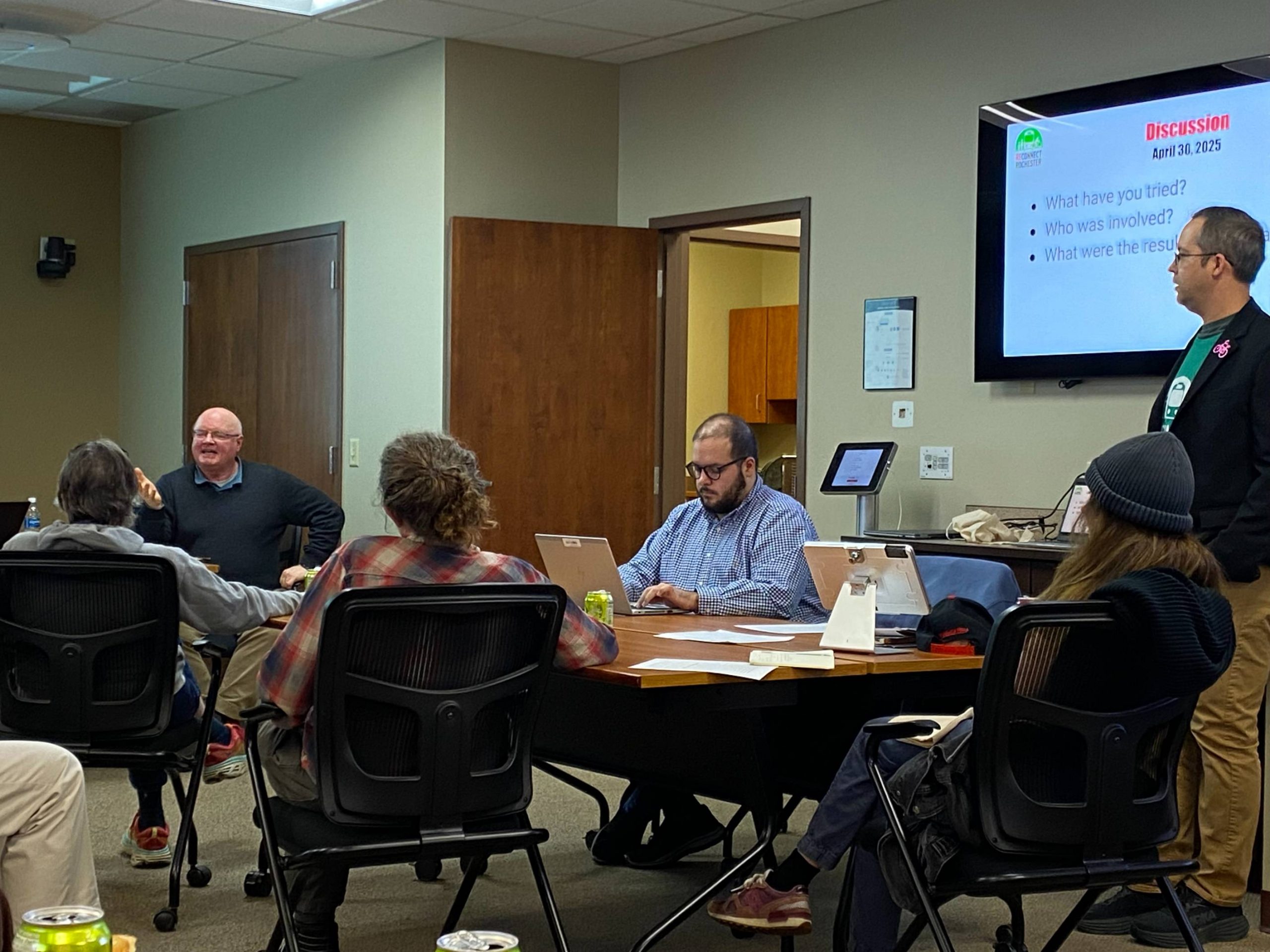
Read our full Monroe County Hopes & Asks document and County Budget advocacy letter.

For example, upcoming projects like Monroe Avenue in Brighton are state projects, and so we need those to also include active transportation features…speaking of which!

Monroe Avenue Public Meeting and Follow-up

Finally, we mobilized advocates to speak up at the Monroe Avenue project public meeting on Jan. 20th. NYSDOT officials heard from Reconnecters who are Britonians and everyone else who just likes to visit Brighton’s businesses by bike, by bus or on foot. As a follow-up to that meeting, we are calling on our advocates to send Action Network emails to the NYSDOT project managers to keep up the pressure. We have a meeting with the new Regional Director of NYSDOT Region 4 in early February where we’ll keep echoing our call for safer state roads.

Coming up next:

by No Comments

A Smarter AV Deployment In New York

Currently, the Governor’s budget proposes to allow for-hire Autonomous Vehicle (AV) operation in New York State outside of NYC. The proposal leaves licensing and regulatory decisions to the DMV. A scaled AV deployment could nearly double vehicle miles traveled, reduce transit ridership by three quarters, and hinder emergency response operations. We encourage the legislature to act with caution and ensure the following nuances are clearly addressed:

  1. Allow municipalities a say in managing their streets: The Governor’s proposal requires a demonstration of local support as defined by the commissioner of the DMV. The NYS legislature should define public support to be in the form of a municipal resolution by the local governmental body (Town Board, Village Board, County Legislature, City Council) and these bodies should be explicitly allowed to create incentive zones, exclusion zones, and other regulations tailored to local needs to address transit deserts, congestion, and other specific local issues.
  2. Transparent data collection & public release: The NYS Legislature should require that metrics including but not limited to disengagements, traffic violations, mileage, incidents involving vulnerable road users, all crashes, and video of crashes should be reported to New York State and posted publicly. Transparency will allow lawmakers, advocates, and academics the opportunity to evaluate the AV pilot program and build trust with the public. 
  3. Time-limited process which requires reauthorization: We support the NYS Legislature requiring a licensing and reauthorization process which evaluates safety traffic control, traffic enforcement, the local workforce, and emergency services. 
  4. AV operators must be held accountable: Law enforcement must be able to issue tickets to AVs which violate vehicle and traffic laws.The Governor’s proposal says vehicles must remain compliant with traffic law but does not provide a framework to incentivize safe operation. 
  5. Remote operator oversight: The NYS Legislature should require that remote AV operators working with vehicles driving on New York’s roadways have a driver’s licence valid in New York State. Companies should be required to disclose training procedures and regulators should establish specific requirements to ensure operators have enough remote operators to respond to their fleet in an emergency.

If you live in New York State, lawmakers need to hear your voice to urge for a cautious and well thought out AV legalization! Please send a letter to your NYS representatives and the Governor’s office with your thoughts.

Image From Dllu via Wikimedia Commons

New York should learn from municipalities across the country, and address these issues proactively:

  • San Francisco has seen a number of dangerous and illegal behaviors by Waymo vehicles including stopping in bus and bike lanes, making illegal u-turns, and recently, the entire fleet stopped working while on the road during a blackout (12/25).
  • In Atlanta, local police officials have complained that there is no process for citing AVs for behaviors that warrant a citation for a human driver(5/25).
  • In Austin, Waymo vehicles have repeatedly failed to stop for school buses, putting children in danger (12/25).
  • In Santa Monica, like in the majority of localities, local officials have officially stated that their hands are completely tied to response to resident requests for policy fixes (6/25).

Help us push for a smarter AV deployment in New York! Use the form below to customize a letter to your representatives!


by No Comments

Embracing Community: 20 Years Car Lite In Rochester

Car Lite Rochester is a blog series that highlights the stories of Rochesterians living a car-lite lifestyle. The term “car lite” encompasses a variety of multimodal transportation lifestyles, featuring little dependence (but not NO dependence) on a car.  It typically looks like sharing one car within a household or only using a car when absolutely necessary.

So, we hope you’ll continue to follow along.  Maybe you will be inspired to join our bloggers in living a car-lite lifestyle!

Wanna rep it? Check out the t-shirt in our online shop.

Embracing Community: 20 Years Car Lite In Rochester

By Leverett “Coach” Copeland:

My family and I arrived in Rochester, NY in the fall of 2005 without a car. We would walk or take RTS to travel around the city and use taxis for groceries. In the 20 years we have resided here in Rochester we only owned a vehicle for 2 years. As a whole we have been car lite most of our Rochester residence.

Having a more comprehensive transportation service like RTS has made it possible to travel to places outside my community and region. Although it is difficult when the weather is either very hot or very cold, because of no shelter or comforts, the transit system in Rochester is very reliable, consistent, and appreciated.

The main reason that we do not use a vehicle is that financially it creates an issue. We could afford the opportunity but with the creation of transportation services like Lyft or Uber, plus stores delivering groceries and food, we enjoy the car lite life. Being car lite helps me familiarize myself with my community and my neighbors. I have the opportunity to build better relationships and my social environment, which improves my health and well being.

Although there are some challenges, such as weather, being car lite has many more positive instances and rewards. Walking through my community, rather than driving, has me more attuned to my neighbors and businesses. I am able to advocate for the community with deeper insight and empathy. It also increases my ability to communicate and represent to those in power what the community desires and needs.

I’m grateful for the Complete Streets Makeover project that Reconnect Rochester did at Avenue D and Hollenbeck last year. It’s good that we worked to make the street safer from reckless driving but also came together to make it happen. I think the biggest thing is that the community feels acknowledged and something was done to meet a need. They have pride in the fact that someone cared enough to try and slow traffic down for their kids and beautify the intersection. We really need it. I think this is the beginning of turning Rochester around – where it’s not as violent but it’s more vibrant

Photo by De’Jon Washington

As for my future being car lite, I believe I will continue and do not see any reason to change. Having a vehicle is nice but for my mental and physical health, as well as community awareness, being car lite is how I will continue. I am able to serve on various committees and boards as well as volunteer and serve in many capacities and being car lite has not diminished my abilities or access.


At Reconnect, we’re inspired by the stories of people in our community, like Josie McClary, Jasmine Burley, and Karen Nozik who are passionate about living a car-lite or car-free lifestyle.  If you want to support our work and make it easier for others to go Car-Lite please donate and sign up for Mobility Action Alerts to stay in the loop with opportunities of how to advocate for safer streets and transportation options.

Let us know if you want to share your mobility story! What’s in it for you? The intrinsic reward of knowing you’ve inspired others, and a free t-shirt from our online shopContact Chaz to submit your story. 

by No Comments

Reweaving a City: Cody Donahue on Bicycles, Belief, and Building a Safer Rochester

Written by George Cassidy Payne and originally published on Medium.


Cody Donahue didn’t grow up with freedom of movement. His childhood stretched along a thin ribbon of rural highway in Oregon’s Willamette Valley — a Walmart, a decimated downtown, and three miles of empty road between home and anything else. “I didn’t have much transportation freedom in my youth,” he says. Bikes came late. Driving later. Independence arrived only in fragments.

He carried that mindset into adulthood: When work calls, a car is the simpler solution. He believed that for years” with “for years, the car was the only option to get around in rural Oregon.”

Then he moved abroad, first to France for study abroad and then to West Africa to work for a nonprofit.

In Dakar, he discovered a city humming without car dominance. People moved through dense streets by foot, bike, taxis, and informal buses called “Ndiaga Ndiayes”, an ecosystem built on proximity rather than horsepower. “Only the very rich had their own car. You could get anywhere by other means. It was a different way of moving,” he recalls.

That realization reshaped his sense of what mobility could be.

Today, as Co-Executive Director of Reconnect Rochester, Donahue channels that revelation into the city he now calls home. He chains errands, bikes to work, hops the 17 bus when the weather turns. Simplicity is the point. Connection is the ethos.

Rethinking the Urban Core

Ask Donahue what Rochester could look like without political or financial constraints, and he doesn’t leap into fantasy. He points to a real project already unfolding: the Inner Loop North redesign.

“We’re actually getting the opportunity to do this,” he says. “The project will replace a sunken, underutilized highway that disconnects neighborhoods with a neighborhood scale street grid. We’re not advocating to eliminate roads — but to create spaces where people can feel comfortable walking and biking with their families. ”

The plan envisions creating 22 acres of new development parcels in the heart of the city, with calm, tree-lined neighborhood streets, restored parks, integrated walking and cycling infrastructure, and connections to the future High Falls State Park. Each section of the 1.5 mile stretch can be somewhat different, but Donahue is excited about the possibility for mixed-use, dense development, and ground-floor businesses around our transit hubs. “We can build up around our Intermodal Station while also expanding its footprint to be the hub for intercity buses,” said Donahue of a project that has state funding and will run in parallel to the Inner Loop North redevelopment.

“This whole area is going to be a lot more vibrant and connected,” Donahue says. “The uncomfortable truth about the Inner Loop is that it was designed to bring people from the suburbs to work and then back home. It wasn’t built for city residents. This project corrects that.”

The state has already secured $100 million for construction. While timelines may shift, bidding is set for September 2027, construction begins in April 2028, and completion is projected for October 2030. Parcel development will follow over the subsequent years, reshaping not just infrastructure but the way people live and move in Rochester.

The Hidden Curriculum of Movement

“Reconnect Rochester now offers everything from ‘Getting Back on Your Bike’ workshops to school safety lessons, winter cycling training, commuter programs, and hands-on Smart Cycling classes,” Donahue says. As he scales that range — from fifth graders to downtown workers — patterns emerge.

“We’re really invested in bike education because kids should have it,” he says. “When they don’t, they develop unsafe habits and carry them into adulthood. That contributes to crashes.” Nearly half the time, the cyclist triggers the crash — not necessarily because they’re reckless, but because no one ever taught them the proper way to ride.

That lack of training intersects with a fragmented bike map.

“We have cycling infrastructure gaps we’re trying to close. The bike lane map looks like someone threw spaghetti at a wall,” he says. “Our Mind the Gap competition helps identify the highest priority connections for the city and the county to make for a comfortable bike network.”

Residents want comfort, predictability, and physical protection. That requires real design: barriers in the street, well-placed cycle tracks, infrastructure that doesn’t force riders onto sidewalks.

Culture plays a role too. Donahue and his team work with employers to add bike parking, secure racks through the city, or negotiate indoor, secure bike storage with landlords. A new downtown lunchtime learning series reaches commuters who may have never imagined biking to work. They hope to reach downtown companies with lunch and learns next year to show downtown workers just how fast and easy it is to bike to work in the Central Business District of Rochester. In May, Reconnect will again host bike to work day to reach new commuters.

Then, there is the matter of our snowy winters. “The world doesn’t shut down in the winter,” Donahue says. “I drive more, but I also take the bus more. Some fat tire bikes handle snow better. And we continue to push the city to clear main bike routes. The City has committed to studying enhanced winter maintenance, so we’re making progress.”

True cultural change, though, requires leadership.

“We’d like to see more of a culture of property owners taking responsibility for clearing sidewalks,” he says. “Madison, Wisconsin has a great approach. It’s just a different civic culture when it comes to tending to the snow.”

A Concerning Trend and an Urgent Response

The national context is grim. Pedestrian fatalities in the U.S. have risen 75% since 2010. Locally, Monroe County averages 12 walking or biking deaths per year, and 2025 has already exceeded this average at 13 as of December.

“We must do better,” Donahue says. “These are preventable losses.”

To shift that trajectory, on-street demonstration projects matter. In 2025, Reconnect Rochester launched Downtown SmART Streets, inspired by Washington, D.C. ‘s Arts in the Right of Way program. Seasonal curb-extension murals function as both art and traffic-calming infrastructure, beautifying streets while protecting people.

The 25 MPH Shift and the Politics Around It

Rochester has embraced ambitious mobility goals, Vision Zero, safer arterials, expanded bike networks, but serious injuries and deaths continue to rise.

Donahue is clear about the most actionable fix: lower the citywide speed limit to 25 miles per hour.

A municipal lawyer working with Reconnect Rochester produced a comparative analysis: Boston and Seattle implemented the reduction; Providence did not. Even without added enforcement, the cities that lowered the limit saw reductions in speeds, crash rates, and fatalities. Albany is now seeing monthly declines as well.

“The bottom line is that these programs reduce fatalities,” Donahue says. “This is our guiding star. Slower speeds save people walking to the bus, cyclists, kids — everyone.”

He insists that driver accountability must be part of the solution.

“We can stop those who have no regard for people,” he says. New York State is considering legislation to require the worst repeat speeders to drive with speed governors — devices that physically prevent them from exceeding safe limits. “These policies work.”

And the stakes are bigger than traffic engineering. “We’ve backed ourselves into a societal corner where parents don’t feel comfortable letting their kids walk down the street.”

Where Expertise Lives: Complete Streets in Action

The Avenue D & Hollenbeck Complete Streets Makeover crystallized a principle Donahue now calls non-negotiable: lived experience is expertise.

“It was our fifth complete street makeover — what we call the quadfecta, one in each quadrant before returning to the Northeast,” he says. “We sourced nominations citywide. One thing we learned from the Arnett Boulevard project is that some roads are classified by the state to prioritize vehicular traffic. So our makeovers are now looking at the most local road you can get to reduce the restrictions on what we can do.”

The neighborhood’s R-Center staff had been clamoring for improvements. Their knowledge shaped the project’s design: temporary installations, seasonal centerline flex posts, and monitored interventions. “All summer and fall, not one post needed to be replaced due to damage,” Donahue notes. “We’re conducting a traffic study on speed and turning to evaluate the effectiveness. We plan on doing new installations in new locations over the next three years.”

Complementing these interventions is a design rendering prize, offering a professionally engineered visualization to a neighborhood free of charge. Monroe Avenue in Brighton received one in 2019, now actively used in state-level advocacy to enhance safety and create more vibrant public space.

Downtown, the SmART Streets initiative extends this philosophy: seasonal curb-extension murals at East Main and Gibbs, Broad and Fitzhugh, with more to come, reinforcing walkability through public art. The work demonstrates how neighborhood input and tactical design combine to reduce risk and foster a safer, more inviting urban environment.

Influence, Advocacy, and Evolving Beliefs

Donahue’s campaigns- Intermodal Station expansion, suburban walk audits-highlight a key lesson about New York transportation politics: advocacy matters.

“I would point to a common thread: resident voices,” he says. Promoting density and mixed-use development brings daily amenities closer to homes, reducing car dependence and improving safety.

“The NIMBY contingent is usually a vocal minority,” Donahue notes. “We’re trying to promote YIMBY: yes in my backyard. Call your local officials. Tell them you want sidewalks, bike lanes, transit, more mixed use neighborhood amenities.”

A recent candidate questionnaire across several towns showed majority support for safer streets. Those elected embraced these changes. “We want people showing up to public meetings,” Donahue says. “It makes a difference.”

Reflecting on his early advocacy, he admits a lesson learned:
“Early in my career, I thought there was one right way to do things. But there isn’t. It’s important to realize we can reach the same conclusions through different methods. Live the experience of the people you’re making policies about. If you’re making bus policies, take the bus for a month. We become extremely fragmented in our lived experiences. It’s not obvious we’ll reach the same conclusion, but you have to identify your values and fight for them.”

A City Rewoven

Donahue’s path arcs from a rural upbringing to a global awakening to a Rochester in transition. Throughout, one conviction anchors him: every person deserves to move safely, freely, and with dignity.

He thinks of Dakar, where movement was communal. He thinks of Highway 20 in Oregon, where mobility required horsepower. And he looks at Rochester — slowly, collaboratively reimagining itself.

Rochester is being reweaved. Not just the roads. The relationships.

And for a city once carved apart to speed commuters, that may be the most transformative redesign of all.