by No Comments

The Case for Open Streets

By Hendrik de Smidt

As winter loosens its grip on Rochester, Iโ€™m eager to get outside and enjoy the sunlight of longer days.ย  Many of my cherished fair-weather memories share a common thread: the terrace and the plaza.ย  Internationally, outdoor drinking and dining are cultural institutions.ย  Town squares and city streets around the world are packed with tables.ย  The air is filled with the sounds of conversation and the smell of fresh food.ย  City planners and community members are intentional about creating safe, calm oases within the urban context to eat, drink, walk, and socialize.
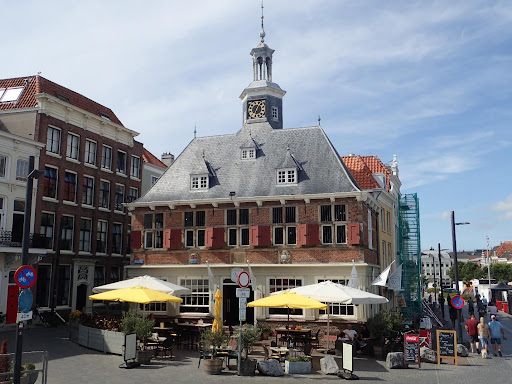
Sadly, this experience is not the norm in our city.ย  With so much of our public realm surrendered to travel lanes and parking spaces, there is little space left for people.ย  Even downtown and in entertainment districts like Park Ave, cars are prioritized while humans are pushed to the margins.ย  Where outdoor seating is available at all, it often encroaches onto already too-narrow sidewalks, creating conflicts between diners and pedestrians.ย  And if you can find outdoor seating, it is frequently located within just a few feet of high-speed car traffic, with all the accompanying noise and fumes.ย 

While I see this situation as a tragedy, defenders of the status quo insist that allocating valuable urban space for outdoor dining and recreation is pointless in a city like Rochester which is gripped by snow and ice for 3-4 months of the year.ย  While on the surface this argument sounds logical, our neighbors to the north see things differently.


City streets around the world are packed with tables.ย  The air is filled with the sounds of conversation and the smell of fresh food…in our city if you can find outdoor seating, it is frequently located within just a few feet of high-speed car traffic with all the accompanying noise and fumes.


Every year during the winter months, the city of Montreal, Quebec is pummeled by an average of 83 inches of snow, with average temperatures below 20 degrees Fahrenheit.ย  To put it in perspective, that is almost as much snow as we get in Rochester with a lower average temperature!ย  But rather than basing decisions about urban space for the whole year on the coldest three months, Montreal has a different philosophy.ย  Every summer, they open up some of their most vibrant city streets for walking, biking, and outdoor dining.ย  Local artists and community members are called in to beautify their thoroughfares with planters, murals, and street furniture.ย 

Montreal has been doing this for several years, and the program is so popular (both with the public and with businesses) that it has been repeatedly extended and expanded.ย  This year, 8 different streets will be closed to cars, and opened to people, from the end of May to mid-October.ย  And itโ€™s not just the Canadians.ย  This year, New York City will fully or partially close sections of over 50 streets for cars to open them for people.ย  This is on top of recent projects which have removed vehicle traffic from some sections of Broadway in the heart of Midtown Manhattan.

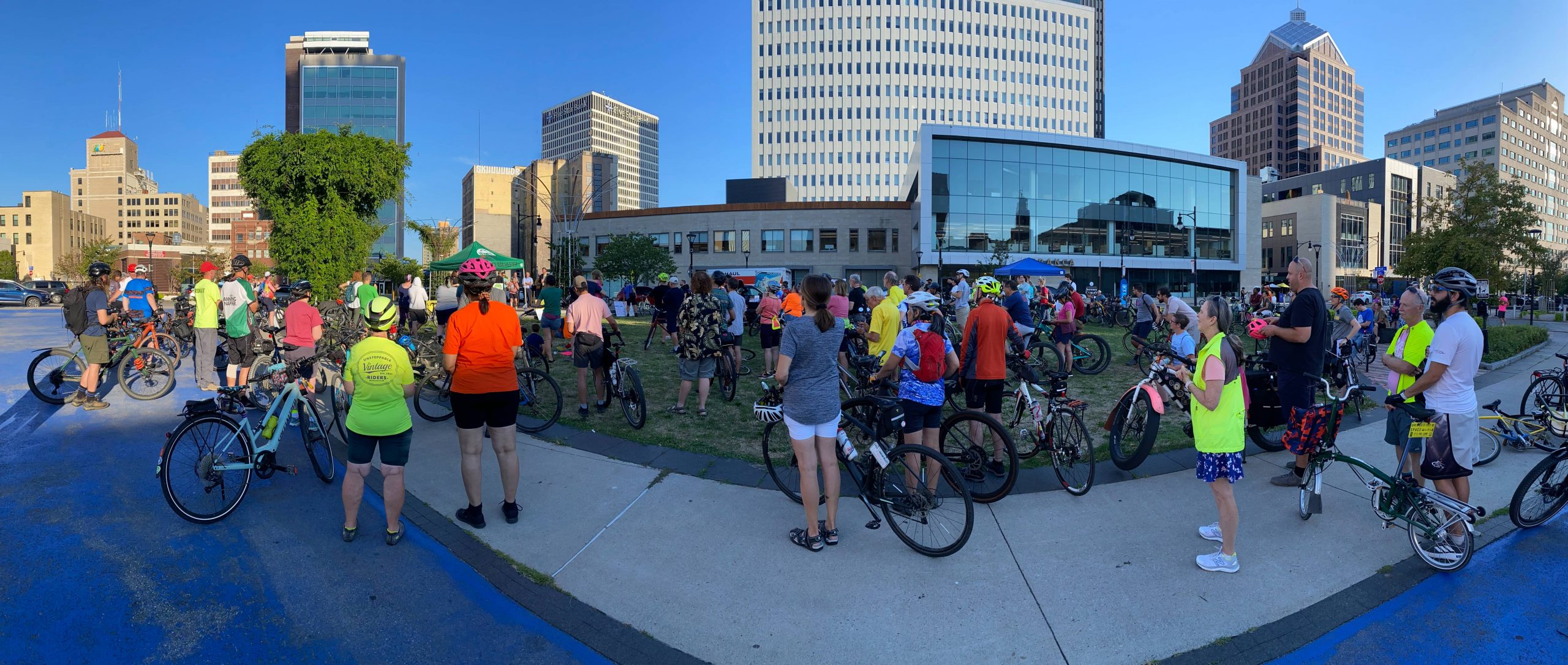
Despite our smaller population, I think this is something we could emulate in Rochester; perhaps from the beginning of the Jazz Festival in June to the end of the Fringe Festival in September.ย  Partnerships could be created with these festivals, as well as other events and local businesses, to active the newly available public space.ย  Here are my nominations for Rochester Open Streets.

Gibbs Street between Main Street and East Ave:
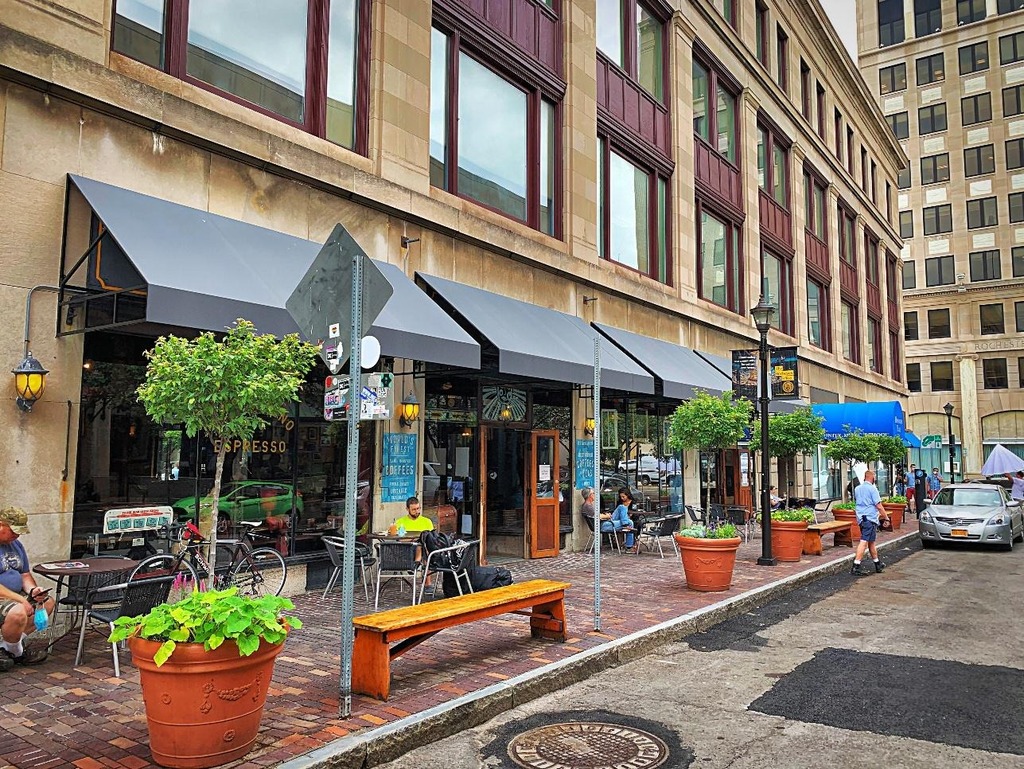
Located directly in the middle of the Eastman School of Music campus, this is area is the closest thing that the prestigious college has to a โ€œquad.โ€ย  A pedestrianized Gibbs Street would act as an extension of the existing pocket park on the corner of Main and create enough space for small outdoor concerts.ย  It would also allow expanded outdoor seating for Javaโ€™s Cafรฉ, Ludwigโ€™s Center Stage Cafรฉ, and Max Chophouse; all of which front onto this section of Gibbs.

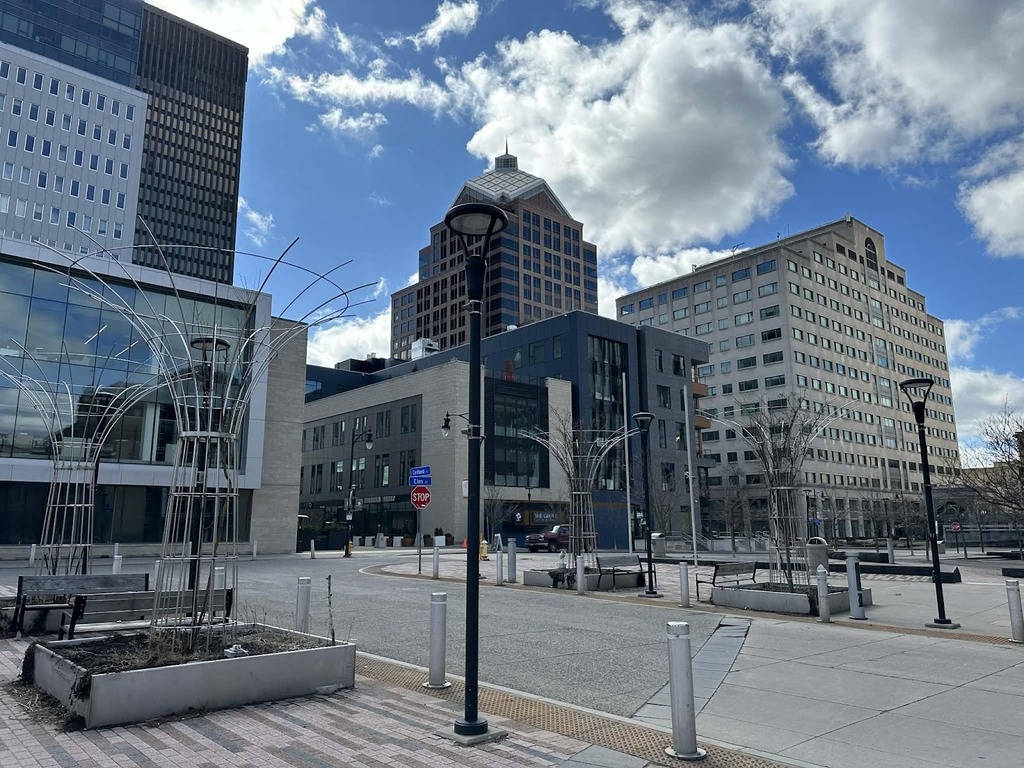
Elm Street and Cortland Street at Parcel 5:

Parcel 5 has been growing in popularity as a venue for events and public gatherings; however, Elm and Cortland currently separate it from the nearby pedestrianized areas of Midtown Commons and The Grove to the southeast.ย  Pedestrianizing these two streets would connect existing assets into a proper public square with the capacity for larger community events.ย  It would also provide additional outdoor dining capacity for Branca, Patron Saint, and the food trucks that frequently set up shop in the area.
Park Avenue from Berkeley Street to Culver Road:
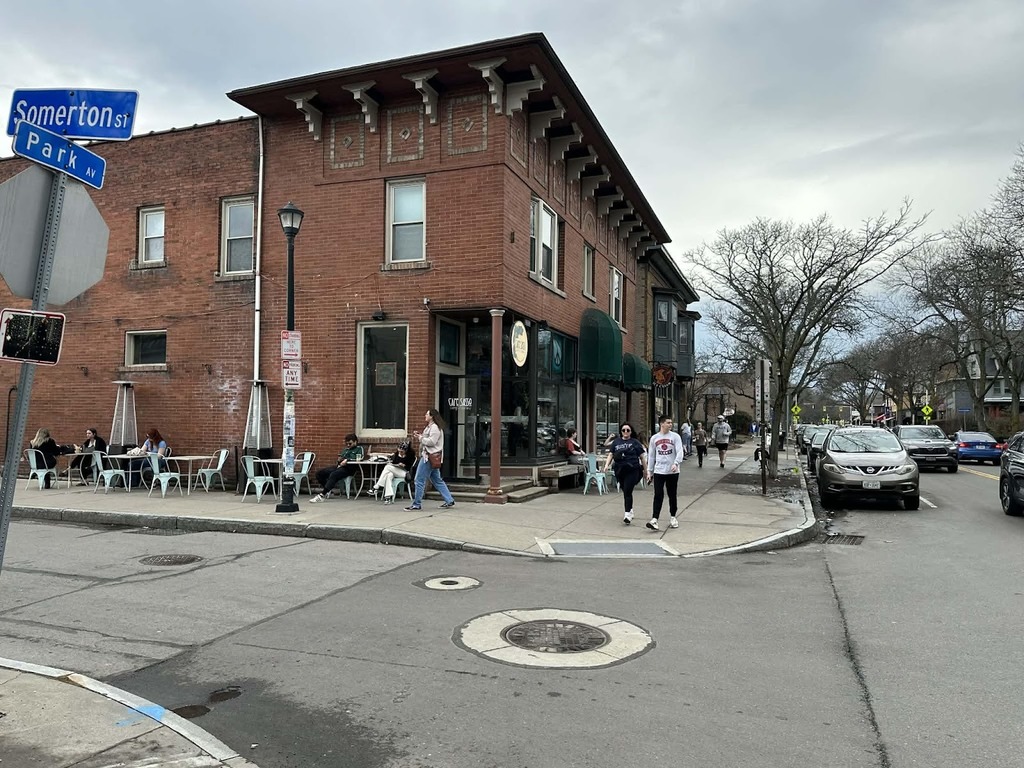
This stretch of Park Ave is home to many beloved restaurants and cafes.ย  While I would love to see the entire length of Park Ave receive the Open Streets treatment, this section is the most obvious and least disruptive.ย  RTS service could be shifted to East Ave during the window.ย  Alternatively, a 12-foot span in the center of the roadway could be left unobstructed to create a temporary transit mall.ย  This intervention would truly bring the corridor to life during some of its most vibrant months.


Which of these locations would you most like to see receive an Open Streets treatment?ย  Is there another location in the City of Rochester you would like to see temporarily or permanently pedestrianized?ย  Let us know!
by No Comments

Advocacy Team Updates: Spring is Springing Edition

After weeks of collectively feeling underwhelmed by the Cityโ€™s snow management, we welcome the time of year when Rochesterians bundle up for early spring walks and rides! Up until last week, a lot of our public right of way was icy and unrideable, but kudos to everyone (City and private property owners) who cleared their paths and sidewalks to make the melt go faster.

Below are a few highlights from the last few weeks in our Advocacy Teamโ€™s work!
Slowing down the roll out of Autonomous Vehicles

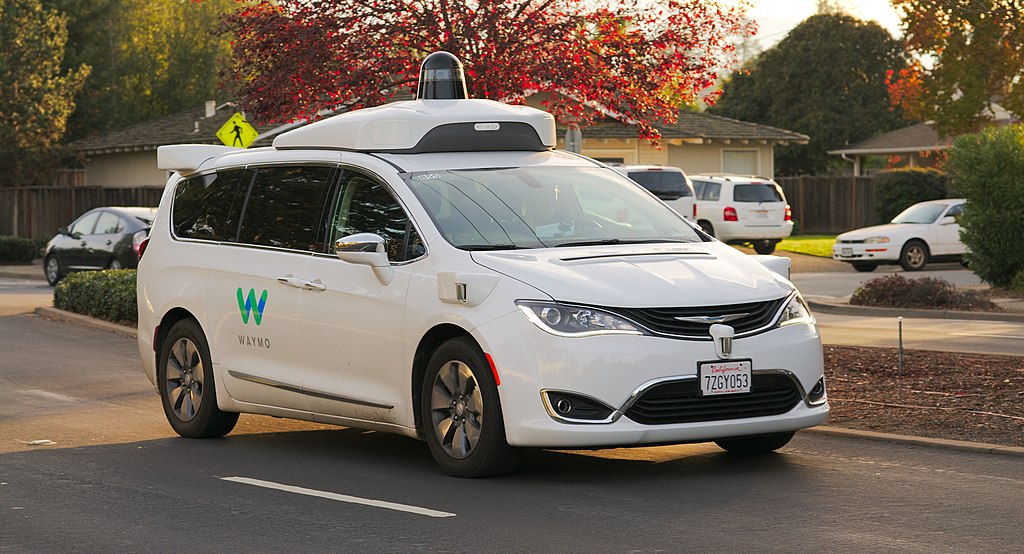
After Reconnect Rochester, upstate organizations and advocates highlighted the risks of a rapid roll-out of autonomous vehicles, Governor Hochul removed the proposal from her budget in her 30 day amendments. All signs point toward a continued push during the legislative session, so we’ll keep pushing our message of transparency and oversight.

Image From Dllu via Wikimedia Commons

Road Projects Toolkit and Book Talk

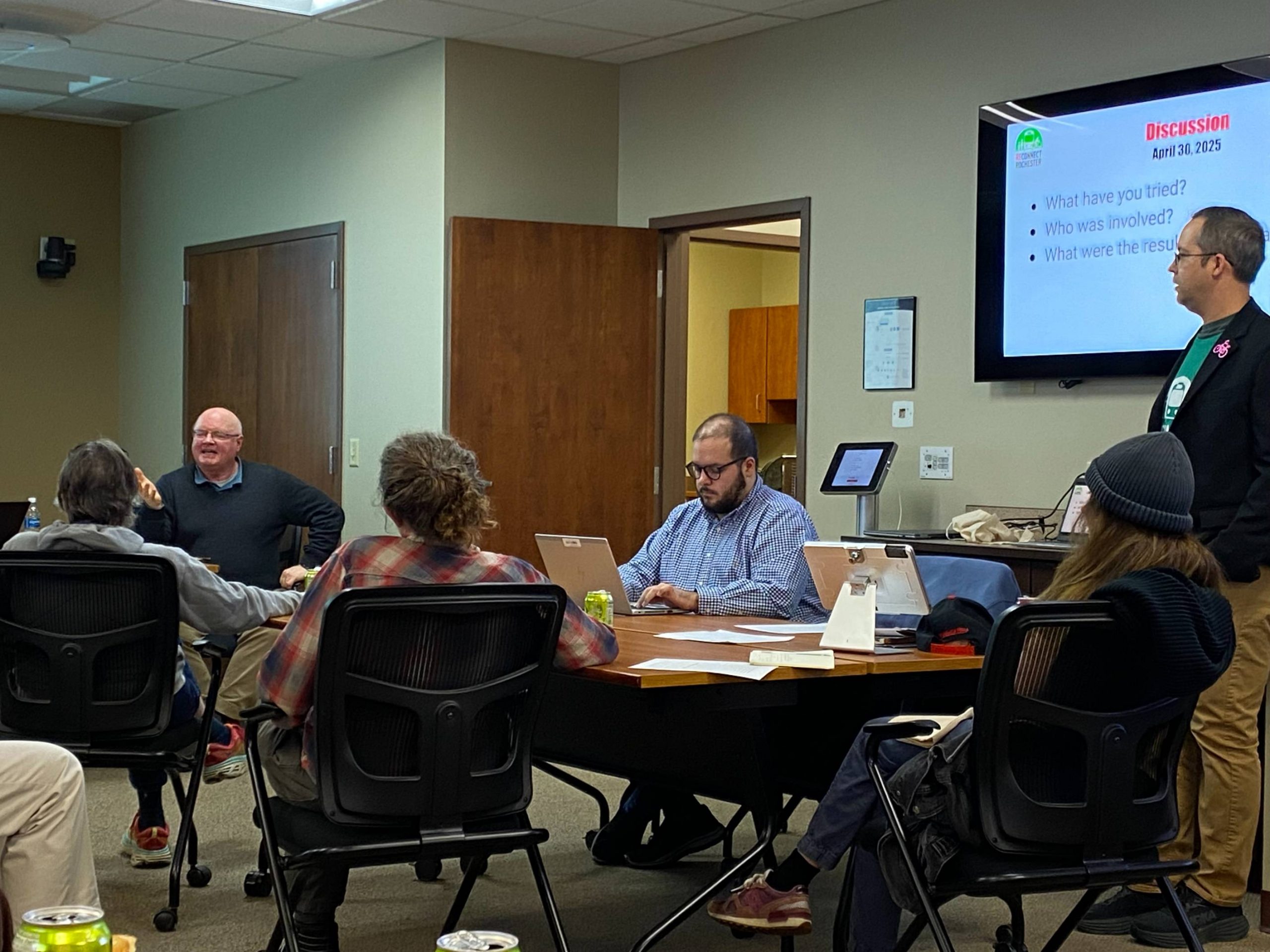
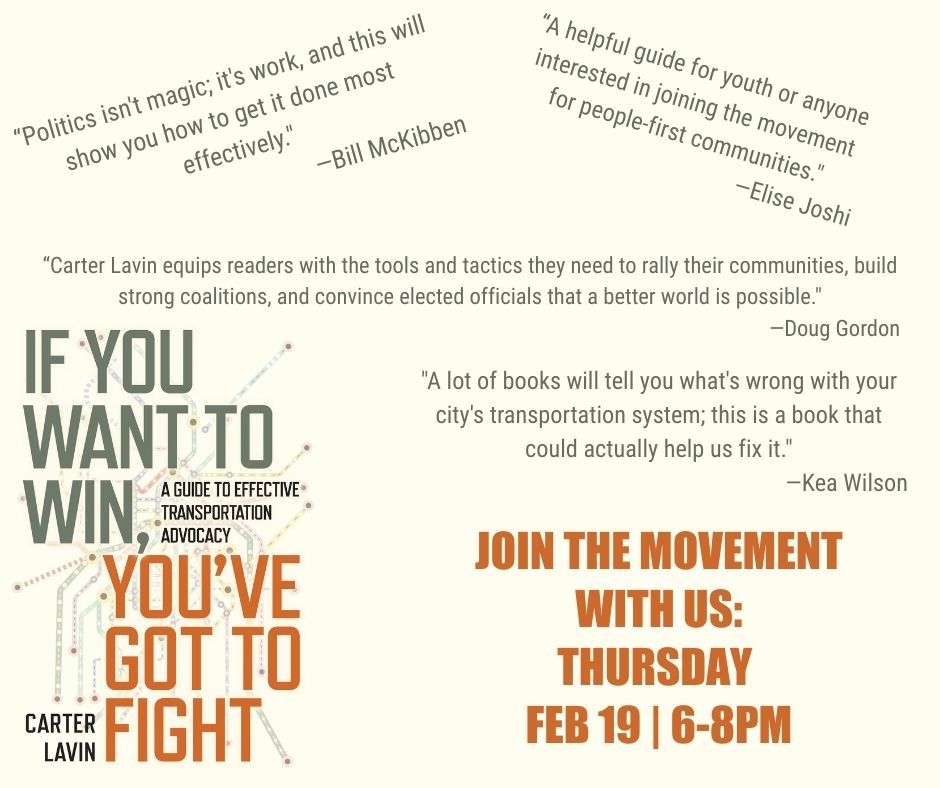
We held our second community conversation of 2026 with Carter Lavin, author of If You Want to Win, Youโ€™ve Got to Fight. If you missed it, watch the recording here and buy Carterโ€™s book! We also launched the Reconnect Rochester Road Project Advocacy Toolkit, outlining some of the most useful things weโ€™ve learned while doing road project advocacy. Take a look and give us your feedback so we can improve the usefulness of the information.

Better Buses for Rochester

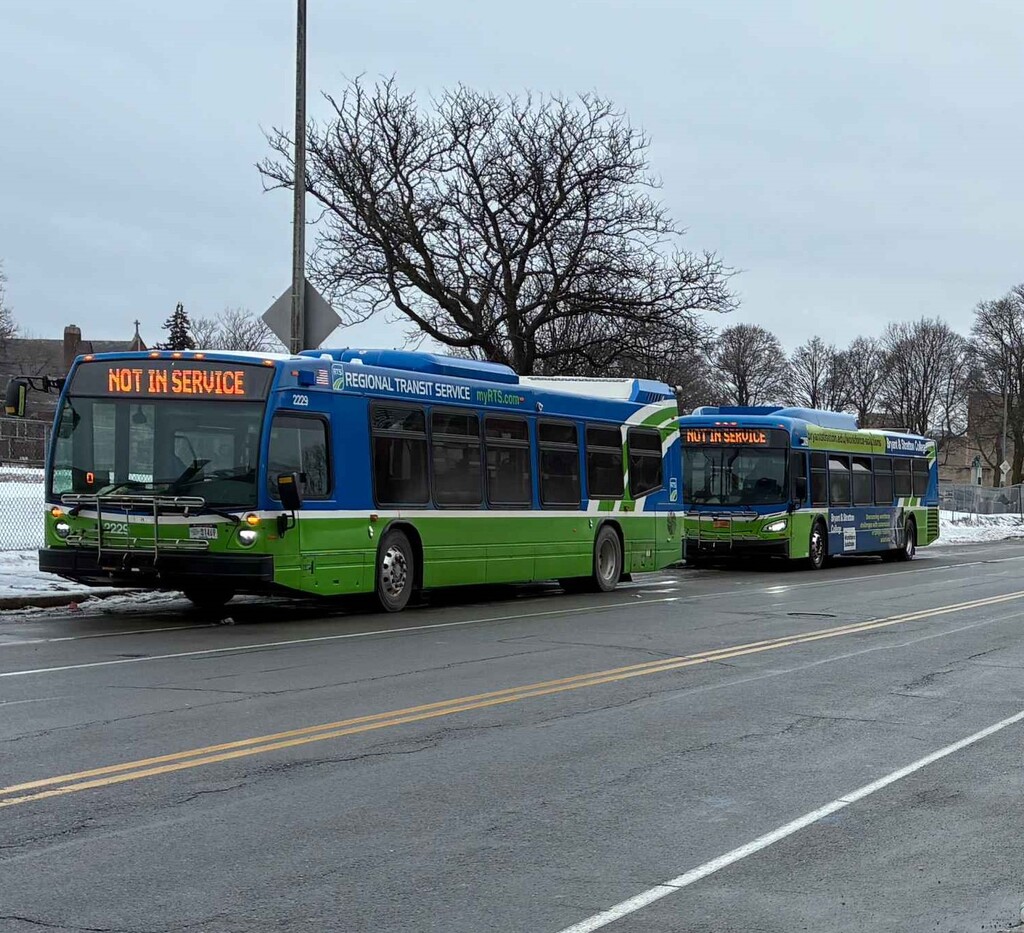
Transit Awareness Month in February saw a flurry of activity. We mobilized a joint letter with RMAPI, Climate Solutions Accelerator and Healthi Kids on transit funding, attended a legislative breakfast in Albany with the State Legislature Transportation Chairs, met with lawmakers to share support for DMV Surcharge, and put out the third edition of the Voices of Transit series. To better understand RTSโ€™s funding crunch, read the Beaconโ€™s great overview.

Supporting Crash Victims

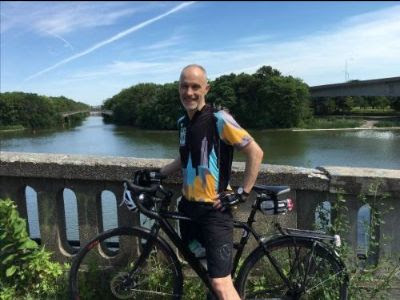
As a follow up, we installed a Ghost Bike in 2025 for Jerome Blocker and his family members have been active advocates with Reconnect since then. The driver of the vehicle that struck and killed Blocker, then left the scene, was sentenced this week.

Coming up next:

  • Reconnect Rochester is getting ready to fly to DC for the League of American Bicyclists Summit and we will be lobbying on capital hill for funding to multimodal transportation projects in the next transportation reauthorization bill!
  • Save the date: Weds, May 13th is NYS Safe Streets Day of Action in Albany!
  • Save the date: Thursday, May 21 – Reconnect Rochester community conversation on eBikelash!
by No Comments

Launching our Advocacy Toolkit and Book Talk of If You Want to Win, Youโ€™ve Got to Fight

Reconnecters,

People power this movement for more transportation options and a vibrant community – through riding, walking and raising your voice. Your voice can make a difference speaking to your municipal, county, state and federal leaders to get improvements made to your street, bike lanes and sidewalks in your community.

But we know it can be daunting for newcomers to understand the difference between a bump-out and daylighting and any number of other bespoke transportation terms. Thatโ€™s why today weโ€™re launching Making Streets Safer and More Multimodal in Monroe County – A Living Advocacy Toolkit from Reconnect Rochester!

This toolkit is a compilation of everything weโ€™ve found useful and important in understanding different road projects, national trends and local plans to enhance our multimodal transportation network! It contains links to other partner resources that go deep into all aspects of safe road designs for all users – from kids to seniors and every ability in between.

Why is this important to Reconnect?

All of us on staff are residents and advocates. None of us have degrees in urban planning or traffic engineering. Weโ€™re self-taught and we have lived experiences riding the bus, a bike, and walking. We all decided at a certain point that this was a topic we wanted to learn more about, and joined with others to identify a project we wanted to fight for.

In advocacy, thereโ€™s a ladder of engagement and we want more residents to be engaged, knowledgeable and powerful in advocating for their neighborhood’s needs. That means having access to the same information, resources and frameworks that we have. Itโ€™s fine if you want to trust us and copy the talking points from Mobility Action Alerts, but we also think itโ€™s important to share the knowledge and inspiration while we advocate.

We want to hear your perspectives

Whether you spend time with this guide or not, we always want to hear from you about local projects. Send your thoughts and ideas to our email. Our input to the City, County, State and Federal partners should always be grounded in your feedback.

An invitation

Our blog and social media are great ways to share an idea youโ€™ve had for your community. Write up a 300-500 word post with original pictures and share them with Reconnect and weโ€™ll work with you to get your idea out there. Weโ€™ve previously featured ideas about High Falls that might get real treatments in upcoming projects, visions of Bus Rapid Transit on Lake Ave, and proposals for a mixed-use trail on the east side of Irondequoit.ย 

An opportunity to learn more THIS MONTH!

Join Us!ย Thursday, Feb. 19th, 6-8 pm

Book Talk: If You Want to Win, Youโ€™ve Got to Fight by Bay Area transportation advocate and trainer Carter Lavin. Carter has written the definitive guidebook on how to get involved in transportation advocacy – from the very first step all the way through to winning.ย We hope you’ll join our February community conversation.

by No Comments

Kicking off 2026 with the Mayor, the County Executive and a ROC Vision Zero update

Reconnecters,

The Advocacy Team has kicked off 2026 with a slate of meetings with our local leaders to advocate for the things you care about: safer streets, more bike infrastructure, and places that feel safe to walk in.

City of Rochester Mayor Evans & New Vision Zero Report

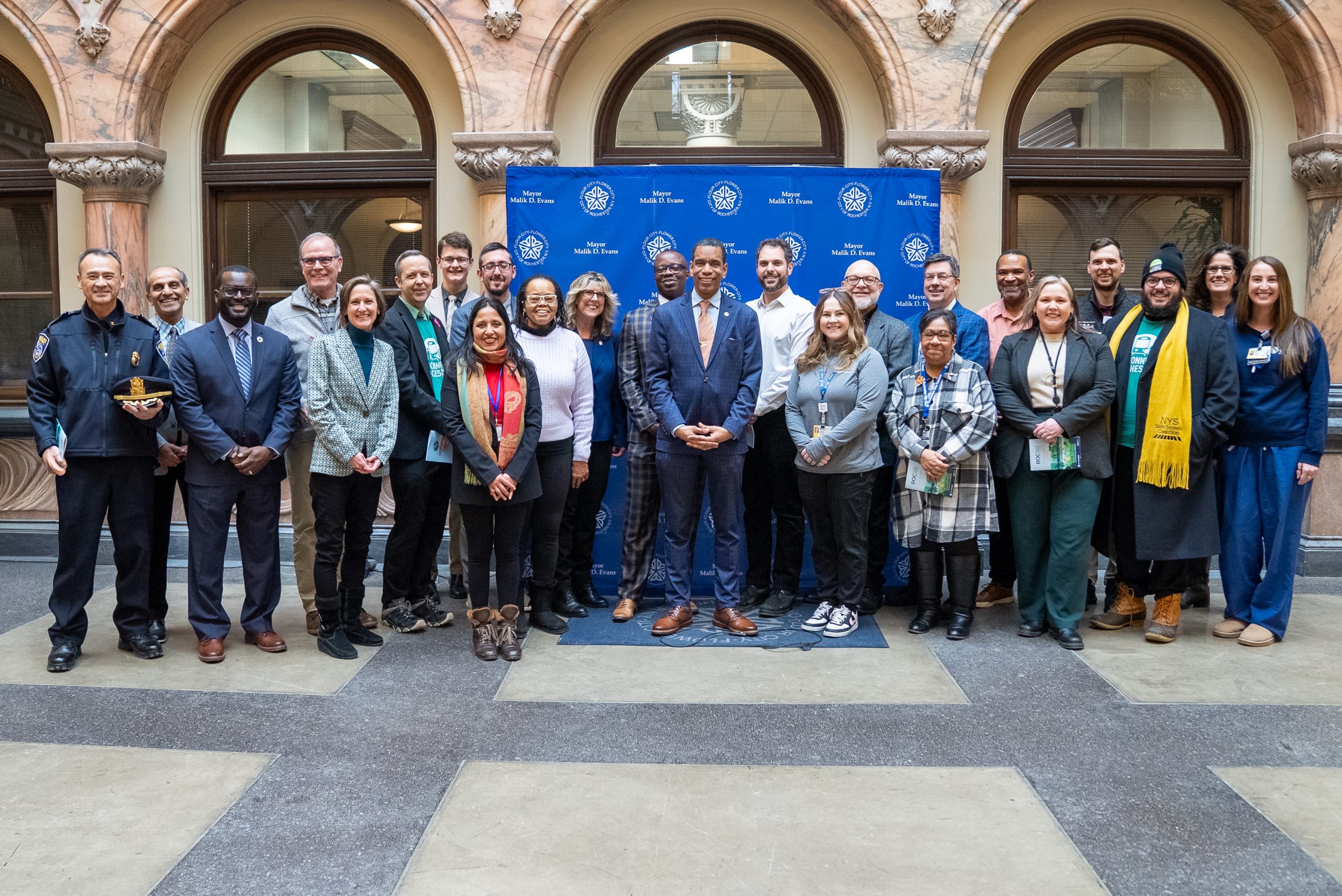
We began with our annual sit-down with newly (re)inaugurated Mayor Evans and his newly confirmed Commissioner of the Department of Environmental Services, Kabutey Ocansey on the same day the City of Rochester officially started issuing bus patrol tickets (If you have a sec, watch the bonkers video of cars passing stopped school buses). During our meeting we focused on several ROC Vision Zero topics:

  1. We should lower the speed limit to 25 MPH in the City of Rochester as soon as possible. The Mayor confirmed the City is moving forward with this change, as reflected in the ROC Vision Zero report.
  2. The City can establish more quick-build mechanisms to quickly respond to traffic safety concerns, build confidence in ROC Vision Zero, and try new approaches to multimodal safety. 
    • We are committed to working together with the Cityโ€™s Vision Zero task force to help bring national examples from Pittsburgh, Portland, Sacramento and even small municipalities like Keyport, NJ to the table.

You can read our Executive Summary of City of Rochester Hopes & Asks and our Budget Advocacy Letter here. 

We also followed up with Mayor Evans about the building of the Intermodal Station Bus Terminal Phase 2, which NYSDOT has funds to build and Amtrak has responsibility to operate. We understand they are working behind the scenes on several issues, but we are also advocating to NYSDOT in Albany to press forward on the design of the station.

Last week, the City also released its first ROC Vision Zero report to the community. It contains a ton of useful information about what the City, partners and community stakeholders, including Reconnect Rochester, have been doing on the initiative over the past year. Weโ€™re excited about the year ahead because the report outlines several tangible projects that residents will start to see in their communities, like protected bike lanes, pedestrian enhancements, new bus amenities, and slower speeds. Driver accountability will also take center stage this spring with more public engagement around how drivers who break the law speeding or running red lights should be held accountable.

County Executive Bello Check-In

Monroe County government has been leading the charge to encourage Active Transportation Planning, expanding how community members can report traffic concerns, and to plan for sustainability. During our meeting with CE Bello, we emphasized that now we need to amp up implementation of active transportation. Towns and Villages in Monroe County have some local roads, some county roads and some state roads, and the county maintains 664 centerline miles of roads. The CATP calls for building out a network of bike lanes, but the county budget only envisions 4 miles of bike lanes per year and 10 miles of shoulder widening to make it more suitable for biking and walking per year. At that rate, we wonโ€™t have a connected network for a very very long time! Some of the town roads are state roads, which is why weโ€™ve put so much emphasis on building a movement for safer state roads. 

Read our full Monroe County Hopes & Asks document and County Budget advocacy letter.

For example, upcoming projects like Monroe Avenue in Brighton are state projects, and so we need those to also include active transportation featuresโ€ฆspeaking of which!

Monroe Avenue Public Meeting and Follow-up

Finally, we mobilized advocates to speak up at the Monroe Avenue project public meeting on Jan. 20th. NYSDOT officials heard from Reconnecters who are Britonians and everyone else who just likes to visit Brightonโ€™s businesses by bike, by bus or on foot. As a follow-up to that meeting, we are calling on our advocates to send Action Network emails to the NYSDOT project managers to keep up the pressure. We have a meeting with the new Regional Director of NYSDOT Region 4 in early February where weโ€™ll keep echoing our call for safer state roads.

Coming up next:

by No Comments

A Smarter AV Deployment In New York

Currently, the Governorโ€™s budget proposes to allow for-hire Autonomous Vehicle (AV) operation in New York State outside of NYC. The proposal leaves licensing and regulatory decisions to the DMV. A scaled AV deployment could nearly double vehicle miles traveled, reduce transit ridership by three quarters, and hinder emergency response operations. We encourage the legislature to act with caution and ensure the following nuances are clearly addressed:

  1. Allow municipalities a say in managing their streets: The Governorโ€™s proposal requires a demonstration of local support as defined by the commissioner of the DMV. The NYS legislature should define public support to be in the form of a municipal resolution by the local governmental body (Town Board, Village Board, County Legislature, City Council) and these bodies should be explicitly allowed to create incentive zones, exclusion zones, and other regulations tailored to local needs to address transit deserts, congestion, and other specific local issues.
  2. Transparent data collection & public release: The NYS Legislature should require that metrics including but not limited to disengagements, traffic violations, mileage, incidents involving vulnerable road users, all crashes, and video of crashes should be reported to New York State and posted publicly. Transparency will allow lawmakers, advocates, and academics the opportunity to evaluate the AV pilot program and build trust with the public.ย 
  3. Time-limited process which requires reauthorization: We support the NYS Legislature requiring a licensing and reauthorization process which evaluates safety traffic control, traffic enforcement, the local workforce, and emergency services.ย 
  4. AV operators must be held accountable: Law enforcement must be able to issue tickets to AVs which violate vehicle and traffic laws.The Governorโ€™s proposal says vehicles must remain compliant with traffic law but does not provide a framework to incentivize safe operation.ย 
  5. Remote operator oversight: The NYS Legislature should require that remote AV operators working with vehicles driving on New Yorkโ€™s roadways have a driverโ€™s licence valid in New York State. Companies should be required to disclose training procedures and regulators should establish specific requirements to ensure operators have enough remote operators to respond to their fleet in an emergency.

If you live in New York State, lawmakers need to hear your voice to urge for a cautious and well thought out AV legalization! Please send a letter to your NYS representatives and the Governorโ€™s office with your thoughts.

Image From Dllu via Wikimedia Commons

New York should learn from municipalities across the country, and address these issues proactively:

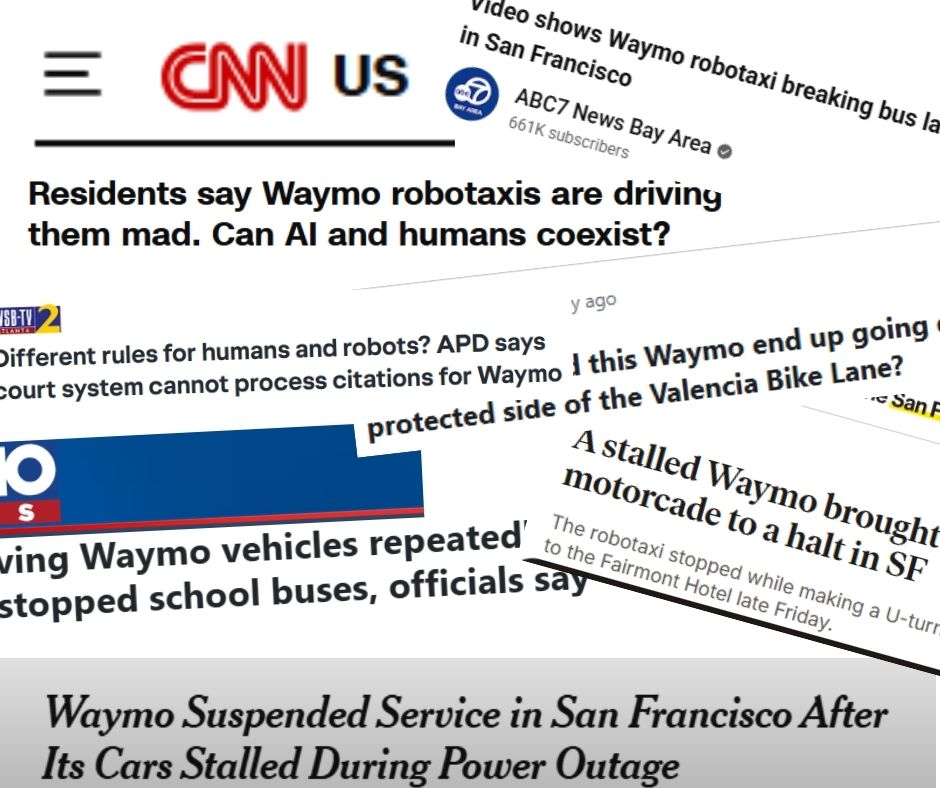
  • San Francisco has seen a number of dangerous and illegal behaviors by Waymo vehicles including stopping in bus and bike lanes, making illegal u-turns, and recently, the entire fleet stopped working while on the road during a blackout (12/25).
  • In Atlanta, local police officials have complained that there is no process for citing AVs for behaviors that warrant a citation for a human driver(5/25).
  • In Austin, Waymo vehicles have repeatedly failed to stop for school buses, putting children in danger (12/25).
  • In Santa Monica, like in the majority of localities, local officials have officially stated that their hands are completely tied to response to resident requests for policy fixes (6/25).

Help us push for a smarter AV deployment in New York! Use the form below to customize a letter to your representatives!


by No Comments

Simplicity and Saving – Two Motivations for Being Car-Lite

The term โ€œcar liteโ€ encompasses a variety of multimodal transportation lifestyles, featuring little dependence (but not NO dependence) on a car.  It typically looks like sharing one car within a household or only using a car when absolutely necessary.

Wanna rep it? Check out the t-shirt in our online shop.

Simplicity and Saving – Two Motivations for Being Car-Lite

By Cody Donahue:

As the holiday season ramps up, I am probably with the majority of Americans when I say that Iโ€™d really like to save more money while still fully celebrating our holiday traditions. Over the years, the holidays seem to start earlier and earlier and the expectations of giving and getting keep inflating. As does cost: Bloomberg found that inflation and tariffs are driving up costs for just about every category of holiday giving. Sorry family, itโ€™s socks for everyone!

While many of us are stressed and anxious about the gift and food budget, letโ€™s throw the overwhelming cost of car ownership into the mix. For years, we have reported on the AAAโ€™s cost of car ownership, but I just recently saw USA Todayโ€™s report that put car ownership in the perspective of โ€œThe American Dream.โ€ To achieve the โ€œAmerican dreamโ€ of owning a new car, a dream shared by 72% of Americans, youโ€™ll have to spend $900,346 over your lifetime in 2025, up from $811,440 a year ago. By comparison, a lifetime of homeownership costs $957,594, up from $929,955 in 2024.

Amazingly, car ownership roughly costs the same as raising two children and sending them to college. In a place like Rochester, itโ€™s incredibly hard to have young kids and not drive one or sometimes two cars. And if you canโ€™t afford cars, you probably have no other choice than to use the bus or rely on other people whether those are good options or not. 


If you have kids, live in Greece, canโ€™t get to a grocery store without hitting 390, and your place of work is in Henrietta, then car-free rankings and weeks without driving just probably feel out of reach.


Political talk in New York State will continue to emphasize “affordability” throughout the next state election cycle in 2026, and I for one would like to see โ€œaffordableโ€ applied to transportation choices differently. Transportation choices that are created from state investments in all modes of transportation can pay off in numerous ways, but letโ€™s start with money first: according to an RMI analysis, NY state could save households an average of $3,750 per year (fuel, maintenance, and depreciation) by putting money into programs that would reduce vehicle miles traveled (VMT) by 20% per-capita.

There are lots of ways to reduce VMT, including but not limited to investing in the bus system, adding safe and continuous bike lanes, sidewalks and making land use choices that place daily destinations in neighborhoods. $3,750 is a lot more than any rebate program any politician has talked about or implemented.

Beyond the monetary savings, affordable transportation choices would also create societal savings: by avoiding car crashes, 593 lives on average per year could be saved in the state. By increasing active lifestyles and avoiding bike/ped crashes, you could save 4,294 lives in NY state. Finally, 53 lives could be saved by reducing air pollution on average per year in New York State. Avoiding having to pay for something because it didnโ€™t happen in the first place seems like a great approach to me.

Reconnect Rochester recently challenged folks to try going car-free or car-lite for a week, and we heard a lot of positive feedback if your lifestyle lined up to having a shorter commute (1 bus ride or 1 bike ride) or you lived in a place where getting to the store was as easy as walking. We also heard the feedback from folks for whom this doesnโ€™t work as well – people who have young kids, people who live in one suburb and work in another suburb, people who have no grocery stores in their neighborhood, or people whose bus commute would exceed 45 min when they could drive the same distance alone in their car in 10 min. 

A national storage unit company recently published a listicle about the best cities to be car-optional that ranked Rochester as 9th in the country, one place higher than Portland, OR! While Iโ€™d be really happy to believe that all of Rochesterโ€™s hard work has paid off and weโ€™re a fantastic place to live car-free, I would caution that this is only true for certain people.

If youโ€™re an able-bodied, city resident who enjoys the average 4.1 mile commute, you have a direct bus route, you are a practiced cyclist or you have the time to walk, this probably rings true. If you have kids, live in Greece, canโ€™t get to a grocery store without hitting 390, and your place of work is in Henrietta, then car-free rankings and weeks without driving just probably feel out of reach. But that doesnโ€™t mean those people donโ€™t want more of their life to be car-optional. The point for me is that people should have more options, our policy choices should expand those options, and at the end of the day those options make household life more affordable.

Photo: John Paul Corona

Is there a way to make car-optional living more attractive for more residents? I recently re-read Voluntary Simplicity by Duane Elgin and in it, he emphasizes that for those of us privileged to have choices, we can choose simpler ways of living that promote personal, community and global sustainability, while also saving money. For example:

  • While easier said than done in this housing market, choosing a place of work that is accessible by public transit or biking. As Mr. Money Mustache commented over a decade ago, car commuting costs a lot more than gas.
  • If the option is available, working remotely a few times a week to avoid the time and cost of commuting.
  • Chaining trips together so you get your groceries, pharmacy and other shopping done together or on the way home from work one day.
  • Choosing simple or free recreational activities within your local area that involve active lifestyles, greenspace, public libraries, and community building activities.

What ways are you simplifying and saving this holiday season? Send us your examples or tag Reconnect Rochester on Instagram and Facebook with your stories. 

by No Comments

Addressing Questions and Misconceptions: A Reconnect Rochester Tabling FAQ

At Reconnect Rochester we love getting out into the community to talk about our work. This summer we gave presentations, tabled all over Monroe County, and held hundreds of conversations about mobility with supporters, skeptics, and everything in between. Among the skeptics there were a few topics that came up so often we thought it would be helpful to list them out in a blog post along with our perspective.

People on bicycles make everyone less safe.

When a cyclist is riding recklessly they are overwhelmingly just a danger to themselves. Yet the 47 deaths and more than 5,000 injuries that happen on our streets every year in Monroe County always involve cars. It is all of our responsibility to keep each other safe, but drivers have a bigger responsibility given their capacity to do harm to people and property. This is why we advocate for and implement complete streets designs on our roadways to slow down cars.

Bicycle education is a cornerstone of our work at Reconnect Rochester via our On Bike Smart Cycling Classes, Bike Education Programs, and Our Weekly Rides. Many school districts do not provide bike safety classes despite the state requirements. This leads to many kids who don’t learn the safe and legal way to ride. We aim to teach riders how to safely interact with traffic and be predictable in order to make all of us safer. A study found that nearly every road user will admit to breaking the law, though with cyclists it is often to keep themselves safe while drivers will be more likely to break the law to save time.

RTS isnโ€™t safe.

There are millions of RTS bus trips every year in Monroe County. Less than a half percent of reported crimes take place on an RTS bus or at the Transit Center. As Misha Manjuran Oberoi wrote recently for the Democrat and Chronicle, โ€œthatโ€™s fewer than the number of crimes reported at both schools, hospitals, bars and more.โ€

If risk factor is your main concern, youโ€™re much more likely to be involved in one of the 14,000+ vehicle crashes that happen every year than you are to be in danger on the RTS buses. RTS is a great community resource and we encourage everyone to try to incorporate it into their lives when possible. The more of us who use RTS, the more it will be prioritized in transportation funding which will improve frequency and make it a more convenient option.

What about people with disabilities? How are they supposed to get around without a car?

There are many disabilities that make biking or taking the bus challenging or even impossible. At the same time, many people have disabilities that prevent them from driving but still allow them to live independently. We want to ensure that anyone who cannot drive (or anyone who just doesn’t want to) is able to move freely throughout our community. Our board member, Steve Roll, shared a powerful story about this in a blog post. After a seizure left him unable to drive for six months, biking and public transit became essential tools for maintaining his independence.

Furthermore, we have encountered many people in wheelchairs who appreciate our focus on safe streets. Our current car-centric infrastructure that relegates pedestrians to cramped sidewalks with heaved segments and poorly placed curb cuts is challenging for anyone to navigate. It is especially difficult if you are vision impaired, use a walker or rollator, or are in a wheelchair. We actually had someone put one of our Bicycle License Plates on the back of his wheelchair so he could feel safer when he is somewhere without a sidewalk (which, sadly, is true for too many of our roads). Andโ€”disabled or notโ€”parents pushing strollers encounter the very same struggles! When we design streets for pedestrians, everyone benefits.

Why canโ€™t you help me get a protected bike lane on my street? Itโ€™s just one street!

Many roads fall under different jurisdictions and require approval at the county or even state level to change.  We encourage you to sign up for our Mobility Action Alerts to keep you informed on upcoming street projects and receive talking points to advocate for safe streets. We really need support at public meetings! This is where most of the changes happen. 

Lastly, while protected bike lanes are great, there isnโ€™t always space for them without drastic redesigns which arenโ€™t always a viable option. Check out our ROC Easy Bike Map and utilize Rochesterโ€™s Bicycle Boulevard network when looking for low stress bike routes that minimize your interaction with cars.

You need to control those Veo e-scooters and you need to get them out of the middle of the sidewalk.

We support expanding transportation options for everyone, and Veo is a great choice for short trips around the city. You can grab one, ride to your destination, park it, and move on with your day unencumbered. More mobility options mean more freedom. We showcase Veo to educate people on their mobility options but we arenโ€™t affiliated with the company and have no ability to modify their system.

Unfortunately we agree there are too many unsafe behaviors on Veo e-scooters, we have been advocating to the city and Veo to require safety education in their onboarding.

We also advise users to follow Veoโ€™s parking rules which means out of pedestrian walkways with the kickstand engaged. We have encouraged Veo to go to a model which prevents users from parking in the middle of the sidewalk.

Whatโ€™s the point of bike lanes if no one bikes in the winter?

Winter cycling is easier and more common than you may realize. Our Cycling Manager Jesse Peers wrote a great blog post about this. We encourage you to read it and watch our Winter Edition of Rochester Street Films to learn more!

No one is making you drive! Stop trying to make things harder for drivers just trying to get around.

It is worth noting that we are not anti-car. Cars are an effective tool for the right job but not every trip for every individual. Our work is focused on ensuring there are options for Monroe County residents beyond driving. Transportation options mean freedom. Freedom to choose the way you move through your day and shape the life you want to live. We deserve a transportation system with safe, connected bike routes, frequent bus service, AND roads that work for those who choose to drive.

Many people are not aware of the amount of subsidies that go into road construction and maintenance as well as gas prices; not to mention the amount of valuable public space we have ceded to storing private vehicles in the form of ample free parking. Our institutions do a lot to encourage driving and very little to encourage other modes of transportation despite the evidence that it’s cheaper to maintain road infrastructure and can improve congestion.

We are not necessarily trying to make things harder for drivers. We are pushing our leaders to consider options beyond the car when designing our communities going forward. The fact that many neighborhoods donโ€™t have sidewalks, many roads donโ€™t have bike lanes, and our buses only run once an hour on weekends make alternatives to driving very challenging for the 26% of city households and 12% of county households without access to a personal vehicle. When we make it easier to get around without a car, we can remove congestion, reduce collisions, and make travel easier for everyone including drivers.

You only care about bikes. What about us bus riders?

Reconnect Rochester is a multimodal advocacy organization – we have members who ride the bus every day. Transit is a big part of Reconnectโ€™s history, including the ROC Transit Day celebration and a lot of advocacy around Reimagine RTS. We are involved in the cityโ€™s bus stop improvement project to improve amenities at hundreds of bus stops around the city. This summer we rallied RTS on-demand riders to push back on the service changes. Regrettably we were largely unsuccessful, but we will continue to advocate for better service and amenities for RTS riders at every opportunity.

A lot of transit advocacy is directed to the state and federal government so that they fund our system. On a state level our Voices of Transit program (email us at info@reconnectrochester.org if you want to participate!) tells the human stories of RTS riders to our legislators to encourage transit funding beyond car infrastructure. We are part of the New Yorkers for Transportation Equity statewide coalition, advocating for increased transit funding to improve RTS bus frequency and coverage.


We hope these answers shed light on any questions you may have about Reconnect Rochester and our work. We welcome community voice and dialogue and itโ€™s important to us that we continue to push for change that benefits all of us! If you like what we do, we encourage you to subscribe to our email list, follow us on Facebook, Instagram, Twitter, or Bluesky, attend one of our engagement breakfast events, and donate to support the cause!

by No Comments

Fall 2025 Advocacy Updates

Hello Reconnect Advocates! Weโ€™re entering December with a renewed energy to start planning our 2026 activities at Reconnect Rochester and reflecting on our 2025 work. Weโ€™ve heard from you that youโ€™d like more frequent updates about the issues we asked you to advocate on. Below are some happenings from the summer and early fall around key issues that Reconnect is following:

Rochester Intermodal Station Phase II Project to add bus amenities

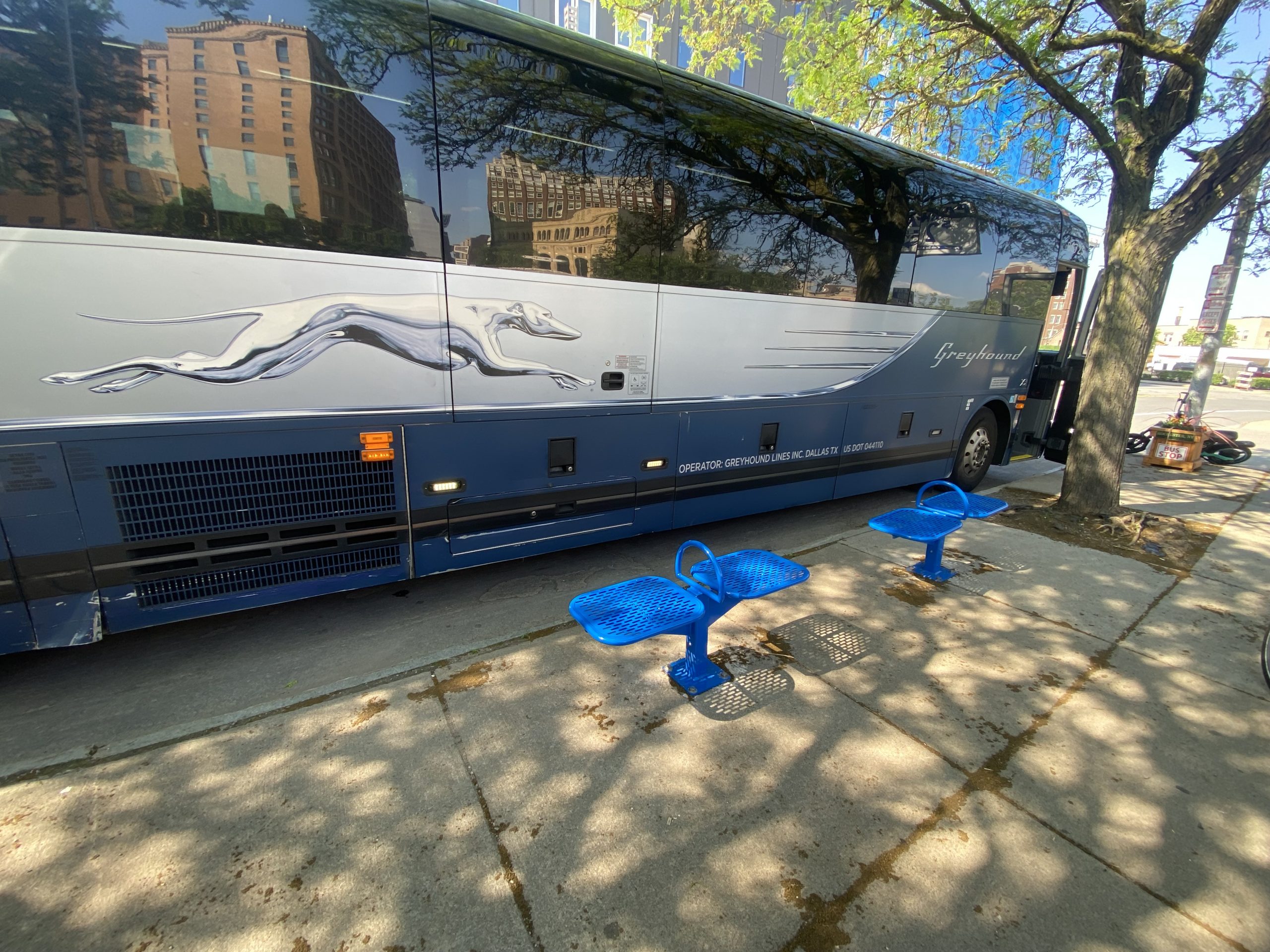
Itโ€™s been about 18 months since your advocacy led to Rochester being awarded $18 million in the state budget to build the bus station addition to the current train station. The project is somewhat complicated – Amtrak owns the facility, but NYSDOT built it originally and NYSDOT was given the funds. At the same time, the city is undertaking a massive Inner Loop North project across the street from the facility with a lot of changes planned to the road network. We have been in touch with Amtrak & NYSDOT to urge the kickoff of this project and to keep local stakeholders involved in the planning process so we can fully realize the vision of the intermodal station. In the meantime, we are also working with the bus companies to explore ways to improve the experience of waiting for the bus in Rochester. We successfully advocated for the city to install a simmie seat and weโ€™re trying to get additional seating at the stop.

Keep Us Safe on State Roads Campaign

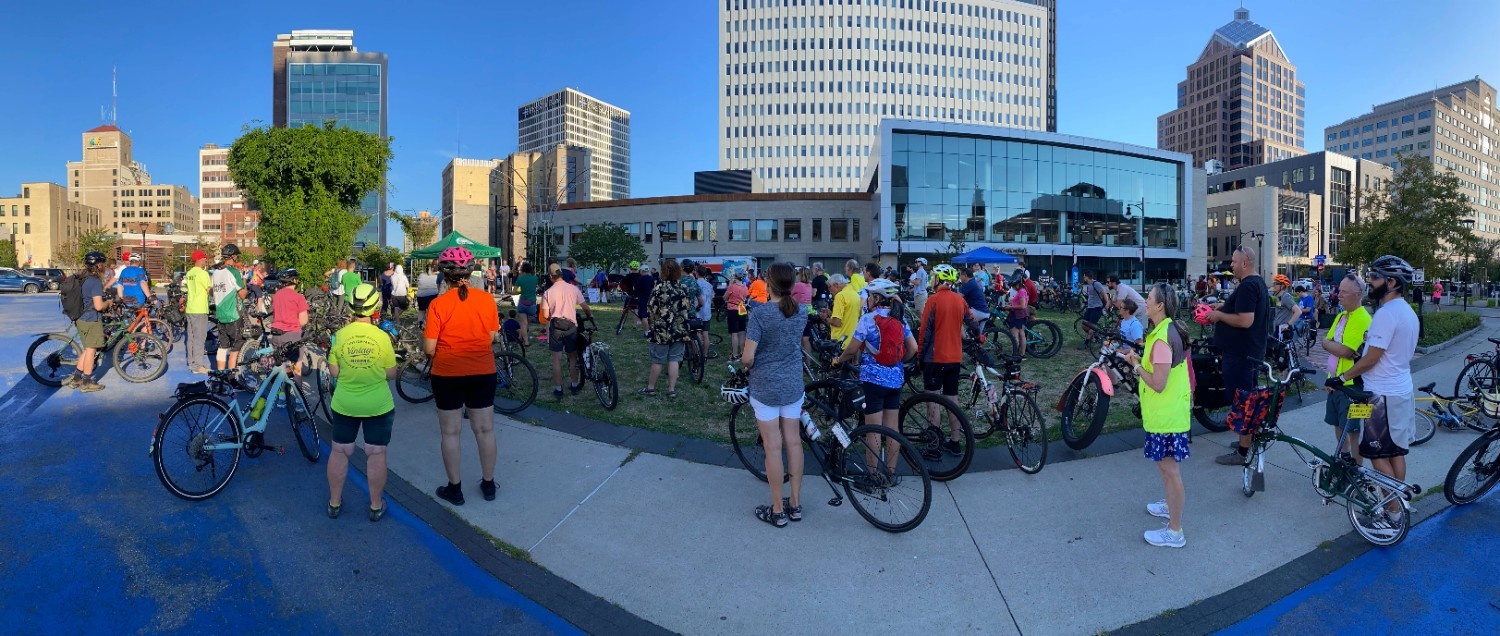
You showed up to ride to Parcel 5 to call on New York State officials to keep us safe on state roads and since then weโ€™ve been busy continuing this advocacy. For those of you who couldnโ€™t attend, the NYS Department of Transportation sent this statement for us to read at the event, which unfortunately didnโ€™t give them the opportunity to see the mass of cyclists who came out to push for safer state roads. Since the event, 311 people signed a letter calling on start officials to invest in safe state road infrastructure for people walking and biking and taking transit! Behind the scenes, weโ€™ve continued to advocate for multimodal changes to Empire Boulevard, Monroe Avenue, West Henrietta Rd. and Lake Avenue. Brightonโ€™s Town Supervisor highlighted the strong prospect that Monroe Avenue would get a road diet, and with the right lane configuration, we could even get 5โ€™ bike lanes on both sides. We need to keep encouraging this kind of thinking for the future.

ROC Vision Zero and 25 MPH

ROC Vision Zero work has really started to get off the ground this autumn, with public engagement planned early in the new year on the automated enforcement and speed limit changes proposed in the plan. Reconnect Rochester and the Healthi Kids Coalition have consistently advocated for speed limit reductions because that policy change alone have shown immediate safety improvements across jurisdictions. The City of Rochester joined other school districts in Monroe County by implementing Bus Patrol stop-arm cameras on school buses, but there are more opportunities to ensure that drivers are held accountable for unsafe driving. Our input is guided by the Vision Zero Networkโ€™s resource called Fair Warnings, a systematic review of safety camera programs to ensure equity in implementing the program for residents. The city deployed a seasonal protected bike lane on West Main St. this year and is still putting together a protected bike lane demonstration program alongside other safety programs that will enhance active transportation and winter maintenance.ย 

The broader effort around 25 MPH communities applies to all the suburban towns and villages that are eligible to lower their speed limits to 25 MPH on locally-controlled roads. GTC held a regional traffic safety summit during which we exposed local leaders to the 25 MPH local law and examples in our own region that have made the switch. If you live in a suburban town or village, reach out to your decision makers to tell them you support this! 

RTS Service and Budget Crisis

In June, we shared our opposition to many of the changes that RTS was implementing to their OnDemand service and we continue to dialogue with RTS on some of their choices for that service, in particular the virtual stops. Weโ€™re concerned these changes wonโ€™t improve the rider experience, and the suburbs would probably be better served by restoring some kind of fixed route service. As we move into the new year, please reach out and let us know your thoughts about bus service in the suburbs.ย 

In the meantime, we are collaborating with RTS and the New York Public Transit Association (NYPTA) to try to spur more investment in public transit. Transit fuels economic activity and it returns many times over what it takes from the state. As a recent Streetsblog article highlighted, without renewed investments upstate, weโ€™re going to be facing a crisis that could lead to service cuts.

Land Use and Zoning

One of the most common questions Iโ€™ve been asked lately is when will the Rochester Zoning Alignment Project be released back to the public. Weโ€™re not really sure, timelines keep getting delayed. The public probably wonโ€™t get to comment on it again formally before the City Council vote, but again that could change. Weโ€™ve been advocating for denser, mixed use zoning along transit corridors and eliminating parking minimums to spur housing in-fill development. The conversation really took off this year after the Sprawl Effect, including several workshops throughout the year on more inclusive zoning policies, blog posts from a Brighton Town Board member about eliminating parking minimums, and lots of conversations about the spiky analysis that Urban3 does. We would still love to get an Urban3 analysis for Monroe County and will keep working on finding funding for that in 2026. 

Federal Headwinds – Transportation Reauthorization

Finally, federal headwinds have continued to be strong all year, but theyโ€™re about to heat up for transportation. The surface transportation bill is up for reauthorization and will have a huge impact on local projects. Genesee St, for example, was reconstructed this past year with funds from the Bipartisan Infrastructure Law, the current transportation bill. Just over the past 3 weeks, weโ€™ve heard reports from the House Transportation and Infrastructure Committee that โ€œwalking and biking infrastructureโ€ are not important federal priorities and there was a threat (later backtracked) to zero out public transportation funding. The Chair, Rep. Graves (R-Mo) gave an interview in which he said:


Itโ€™s going to be a traditional highway bill. That means building roads and bridges, laying asphalt, pouring concrete. Weโ€™re not going to be spending money on murals and train stations or bike paths or walking paths. Weโ€™re going to spend money on traditional infrastructure โ€” thatโ€™s roads and bridges.


This process will keep going well into next year and there are sure to be twists and turns. To stay updated, please subscribe to Mobility Action Alerts, join the League of American Bicyclists Action list and watch for updates from Streetsblog USA.

Quick Hits


by

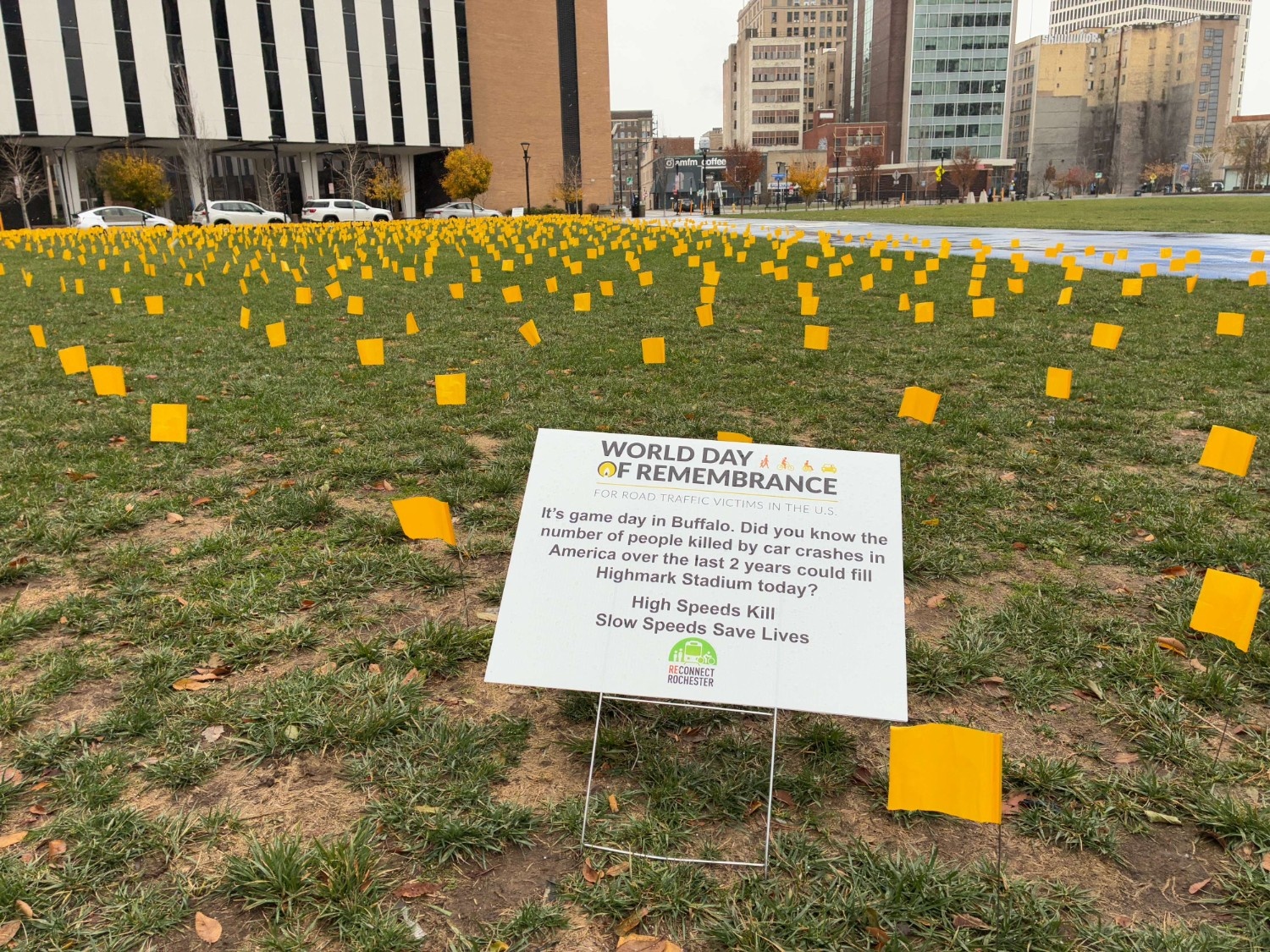
World Day of Remembrance

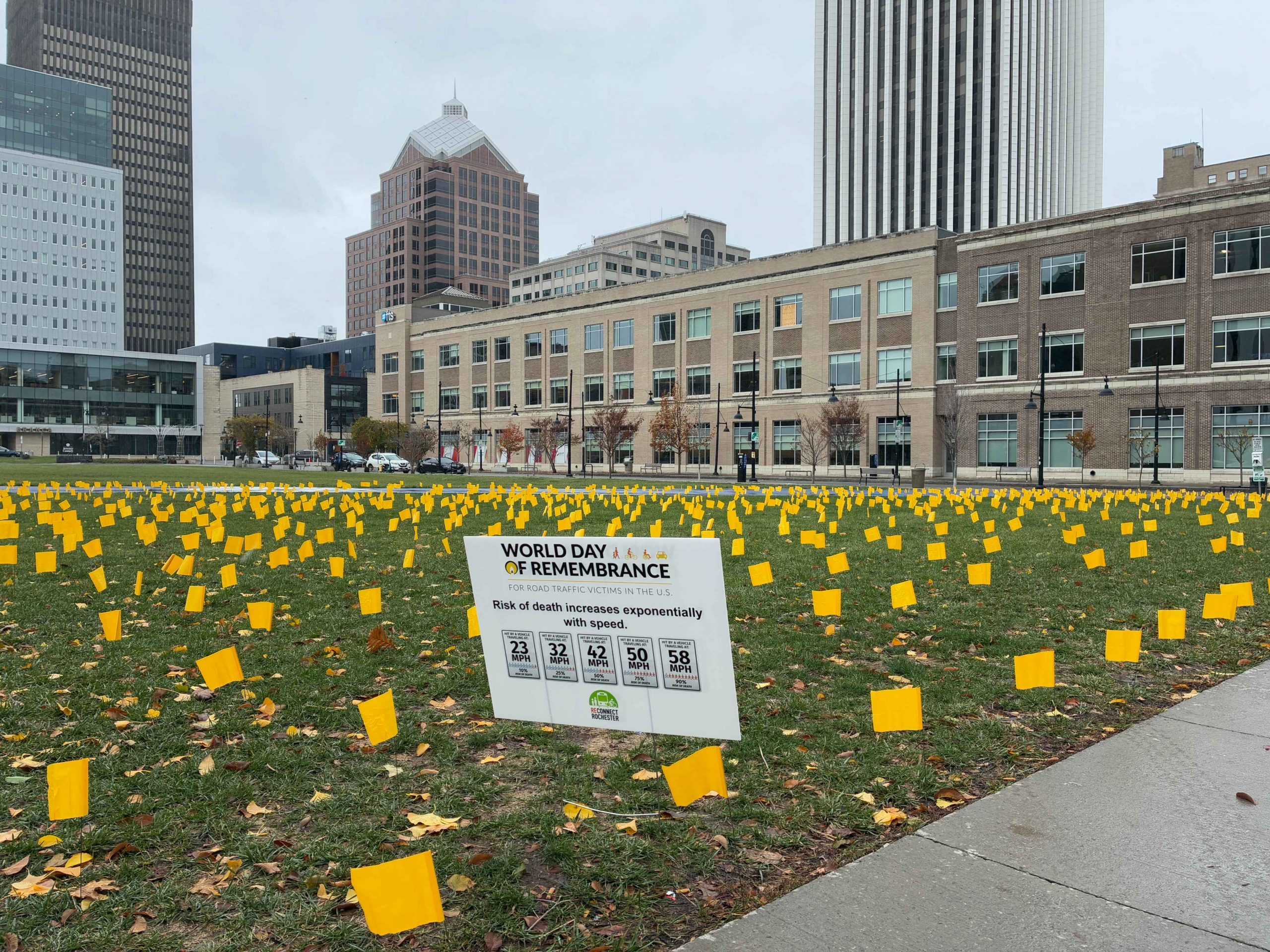
Thank you to all who joined us for the World Day of Remembrance for Road Traffic Victims on Sunday, November 16th. Together we remembered those we have lost, support victims and their families, and discuss ways to act to improve road safety. We also launched an updated Monroe County Crash Map to identify trends regarding bike and pedestrian crashes on our local streets.

The World Day of Remembrance is an international effort to remember, support and act to prevent car crashes, injuries and fatalities. Every year, millions more road victims are added to the current toll of over 50 million killed and hundreds of millions injured since the first road death. As roadway deaths remain at crisis levels, with 40,990 lives lost in U.S. traffic crashes in 2023 and more than 2.7 million people sent to emergency rooms, WDoR offers a powerful chance to raise public awareness and demand real solutions. The U.S. continues to have the highest rate of traffic deaths among 27 high-income countries, underscoring the urgent need for systemic change and a reminder that safer streets are possible.

Our Advocacy Ask for 2025:

Safe Speeds Save Lives and lowering speed limits can, alone without any other intervention, reduce crashes and improve survivability. Therefore we are advocating for the City of Rochester and towns and villages in Monroe County to adopt 25 MPH area speed limits on roads under their control before the end of 2026.

QUESTIONS?

Contact Cody Donahue at Cody@ReconnectRochester.org or 585.484.1523

by No Comments

Walking Rochester: A Personal Reflection

Car Lite Rochester is a blog series that highlights the stories of Rochesterians living a car-lite lifestyle. The term โ€œcar liteโ€ encompasses a variety of multimodal transportation lifestyles, featuring little dependence (but not NO dependence) on a car.  It typically looks like sharing one car within a household or only using a car when absolutely necessary.

So, we hope youโ€™ll continue to follow along.  Maybe you will be inspired to join our bloggers in living a car-lite lifestyle!

Wanna rep it? Check out the t-shirt in our online shop.

Walking Rochester: A Personal Reflection

By Josie McClary:

Walking in the City of Rochester has always been more than just a way to get from one place to another for me. Itโ€™s how I stay connected to my neighbors, my community, and the city Iโ€™ve called home for so many years. But the truth is, being a pedestrian in Rochester isnโ€™t easy. It can be frustrating, unpredictable, and at times, even unsafe. Still, every time I step outside and walk down a block, Iโ€™m reminded why walking matters โ€” and how much better this city could be if it were built with people, not just cars, in mind.

Rochester is a city of neighborhoods, each with its own rhythm. Walking through the 19th Ward feels very different from walking on Park Ave or downtown. When you walk as much as I do, you see the city in a way that drivers never will. You notice the cracked sidewalks, the missing curb cuts, and the cars that speed through crosswalks as if pedestrians are invisible. You also notice the beauty โ€” the old homes with character, the trees that somehow manage to push through concrete, the kids walking home from school, laughing and carrying backpacks that look too heavy for their small shoulders. Thereโ€™s life and community on every block, but getting from one place to the next can feel like an obstacle course.

In certain neighborhoods, walking feels pleasant and safe. But in others, it feels like taking a risk. Some sidewalks just end with no warning, forcing you into the street. Others are so uneven you have to watch every step to avoid tripping. There are intersections where I hold my breath waiting for the light to change, hoping drivers actually stop before turning. And if youโ€™re walking at night, you learn quickly which blocks are well-lit and which ones you should avoid.

The hardest part is that so much of this could be fixed โ€” if local government made it a real priority. Too often, the focus is on roads, parking lots, and traffic flow, not on the people who actually live in the neighborhoods. When snow falls, plows clear the roads, but the sidewalks stay buried for days, sometimes weeks. For seniors, parents pushing strollers, or people with disabilities, thatโ€™s not just inconvenient โ€” itโ€™s isolating. It means being stuck inside or risking your safety just to get groceries or make a doctorโ€™s appointment.


Too often, the focus is on roads, parking lots, and traffic flow, not on the people who actually live in the neighborhoods.


As someone who enjoys walking as exercise, I see how much harder it is for people who donโ€™t drive. Bus stops arenโ€™t always easy to reach, and some donโ€™t even have benches or shelters. Imagine waiting for a bus in the rain or in freezing temperatures, with no protection from the wind, and you start to understand the quiet struggle of getting around this city without a car. Itโ€™s not that people donโ€™t want to be independent โ€” itโ€™s that the infrastructure makes it difficult.

Iโ€™ve had conversations with neighbors who depend on walking and the bus system every single day. Some are older adults who gave up driving for safety reasons. Others are younger people trying to save money or canโ€™t afford a vehicle. For many families, especially in working-class neighborhoods, one car has to serve multiple needs โ€” work, school, errands โ€” and walking fills the gaps. Itโ€™s a reality that often goes unseen in city planning conversations.

Whatโ€™s tricky about walking in Rochester is how much planning it requires. You canโ€™t just step outside and go wherever you need without thinking about safety, timing, or the condition of the route. And yet, despite all of this, I love walking. I love how it slows the world down and gives me space to think. Iโ€™ve met some of the kindest people just by walking โ€” a neighbor raking leaves who waves hello, a parent waiting with their child at the bus stop, and residents walking their dog early in the morning. Walking connects me to the pulse of the community in a way that driving never could. But it also reminds me how much work still needs to be done.

The biggest challenge for nondrivers isnโ€™t just cracked sidewalks or poor street design. Itโ€™s the feeling of being overlooked. The message that our needs donโ€™t matter as much as those of people behind the wheel. A truly inclusive city would make walking and public transit reliable, dignified, and safe for everyone.

We talk a lot about equity in Rochester โ€” about giving people fair access to jobs, food, and opportunity. But access starts with something as basic as being able to move safely through your neighborhood. If we canโ€™t walk to the store, or get to a bus stop without fear, how can we talk about opportunity?


If we canโ€™t walk to the store, or get to a bus stop without fear, how can we talk about opportunity?


I want a Rochester where walking is easy โ€” where kids can safely walk to school, where seniors can stroll without worry, and where the simple act of walking doesnโ€™t require courage or constant awareness. I want sidewalks that are smooth, wider and well-lit, crosswalks that actually protect pedestrians, and city policies that treat walking as a right, not a luxury.

Until that happens, Iโ€™ll keep walking โ€” not out of necessity, but to stay connected to those that donโ€™t have a choice. Walking for me, isnโ€™t just about getting somewhere. Itโ€™s about being part of Rochester, one step at a time, even when the path isnโ€™t easy.

As a community advocate, Iโ€™ll keep speaking up for those of us who walk โ€” the workers, parents, elders, and young people who move through Rochester every day on foot. Our experiences matter. Our safety matters. And when the city truly begins to plan for pedestrians, it wonโ€™t just make walking better โ€” it will make Rochester stronger, more connected, and more humane for everyone.


At Reconnect, we’re inspired by the stories of people in our community, like Jasmine Burley, Karen Nozik, and Steve Roll, who are passionate about living a car-lite or car-free lifestyle.  If you want to support our work and make it easier for others to go Car-Lite please donate and sign up for Mobility Action Alerts to stay in the loop with opportunities of how to advocate for safer streets and transportation options.

Let us know if you want to share your mobility story! What’s in it for you? The intrinsic reward of knowing you’ve inspired others, and a free t-shirt from our online shopContact Chaz to submit your story. 

by No Comments

What is NYS Doing to Keep Cyclists Safe on State Roads?

Join Us on Parcel 5, Friday, Aug 22 at 5:30 PM to Find Out!

Join us for a rally on Parcel 5 at 5:30 PM on Friday, Aug 22 to call on New York State to โ€œKeep Cyclists Safe on State Roads!โ€ Thereโ€™s an optional group ride from Genesee Valley Park Sports Complex (131 Elmwood) that leaves promptly at 5 pm. Pre-registration encouraged!

Some Background:

During Reconnect Rochesterโ€™s Ride for the Spine bike rally in 2024, one of our partners at City Hall made a passing remark that left a lasting impression: โ€œItโ€™s great so many cyclists turned out to hear from the Mayor, the County Executive and Congressman Morelle, but whereโ€™s New York State? They have authority over so much of this.โ€ 

Of course, they were right: The New York State Department of Transportation (NYSDOT)โ€™s decision-making authority over a road project can make or break bike infrastructure choices that any local authority – whether it be the City, Towns, Villages or the County – wants to implement. Projects in our region that are building better bike infrastructure use a combination of federal, state and local funding, and the requirements – and often constraints – imposed by these funding streams dictate what is considered as feasible in the design process. While engineering guides from the Manual on Uniform Traffic Control Devices (MUTCD), to the AASHTO and NACTO bike guides have made momentous leaps forward, design standards used by traffic engineers at all levels of government take far too much time to adopt and implement that progressive guidance.


NYSDOTโ€™s decision-making authority over a road project can make or break bike infrastructure choices that any local authority wants to implement.


For suburban towns and villages, the hand of NYSDOT is even heavier: state roads built before the interstate highway system designed to move freight or serve as highway alternatives are now the main streets of local communities. Unfortunately, Smart Growth Americaโ€™s Dangerous by Design report in 2024 cited that across the U.S., nearly two-thirds of traffic deaths in metro areas happen on state-owned roadsโ€”often fast-moving arterials that werenโ€™t designed for people walking, biking, catching the bus, or simply crossing the street to enjoy a coffee or get home. The burden of mortality isnโ€™t evenly spread either: Black and Native Americans, older adults, and people walking in low-income communities die at higher rates and face higher levels of risk of becoming victims of road violence when compared to all Americans.

To cite a recent Vision Zero Network analysis, state roads โ€œserve very different purposes today – including local traffic, people walking and biking, school buses and delivery vans – without having been redesigned for these uses.โ€ It is urgent for communities, therefore, that New York State officials, including planners, traffic engineers, municipal public works heads, become more responsive to the way local communities are growing and the ways the roads are used today.

Thatโ€™s why this year, Reconnect Rochester is asking NYSDOT and other state leaders to speak to us about what they are doing to keep cyclists safe and build the all-ages/all abilities bike infrastructure on all roads, but especially on the state roads that are often the Main Streets of our countyโ€™s towns and villages.  We see some glimmers of a culture shift , but it will take much more to turn such a large ship. Good intentions are present throughout the Draft NYSDOT 2050 Strategic Master Plan, signs of newly prioritizing active transportation are present in the agencyโ€™s move to update a two-decade old walk/bike plan. Now is the time to reiterate to New York State: safety for your most vulnerable people using the road is safety for everyone, including drivers!

But these intentions arenโ€™t yet fully realized: A recent Brookings Institution analysis concluded that NYSDOT is among the lowest-ranked state DOTs in the United States when measured on evidence that it is shifting its mandate from car-centric infrastructure to building and maintaining multimodal transportation systems that serve all users and responds to environmental change. As articulated in our New York Safe Streets Coalition feedback on the 2050 plan, NYSDOT can show its seriousness about its strategic intentions through more transparency, funding allocations to public and active transportation, and public engagement with local communities.

Whatโ€™s at stake for Monroe Countyโ€™s cyclists of all ages and abilities:

To illustrate whatโ€™s at stake for cyclists in our community, letโ€™s look at the map. Two years ago, Monroe County hired Toole Design to craft the Countyโ€™s first Active Transportation Plan. It was very high level  and created a common vision as a starting point for discussion. The question it asked: If there was an ideal countywide bike network someday that connected towns & villages, what lines on a map would make most sense to invest in? The map below is the result.

The red circled roads are owned & maintained by NYSDOT. Thus, if our county is ever going to be bikeable (for more than just the brave and bold), NYSDOT will need to modernize the way they design and maintain roads to prioritize complete streets elements and build with the safety for all users in mind. Monroe County is working on an implementation plan for the CATP (work item 8756) that will make more specific recommendations, and weโ€™ll let you know when thereโ€™s a chance to give public input.

While the City of Rochester has a lot of control over how it designs its roads, NYSDOT owns and operates portions of the most dangerous road in the city and New York State: Lake Avenue. The City has recognized the unacceptable level of road safety problems on Lake Avenue, and has put on the table the idea of reengineering Lake Avenue to be a multimodal corridor equipped with continuous bike infrastructure and bus rapid transit through the ROC Vision Zero initiative. As recent events confirm, NYSDOTโ€™s cooperation on making Lake Avenue a safety corridor is more urgent than ever. 

A local sign of culture shift toward accommodating complete streets and active transportation is NYSDOT Region 4โ€™s project on Route 204 – Brooks Avenue in the Town of Gates, which coincides with New York State Bike Route 5. Reconnect Rochesterโ€™s input to the project last year highlighted the opportunity to connect the City of Rochester, the Airport, Gates employers and commercial center on 33A with multimodal investments on this corridor. For this project, NYSDOT coordinated with the Town of Gates and local business partners to close sidewalk gaps, and improve bus shelters. Through a combination of shoulder widening and restriping, the project will provide 5โ€™ minimum shoulder width through corridor (with the exception of the railroad underpass area โ€“ which is outside of the NYSDOT jurisdiction) and the installation of a refuge island and other enhancements to provide for a crossing of Rt 204 at the Canal Trail. This is the kind of attention to multimodal needs that weโ€™d like to see on every project. 

What can you do?

The most impactful thing you can do this month is to show up to the rally on Friday, Aug 22 at 5:30 PM at Parcel 5! Even if you canโ€™t bike that day, walk down to the Parcel for the rally! You can also sign up for our Mobility Action Alerts to learn about upcoming state advocacy opportunities in 2025-2026!

What can New York State do?

  • Adopt a โ€œcomplete streetsโ€ design policy for all state road projects if the service life of such resurfacing, maintenance or pavement recycling project is at least ten years. 
  • Implement dedicated bike facilities, sidewalks, enhanced pedestrian crossings, traffic calming or road diets (where appropriate) to create safer places for ALL users of the road.
  • Build safe cycling infrastructure on Empire Boulevard (Penfield) and Monroe Avenue and West Henrietta Road (Brighton) during upcoming road projects!
  • Build a safer, multimodal Lake Avenue as part of ROC Vision Zero!
  • Create a fully connected network of bicycle and pedestrian infrastructure in Monroe County working with towns, villages, the City of Rochester, Monroe County and residents. Improve connectivity across municipal boundaries, between neighborhoods, jobs, and safe routes to schools.
  • Allocate more funding to active transportation enhancements on all road projects.
  • Advocate to the federal government to ensure that the surface transportation reauthorization includes bike infrastructure funding explicitly. 

NYSDOT has an important strategic choice to make: Do we maintain the roads and bridges we have and add safety for all users, or do we spend our limited resources expanding highway capacity to save drivers a few minutes of time? Reconnect for one would like to see our local roads maintained and more bike lanes, sidewalks and transit stops added. We know that adding lanes induces new demand for car trips at a time when climate action demands we reduce our vehicle miles traveled, especially for short daily trips that are most appropriate for walking, biking or transit. Letโ€™s make it safer for more cyclists to use state roads!


Take Action!

by No Comments

School Bus Safety: The Danger Hiding in Plain Sight

Guest Blog: Monroe County Office of Public Safety/Traffic Safety

We trust school buses to keep our kids safeโ€”and for the most part, they do a great job. But what if the real danger isnโ€™t the bus, the driver, or even the road conditions?

What if the biggest threat isโ€ฆ other drivers?

WAIT, PEOPLE ARE REALLY PASSING STOPPED SCHOOL BUSES?

Yep. And way more often than you think.

Even though itโ€™s illegal in all 50 states to pass a school bus when its stop sign arm is out and the lights are flashing, people do it constantly. One national report estimated over 45 million violations every year. Thatโ€™s 45 million times someone risked a childโ€™s life just to save a few seconds.

LIGHTS, CAMERA, CITATION

Monroe County (NY) Executive Adam Bello decided enough was enough. In 2023, the County rolled out a School Bus Safety Program that added cameras to buses in four local school districts. These cameras automatically record any car that blows past a stopped school bus.

The results? Honestly, kind of terrifying.

Over a 19-month period, those cameras caught over 20,000 potential violations. Almost 12,000 of them were confirmed by safety experts and led to actual traffic tickets. To put it another way: every single day, about 50 drivers in just one county ignored a stopped school bus โ€“ and could have hit a kid.

WHICH SCHOOLS WERE HIT HARDEST?

Here’s how it broke down by district:

And this isnโ€™t even the full picture. More schools are signing up, and more cameras are being added.

WHY IT MATTERS (BEYOND THE OBVIOUS)

Sure, a traffic ticket is annoying. But this isnโ€™t about a minor infractionโ€”itโ€™s about keeping kids safe while they get on and off the bus. Thatโ€™s when theyโ€™re most vulnerable. Theyโ€™re small, they move fast, and theyโ€™re not expecting a car to whip past the bus thatโ€™s supposed to be protecting them.


This camera program isnโ€™t about punishmentโ€”itโ€™s about prevention. Itโ€™s waking people up and saying: โ€œHey, pay attention. Thatโ€™s someoneโ€™s child you’re putting at risk.โ€


WHAT CAN YOU DO?

  • Slow down near schools and neighborhoodsโ€”just assume a bus could stop at any moment.
  • Never pass a bus with its stop arm out, even if youโ€™re โ€œin a hurry.โ€
  • Spread the word. Most people donโ€™t realize how common this is, and the more people know,
    the better.
  • Talk to your school district about opting into the Countyโ€™s program โ€“ it is free for districts to
    join!

FINAL THOUGHTS

Sometimes, safety improvements come from tech. Sometimes, itโ€™s awareness. This time, itโ€™s both. These bus cameras are shining a light on something weโ€™ve been missingโ€”and theyโ€™re helping keep our kids safer in the process.

So next time you see a school bus with its lights flashing and the stop sign out, just stop. Itโ€™s not just the lawโ€”itโ€™s the right thing to do.

monroecounty.gov/school-bus-safety


by

“Keep Us Safe on State Roads” Ride & Rally August 22nd 2025

THANK YOU to all who joined us on August 22nd, at 5:30PM at Parcel 5 outside Senator Jeremy Cooney’s office. We were proud to send a strong message to New York State Department of Transportation that we need safer infrastructure on state controlled roads such as W. Henrietta Rd, Monroe Ave, Lake Ave, and Empire Boulevard.

The Monroe County Active Transportation Plan and the City of Rochester Active Transportation Plan were completed in a coordinated fashion with commitments to building safe walking, biking, and transit facilities that cater to people of all ages and all abilities. Yet in order to extend our infrastructure into Monroe County suburbs and beyond, we will need to address the many roads under NYSDOT jurisdiction that are included.

We are grateful for the 150 cyclists who attended 2024’s bike ride and rally at City Hall aimed at drawing more attention to the issue of the scattered and disconnected nature of bike investments so far and the need to change tacks, concentrating on attaining seamless and protected central axes of the envisioned Bike Spine Network in the near term.

This year, we have invited NYSDOT to tell us first-hand, โ€œwhat is New York State doing to protect cyclists on state roads?โ€ Despite the many Bike Resources we offer to encourage our community to ride, we canโ€™t make up for the almost complete lack of dedicated, on-road bicycle infrastructure outside of the City of Rochester. According to the Federal Highway Administration, for about 60% of people who might otherwise ride their bike, these conditions discourage them from even trying to bike to work, to school or to the grocery store. This is especially true for women, children and the elderly. 

WHAT DO WE WANT NEW YORK STATE TO DO?

  • Adopt a โ€œcomplete streetsโ€ design policy for state roads and build infrastructure during regular maintenance projects. Implement dedicated bike facilities, sidewalks, enhanced pedestrian crossings, traffic calming or road diets (where appropriate) to create safer places for ALL users of the road.
  • Build safe cycling infrastructure on Empire Boulevard (Penfield) and Monroe Avenue and West Henrietta Road (Brighton) during upcoming road projects!
  • Build a safer, multimodal Lake Avenue as part of ROC Vision Zero!
  • Create a fully connected network of bicycle and pedestrian infrastructure in Monroe County working with towns, villages, the City of Rochester, Monroe County and residents. Improve connectivity across municipal boundaries, between neighborhoods, commercial centers, and transit hubs.
  • Allocate more funding to active transportation enhancements on all road projects.

QUESTIONS?

Contact Cody Donahue at Cody@ReconnectRochester.org or 585.484.1523

by No Comments

Advocacy Team Key Updates – First Quarter, 2025

Weโ€™ve been busy at Reconnect Rochester since the start of the year pursuing our 2025 Plans and Priorities. Below are a few key updates on whatโ€™s been going on in advocacy, especially those projects or events we asked you to mobilize around, and what to look forward to in the next few months:

Growing Our Movement:

Our biggest goal as an advocacy team this year is to grow our base of active, informed and engaged advocates throughout Monroe County. Weโ€™re always looking for more people to join the movement – get in touch if you are interested! We have opportunities to support multimodal transportation from taking surveys to speaking to elected officials or writing letters. The easiest way to learn about opportunities is to sign up for Mobility Action Alerts and we will send actions and events you can join.

Annual Executive Meetings:

Back in January, we held our annual meetings with Rochester Mayor Evans (City Hopes & Asks) and Monroe County Executive Adam Bello (County Hopes & Asks), setting the stage for our advocacy throughout the year, including budget advocacy that will be ramping up in the City soon. See our 2025 Budget Input submitted to the City.

ROC Vision Zero:

The Beaconโ€™s ROC Vision Zero forum was well attended with a keynote by Mayor Evans, and an expert panel we helped assemble. Reconnect Rochester is serving on the ROC Vision Zero task force and will be participating in committees on education and community traffic safety champions in March and April.

Public Input to Street Projects:

We submitted street project input on the Bullโ€™s Head Street Project Meeting, N. Clinton Project, and Dewey/Emerson this quarter. North Clinton merits a shout-out for being an exemplary design according to the principles outlined by the City Active Transportation Plan. This project is the first design presented of the streets identified in the Federal Safe Streets and Roads for All grant that was announced last year, but as weโ€™ll elaborate more below, weโ€™re concerned this funding could be at risk under current White House-driven reviews of projects.

Transportation Equity and Improving RTS Rider Experience:

Transit has been a big focus. We rallied support for public transit and transportation equity on Rosa Parksโ€™ birthday, Feb. 4, sharing riders’ voices and lobbying with RTS riders in Albany. In addition, we met with RTS Leadership in late February to deliver our 2025 Hopes and Asks of RTS, specifically to urge faster progress on frequent service and address OnDemand service shortcomings in the suburbs. We hope to learn more about the results of the OnDemand survey RTS ran last month. We are also very actively inputting to the Bus Stop Improvement project that aims to put bus stop amenities at most stops in the City. Sign up for the New Yorkers for Transportation Equity local forum on 4/10 to join local advocates!

Zoning and Land Use:

We donโ€™t know when the next version of the Rochester Zoning Alignment Project code will drop, but we have continued our focus on promoting transit-supportive land use that we had last year in our ZAP comments and Sprawl Effect Rochester Street Films Event. Weโ€™re continuing our focus on land use in the Transportation Impact Collective and partnering with Our Local History, Empire Justice Center, RMAPI, and the Climate Solutions Accelerator to deliver informational presentations to pro-housing advocates countywide.

Media Engagement:

Through our daily media monitoring, we are identifying problematic news articles covering crashes and sharing timely feedback using our Crash Reporting Toolkit as a guide.

Federal Uncertainty:

Last but certainly not least on our minds (and likely yours too) is the chaos and uncertainty set off by President Trumpโ€™s Executive Orders. Throughout the last two months, we have stayed in close contact with national advocacy groups such as the League of American Bicyclists, America Walks, and the National Campaign for Transit Justice. Focusing on just Monroe County, we analyzed USDOT memos and Trump Executive Orders and identified about $150 million of discretionary funding aimed at bike, pedestrian, transit and safer streets projects, already appropriated by Congress, announced, and some already under contract, potentially at risk through these orders. We have shared this information with Senators Schumer and Gillibrand and Congressman Joe Morelle, who will be meeting with Rochester cyclists in Washington during the National Bike Summit next week. Currently, we believe White House-mandated review outcomes will be announced in April 2025. We will continue to fight for resources that were appropriated by Congress and awarded to our community to fund multimodal transportation projects.


Save the Dates!

Weโ€™re excited about several things coming up:

by No Comments

Fighting for Safer Streets on the Federal Level

March 11-13 2025 was the National Bike Summit put on by the League of American Bicyclists. We explored DCโ€™s impressive Capitol Hill bicycle network, heard from Killed By A Traffic Engineer Author Wes Marshall & NTSB Chair Jennifer Homendy, and engaged directly with policymakers.

The protected bike lanes surrounding DCโ€™s iconic landmarks highlight the importance of multimodal infrastructure for attracting residents and enhancing livability. Between the three bike share programs, metro trains, and a bus system, DC provides a multitude of options for those looking to get around without a personal vehicle. Pedestrian islands provide refuge for those crossing the street on foot while also providing space for turning bikers. Bus stop islands and shared bus stops allow riders to step out of the flow of traffic while maintaining awareness of cyclists.

We were struck by the decisive action of DDOT and their leadership prioritizing proven safety measures over means-testing and hesitation. Washington DCโ€™s mayor has pushed to add 20 miles of protected bike lanes over three years to meet the demand for bicycle infrastructure for all ages and abilities without worrying about miniscule delays for drivers. Rochester could take inspiration from this approach by installing infrastructure such as two-way protected bike lanes. While this would require coordination with the county and some new traffic signal configurations, the benefits far outweigh the challenges.

We also had the chance to see DCโ€™s Curb Extension Murals (the inspiration for Downtown SmART Streets) up close. As we prepare to break ground on this new program and review artist submissions (due March 22nd) we were eager to take notes on what has worked (and what hasnโ€™t) for these traffic calming elements.

The Asks

The most critical part of the summit was taking our advocacy to Capitol Hill. Thank you to the League of American Bicyclists for the herculean task of organizing these meetings on a national scale. Our first ask? Fighting for Safe Streets for All grant fundingโ€”money that has already been approved by Congress but is now threatened in an unprecedented move from the Executive Branch.ย 

The local projects funded by this grant are designed to meet the needs of each community, understanding that local governments know their streets best. In our meetings with Congressional Representative Joe Morelle, staff from Senate Minority Leader Chuck Schumer’s office, and Senator Kirsten Gillibrand’s legislative aide, we pressed them to recognize the importance of projects such as completing Rochesterโ€™s Bike Spine Network or expanding our Downtown SmART Streets program. These projects will make the streets safer for everyoneโ€”cyclists, pedestrians, and drivers alike. Canceling their funding will also harm our communities through the loss of local construction jobs from the projects and the long-term economic benefits these amenities bring.


As traffic dangers increase for everyone on our roads, improving safety isnโ€™t a political issue; itโ€™s a necessity.


Our next ask to the US House of Representatives was to support HR 1668, The Sarah Debbink Langenkamp Active Transportation Safety Act. In 2022, Sarah Lagenkamp was killed while riding her bike after dropping off her son at daycare. Her husband Daniel made it his mission to make our streets safer.ย 

As the League of American Bicyclists say, this bill highlights the need to fill gaps in biking and walking networks and makes it easier for states and local governments to use Highway Safety Improvement Program (HSIP) dollars as a โ€œlocal matchโ€ to build safe bicycling and pedestrian infrastructure.ย 

We were proud to have a strong Rochester contingent to mingle with our fellow advocates across the country. If you want to get more involved in our incredible local bicycle community here at home, please make sure you are signed up for our Mobility Action Alerts for weekly emails with local advocacy opportunities for safer, multimodal streets.ย 

Two immediate actions you can take to support our cause:

  1. Contact your federal representative and senators to make sure they know about the importance of our asks listed above.ย 
  2. With federal funding for bike lanes and many important transportation projects in danger of being cut off by USDOT we urgently need your support to show the importance of these projects for the entire community. The League of American Bicyclists have put together a petition to show how many people oppose cutting this funding. Please take a moment to sign and send it to 5 of your friends Getting as many signatures as possible is critical to the success of our upcoming projects.

by No Comments

Statewide Advocacy Ramps Up

Reconnect Rochester is back in Albany for a new legislative session!

On Jan 28th, we joined the New Yorkers for Safe Streets Coalition, a group of 150 organizations and dignitaries from across the State to advocate for four priority bills.

Reconnect Rochester has taken the lead on Complete Streets Maintenance, a bill that would require NYSDOT to consider complete streets design features on all types of road projects or when they receive both state and federal funding. Complete streets design features on all road projects would allow the necessary design interventions needed to enable safe access for all road users including pedestrians, people using mobility aids, cyclists, and public transit users.

Thank you to the bill sponsors Senator Sean Ryan and Assembly member Jonathan Rivera for meeting with us!

Simply put, state roads are the main streets of many of our towns and villages in Monroe County, and NYSDOT isnโ€™t currently required to consider complete streets on their most common and most frequent types of projects. Even when towns want to improve safety, the state often doesnโ€™t remove barriers to doing so. With NYS not currently meeting its climate law mandates for transportation, this is a cost-effective way to expand safe walking and biking infrastructure through existing maintenance routines. 

With minimal additional investment, design elements can be considered in projects that will take place in a matter of years not decades. This is how most major cities currently expand active transportation infrastructure.

NYSDOT is in the midst of updating a wildly out-of-date walk/bike strategic plan (2005 was the last update!). That plan will set the goals, but our bill is the way they can implement it. We understand it may require some process changes within NYSDOT to plan for AT infrastructure on each project and we would urge NYSDOT to show leadership on making it a best practice in the country rather than shying away from these urgently needed changes. 

On Transit Equity Day, we called on lawmakers to let us Get Around New York!

The uncertainties around transit funding, federal aid in doubt, wasteful highway spending, and our state DOT’s position at #49 for cost effectiveness did not dampen the enthusiasm of our New Yorkers for Transportation Equity coalition as we celebrated Transit Equity Day on Feb. 4th in Albany! On the 112th anniversary of Rosa Parks’ birth, we urged state lawmakers to embrace transformational policy change leading to more concrete bus, rail, trail, sidewalk, safety and connectivity improvements within and among New York’s rural, suburban and urban communities. On Friday, February, 21st we sent a formal letter to Governor Hochul’s office pushing her to fully fund public transit in New York State.

Thanks so much to Senator Brouk and Assembly Member Bronsonโ€™s teams for meeting with us on February 4th to discuss transit equity issues.

The new federal administration has already attacked funding for transit riders, seniors, immigrants, refugees, low-income and disabled New Yorkers. New York State must dramatically alter how federal funding is spent so as not to waste taxpayer dollars. Highway expansions are ineffective. Highways do not solve long-term traffic problems, they entrench archaic land-use, and they create worse traffic and transportation outcomes long-term.


We urge the State to fix roads and bridges first, reduce Vehicle Miles Traveled (VMT) 20% by 2050, and invest taxpayer dollars in mass public transit, walkability, and density. 


Thank you to Senator Jeremy Cooney, Chair of the NYS Senate Transportation Committee who said, โ€œFollowing the legacy of civil rights heroes like Rosa Parks, Transit Equity Day is a time to reflect on the ways public transportation fueled the progress of yesterday, while also working towards a better tomorrow. In this yearโ€™s budget Iโ€™ll be advocating for more sustainable and reliable initiatives to get New Yorkers from Point A to Point B, pushing for more funding for public transit systems, and continuing to use transportation as a means to combat poverty.โ€

There are proven strategies that New York can implement this year. Our state can fulfill the goals of New Yorkโ€™s Climate Leadership and Community Protection Act and include the Get Around NY Act (S4044/A4230) in the One-House Budget this year.

Public Transportation Investments

As in past years, Reconnect Rochester met with RTS and the New York Public Transit Associationโ€™s lobby team and we support their state budget recommendations, highlighting the particular need for upstate state operating assistance to increase 15% per year. Why is this important? State funding is the largest proportion of the RTS operating budget and increases are needed to make routes run more frequently.

Senator Cooney and Assembly Member Bronson have also been highlighting the connection between transit, economic development and job access. Senator Cooneyโ€™s January op-ed appeared in statewide publications calling on the state to establish a Workforce Equity Fund of $5 million to connect workers to job opportunities and combat poverty across the state. Weโ€™d add that we should incentivize economic development projects in transit-supportive corridors (See the Sprawl Effect for more on land use). 

Supporting Local Coalitions

In addition to Reconnect Rochesterโ€™s state priorities, weโ€™re actively participating in supporting other state coalitions:


At Reconnect, we’re always working to improve mobility access in our community. Sign up for Mobility Action Alerts for tangible advocacy and volunteer opportunities involving transportation, safe streets, and bike infrastructure. 

by 1 Comment

Top ten things we’re most proud of in 2022

At Reconnect Rochester, 2022 brought renewed hope and activity as the world fully opened up and we could get back to what we love doing best — getting together and working alongside people and organizations in the community who share our passion for improved mobility.

This has also been a year of dramatic organizational growth that’s allowed us to do even more to pursue our hopes and dreams for mobility in Monroe County. Check out below the Top 10 things we’re most proud of accomplishing in 2022. The list gets more action-packed each year!


TOP 10 THINGS WE’RE MOST PROUD OF IN 2022
(In no particular order of importance.)

#10

Inspired People to Get Multi-Modal

At Reconnect Rochester, we want to inspire and empower people to use various modes of transportation and discover the joy and freedom of getting around by bus, by rail, on bike or on foot. Our Car-Lite ROC blog series featured the voices and stories of folks around the community who are living a car-lite lifestyle in Rochester and loving it! Catch up on the blog series here and listen to the podcast of some of our guest bloggers on Connections with Evan Dawson.

#9

Expanded Bus Amenities

Bus Stop Cube Ribbon Cutting; group of people smile as they get ready to cut a white ribbon that's in front of a red bus stop cube

In August, we held a ribbon cutting to celebrate the installation of 23 more bus stop cubes on Portland, Hudson, Lake, Dewey & St. Paul. Seating at bus stops not only supports the basic needs of people who rely on RTS bus service, it also encourages more people to use public transit by improving the experience. Special thanks to the City of Rochester for being a valued partner on this project, and State Senator Samra Brouk for securing funding to support this round of bus stop cubes.

#8

Transformed an Intersection

Kids and adults paint the road with large paint rollers

We continued our effort to make Rochester streets safer for all with a Complete Street Makeover of the intersection of Orange Street and Orchard Street in the JOSANA neighborhood.  In collaboration with many neighborhood and community partners, we implemented temporary street design changes to make the intersection safer for those who use it every day. As a result of our installation, the average speed decreased 20%, the 85th percentile speed declined 28%, and the maximum speed declined 26%.

#7

Used the Power of Film to Educate and Inspire

4 panelists sit in director chairs on a theatre stage; 1 moderator stands at a podium

This year, we produced two Rochester Street Films events at The Little Theatre. In June, we partnered with the Climate Solutions Accelerator to showcase the feature-length documentary Life on Wheels, followed by a discussion about the mindset & policy shifts needed to create a more multimodal community. In October, we brought a set of curated film clips to the screen to explore Why We Bike, and had a panel discussion and Q&A about the rewards for us personally and as a society when more people ride bikes.

#6

Expanded Our Advocacy Efforts

7 people on a Zoom grid

In January, we welcomed James Dietz in the newly created Advocacy Manager position to bolster our volunteer-based advocacy work with staff-based efforts. Our advocacy efforts this year included a virtual trip to Albany to fight for safe streets legislation & public transit funding, supporting the expansion and accessibility of mobility options like HOPR bike & e-scooter share and the launch of Floshare electric car share, and more on-the-ground action like mobilizing a team of staff and volunteers to shovel out bus stop cubes.

#5

Stepped up Communications and Outreach Efforts

Staff member Jahasia stands and smiles behind a Reconnect information table

In August, Jahasia Esgdaille joined our team in another newly created position of Community Engagement Manager. This investment in staff capacity has allowed us to step up our engagement in the community with things like increasing our in-person presence via event tabling, conducting an RTS rider survey, introducing quarterly Engagement Breakfasts, and expanding our social media presence (you can now find us on Instagram!).

#4

Strengthened Partnerships

Indoor Press Conference with County Executive Adam Bello for Drive 2B Better campaign

This year, we made a concerted effort to strengthen our relationships with key entities in the transportation sector and organizations that share our passion for better public transit and safe streets. Weโ€™ve established regular meetings with RTSGTC, the City of Rochester and Monroe County, and work with countless other elected officials and organizations in the course of our day-to-day work. It was collaborative conversations that led to Monroe Countyโ€™s decision to fund the relaunch of the public awareness campaign Drive 2B Better, developed by a coalition group led by HealthiKids that aims to increase safety for all road users. You can request a D2BB lawn sign for your yard here!

#3

Gave & Encouraged Public Input

Monroe County Active Transportation Plan Logo

Thanks to the work of our Advocacy Committee, Reconnect submitted input on every major street project and community plan in Monroe County, beating the drum to incorporate complete streets policies and a more multimodal community. We gave special attention to providing robust input into the City and County Active Transportation Plans, attended countless public meetings, and served on project advisory committees for Aqueduct Reimagined and the Zoning Alignment Project.

#2

Expanded Cycling Resources & Activities

Group bike ride photo; "we are the change that we seek" mural.

We continued to exponentially expand cycling-focused programs, advocacy, education & outreach, including the creation of a one-stop Community Cycling Calendar and the RocEasy Bike map of recommended low-stress bike routes around Rochester. Plus, we pulled off our first annual ROC ‘n Roll community ride, continued our Flower City Feeling Good bike rides in collaboration with the City of Rochester and Exercise Express, rolled out Local History Bike Tours, and hosted a 2-day workshop by the League of American Bicyclists for local transportation planner’s and advocates. We’re especially proud of our first annual Mind the Gap campaign which asked cyclists where critical bike connections were missing in Monroe County’s bike network.

Check out the CYCLING TOP 10 LIST for even more about bike-related efforts led by our rock star Cycling Manager, Jesse Peers.

#1

Leveled Up Our Staff & Welcomed New Board Leadership

If youโ€™ve made it this far, youโ€™ll know there were a few areas where we mentioned increased staff capacity. In 2022, we were able to hire two full-time employees and increase the hours of our part-time employees. More human power means more impact, and we are loving all the new and expanded ways weโ€™ve been able to tackle our mission. This growth was made possible in great part by the continued support of Dr. Scott MacRae and a generous grant from the ESL Charitable Foundationโ€™s Building Strong Neighborhoods initiative.

We also brought on three new board members – Bree-Ana Dukes, Bo Shoemaker & Erick Stephens – who have each used their experience and talent to energize our efforts.

Just imagine what we can do in 2023!

by No Comments

Hey Albany!

Last week, Reconnect Rochester went on a โ€œVirtual Trip to Albanyโ€ to champion public transit and safe streets for Rochester residents (and all New Yorkers). We spent the day meeting with state legislators and their staff and having great conversations about what needs to be done to move towards our vision of a robust and equitable transportation network. Weโ€™re fortunate to have many allies in our State delegation to push for better multi-modal transportation across New York.

Weโ€™d like to shout out Reconnect Rochester Board members Victor Sanchez, Bill Collins, and Jason Partyka for devoting their time to the effort, and and huge thank you to all the legislative offices who took the time to meet with us: Assemblymembers Demond Meeks, Harry Bronson, Jennifer Lunsford, Sarah Clark, Josh Jensen, and William Magnarelli, and Senators Samra Brouk, Jeremy Cooney, and Tim Kennedy. Check out more screenshots from the day!

Read our asks for Albany legislators below. Wondering what YOU can do to advocate for better transportation for all New Yorkers? Check out the links below from our partners at the New York Public Transportation Association and the NYS Safe Streets Coalition.

NYPTA Take Action and Toolkit
NYS Safe Streets Coalition Crash Victims Rights and Safety Act


New York State 2022-23 Transportation Priorities

Public Transit:

RTS continues to be a vital service for our region as we recover from the pandemic. While COVID relief funds have helped to cover revenue loss and increased expenses, robust long-term, recurring funding will be necessary to grow and sustain the system. Governor Hochul has shown strong commitment to public transit, and we urge the Legislature to build upon those proposals in the final budget.

    1. Increase State Mass Transit Operating Assistance (STOA) for upstate transit systems by 36% ($49 million). The Governor’s Budget only proposes a 13% increase for upstate systems.
    2. Include $159.5 million annual funding level for non-MTA transit through the entire proposed 5-year capital program ($698 million 5-year total) in the final budget.
    3. Continue the STOA hold-harmless for formula systems impacted by pandemic ridership loss.
    4. Support Rider Representation (S3559A/A7822) – requires the appointment of a transit dependent and para-transit dependent representative on various transportation authorities.

Bicycle and Pedestrian (Active Transportation):

Pedestrian and cyclist injuries and fatalities are on the rise, which is why Reconnect Rochester has been working with the NYS Safe Streets Coalition to prioritize legislation to address this silent epidemic. Consider sponsoring or co sponsoring the Crash Victims Rights & Safety Act (CVRSA) to make our streets safer:

    1. Statewide Speed Limit (S2021/A01007) – allow for lower life-saving speeds across New York State
    2. Sammyโ€™s Law (S524/A4655) – allow for lower life-saving speeds limits in New York City
    3. Complete Streets Funding (S3897/A8936) – increase state funding where the municipality agrees to fund a complete street design feature
    4. Complete Streets Application (S8394/A08624) – require consideration of complete streets design for projects which receive federal or state funding
    5. Complete Streets Maintenance (S5130/A7782) – include complete street design features in resurfacing, maintenance, and pavement recycling projects
    6. Right to Safe Passage (S4529/A547) – require drivers pass bicyclists at a safe distance of min. 3 feet
    7. DMV Pre-Licensing (S1078A/A5084) – educate NY drivers about safely interacting with vulnerable road users
    8. Crash Victims Bill of Rights (S8152/A9152) – guarantee rights and a voice for crash victims and their loved ones in legal proceedings

In addition to the above legislative package, these are other bills related to bicyclists that we would encourage you to consider sponsoring or co-sponsoring:

    1. S920/A3104 – allow for what is known as an โ€œIdaho Stopโ€ which allows cyclists to treat stop signs as yield signs and red lights like stop signs
    2. A8656 – repeal certain provisions of the vehicle and traffic law and would allow e-bikes to be ridden anywhere regular bikes can be ridden
    3. S3080 – establish the ride clean rebate program which would allow e-bikes and e-scooters to be eligible for a 50% rebate with a maximum of $1,100

Train and Long-Distance Bus:

Bus and train users tend to be lower income and people of color, and deserve equitable funding for their long-distance transportation that is comparable to the investments made in airline travel. Consider including funding for a bus terminal extension for the Louise Slaughter Rail Station in the new budget or when additional Federal funding is available. 

All Modes: 

Please sponsor or co-sponsor S4264A/A6967, the โ€œClimate and Community Investment Actโ€, a Green New Deal for New York State. This would help create jobs and funding for carbon reduction and environmental justice programs.

by No Comments

Welcoming New Energy on our Staff & Board

Reconnect Rochester kicked off the new year by ushering in new leadership and energy onto our staff team and Board of Directors.

James Dietz joined our dynamic and growing staff team that works day-in and day-out to improve mobility in our community. Heโ€™ll be spearheading our advocacy activities, expanding our community outreach, and running the Complete Streets Makeover and Rochester Street Films programs. Find out how James landed here and what inspires him in the message below.

At our Annual Meeting in January, Victor Sanchez was elected our new Board President, taking over from Renรฉe Stetzer who will stay on as an active Board member. We also welcomed three new Board members โ€” Bree-Ana Dukes, Bo Shoemaker and Erick Stephens. Get to know them and what they bring to the table in the profiles below.

Welcome James, Bree-Ana, Bo & Erick! We consider ourselves very lucky to have this kind of talent join our work to champion transportation choices in Monroe County.


JAMES DIETZ

I’m so excited to be Reconnect Rochester’s new Advocacy and Outreach Manager! Originally from Buffalo, I moved to Rochester in 2015 to attend the U of R, where I obtained my BA in Political Science. It was during my time in undergrad that I moved off of campus and began to call Rochester my home. I sought out opportunities to work with community organizations, which led me to become an AmeriCorps VISTA shortly after graduating. I spent a very rewarding year working on housing and economic justice with City Roots Community Land Trust, and urban agriculture with Taproot Collective.

Not having a car of my own, I quickly learned to navigate taking the bus and riding my bike to get around. It made me realize not only how important a good, robust public transportation system is, but also how much better Rochester’s transportation infrastructure could be, especially for those whose car-free lifestyle isn’t a choice but rather a necessity. I remember the first time I found myself in the old abandoned subway tunnels thinking to myself, “Why would they ever get rid of this?” My hope is that the work I do with Reconnect Rochester will bring us closer to a vision of Rochester that is more equitable, healthy, and sustainable for everyone.


BREE-ANA DUKES

Bree-Ana is a Rochester native and serves as the Program Coordinator for Rochester’s electric carshare program, Floshare. Bree-Ana holds a Bachelor degree in Social Science Interdisciplinary and a Masters degree in Higher Education Administration. She brings passion and experience in advocating for a good quality of life and the welfare of societies through accessibility to healthy food, transportation, education, medical care, and housing. In her role at Floshare, Bree-Ana coordinates the operations and member services of Rochesterโ€™s first 100% electric vehicle carsharing service. Bree-Ana is honored to be serving on the board of Reconnect Rochester and most looking forward to have the opportunity to further serve and engage the multi-modal transportation interests of Rochester residents.

BO SHOEMAKER

Bo is an avid trail runner, road runner, history run leader, cyclist, and triathlete. After completing law school at Syracuse University College of Law, he has worked as an attorney for Monroe County, the regional appellate court in Rochester, New York City, and now, Genesee County. Bo lives in the North Winton Village neighborhood of Rochester. He is currently leading a segment-by-segment running exploration of The Crescent Trail, is well into planning for his next run through Rochester History Runs, and after several Covid-related delays, plans on running the New York City Marathon this coming November!

ERICK STEPHENS

Erick is the Parent Engagement Specialistย for Healthi Kids at Common Ground Health. In this role,ย Stephens provides technical assistance and support to schools to strengthen and improve parent engagement efforts. He also works directly with parents training them on advocacy and connecting them to opportunities to impact policy, systems, and environmental change in schools. Erick served as a Youth Service Assistant at the Phillis Wheatley Branch Library in Rochester’s Southwest and was the Parent Liaison at James P.B. Duffy School #12, where he now volunteers and runs a program to help develop leaders at the school through mentoring.

by No Comments

Top 10 Things We’re Most Proud of in 2021

2021 is coming to a close. In the realm of transportation, this year brought a mix of positive progress and setbacks. At Reconnect Rochester, we strive to be innovative and to pivot fast when we see input opportunities to capitalize on, or mobility issues that need attention.

Despite the uncertainty and challenges of our times, we movedย our missionย forward with intensity. Below isย “Top 10” list of accomplishments we’re most proud ofย this year.


TOP 10 THINGS WE’RE MOST PROUD OF IN 2021
(In no particular order of importance.)

#10

Legislative Advocacy

In March, we made a virtual trip to Albany to champion public transit and safe streets for Rochester area residents (and all New Yorkers). In April & May, we made the rounds to meet with our federal legislators. Among other things, we asked for Phase 2 funding to build the station that long-distance bus riders deserve. Here’s our team meeting with staff from Senator Gillibrand’s office.

#9

More Cubes on the Ground

Thanks to the City of Rochester and many other people and partners (you know who you are), we installed 16 more fiberglass bus stop cubes in the 19th Ward & La Marketa neighborhoods. That brings the total to 31 bus stops where RTS riders now have a respectable place to sit while they wait. Here’s a birds eye view from the balcony of Teen Empowerment on Genesee Street.

#8

Weighing In on Projects & Plans

Through our Advocacy Committee, we submitted written input, attended public meetings and served on advisory committees on countless infrastructure projects and community plans. We urge planners and decision makers to create a connected community with streets and spaces designed for people. This kind of hyper-active advocacy work results in big wins, like the cycle track you see emerging here on E. Main Street, a project we weighed in on in 2019.

#7

Supporting Public Transit

We continued to play an active role in what’s happening with public transit in our community. We partner with RTS to advocate for increased funding that will allow them to make service improvements and expand bus stop amenities. We support mechanisms that will give riders visibility and voice around decision making tables. When there was an unexpected rollback in service in September, we made a strong statement and tried to keep the community informed.

#6

Spotlight on Pedestrian Safety

At our November edition of Rochester Street Films, we brought together our safe streets community partners, victims of road violence, community leaders and concerned citizens to have a community conversation about the silent epidemic of pedestrian injuries and fatalities on our streets. In case you missed it, watch the recording to catch up on the conversation!

#5

Informing the Electorate

Leading up to election days in June & November, we surveyed all candidates for Rochester Mayor and City Council to learn where they stand on issues related to transportation and mobility. Questions were designed to learn about their opinions, ideas and vision for a well-connected and accessible community.

#4

Making Monroe County Bike Friendlier

We continued to exponentially expand cycling-focused programs, advocacy, education and outreach. In fact, there are so many accomplishments that we had to create a CYCLING TOP 10 LIST. These efforts are led by Cycling Manager Jesse Peers with support from countless passionate people and partners working to make our community a safer and more bike friendly place.

#3

Supporting New Mobility Options

We helped educate the community and promote HOPR’s first season in our area, and we celebrated the installation of 8 new HOPR stations to expand bike & e-scooter access in Rochester’s underserved neighborhoods. We also spread the word about the launch of Floshare, an electric carshare pilot that offers an option for low income residents that can’t afford to own a personal vehicle.

#2

Blog Content That Inspires

We amped up content on our blog and enlisted guest blog writers to help us provoke thought and community engagement about things like transportation climate solutions, urban density, and designing streets for people. We’re especially proud of our 20 Minutes by Bike blog series.

#1

Strengthening Our Organization

Reconnect Rochester took some big leaps forward in 2021. We completed a 3-year strategic plan that charts our path ahead, announced a transformative investment by Dr. Scott MacRae (pictured above) that will enable us to expand our staff capacity, and appointed Mary Staropoli as Interim Executive Director to lead us through this period of growth and transition. In case you missed it, you can catch up on all the excitement here.

Just imagine what we can do in 2022!